

Industry voice: Flying smarter: how uncrewed innovations are supporting helicopter operators

Eric Freeman, CEO and Founder of Alpha Unmanned Systems, explains how uncrewed aerial systems are complementing the work of helicopter crews in a multitude of ways
The use of uncrewed aerial systems (UAS) in demanding operational contexts such as border patrol, search and rescue (SAR), firefighting, and natural disaster response is, today, gaining ever more traction. While crewed helicopters remain indispensable given their payload capacity, range, and mission flexibility, uncrewed aerial platforms are increasingly being integrated into aerial operations as complementary assets. This teaming approach is redefining the landscape of helicopter operations, offering greater safety, efficiency, and mission capability.
In response, the uncrewed aerial vehicle (UAV) sector is advancing rapidly to meet the needs of helicopter operators, particularly through design and manufacturing innovations, better interoperability, advances in sensor technology, training, and regulatory collaboration.
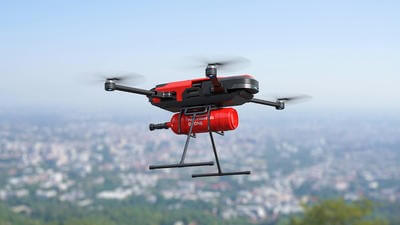
Uncrewed platform design and manufacturing innovations
One of the most critical advancements in the uncrewed sector has been the development of lighter, more durable materials. The use of advanced composites such as carbon fiber has made UAVs lighter while improving structural integrity. These weight reductions extend flight endurance, unlock heavier payloads, and make drones easier to transport and deploy.
These weight reductions extend flight endurance, unlock heavier payloads, and make drones easier to transport and deploy
Alongside materials, powerplant technology is evolving at a rapid pace. While battery-powered drones remain prevalent, they are all too often limited by endurance and payload restrictions. For longer, more demanding missions, fuel-powered platforms are emerging as a practical solution. Gasoline and heavy-fuel engines extend flight times well beyond the 60–90-minute limits typical of battery-powered systems, enabling hours of continuous surveillance or crewed helicopter support.
Advances in aerodynamic design and uncrewed autonomy
Uncrewed helicopter platform manufacturers are also focusing on aerodynamics to optimize flight efficiency. Improved rotor systems are boosting lift-to-drag ratios, extending endurance and payload capacity. At the same time, autopilot technology has improved dramatically. Today’s systems feature advanced flight stabilization, redundant navigation systems, and artificial intelligence (AI)-assisted in-flight decision-making. These advances make uncrewed systems much more dependable in complex operational theatres.
For crewed helicopter operators, reliable autonomy reduces the burden of controlling multiple assets. Uncrewed platforms can now act as fully autonomous scouts, flying ahead to provide real-time video and sensor data, freeing up crews to focus on critical in-flight decision-making. Dependable autonomy extends the helicopter’s effectiveness as a command-and-control hub while keeping crew risk exposure to a minimum.
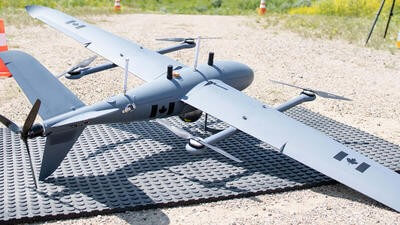
Payload sensors as mission multipliers
The most valuable contribution of uncrewed systems to crewed helicopter operations is the payloads they carry. Advances in electro-optical and infrared (EO/IR) cameras and multispectral sensors are allowing UAS to autonomously detect individuals, track movement, and map environments under conditions often limiting for human crews.
For SAR missions, thermal cameras can detect lost hikers at night or through dense vegetation. For border patrol, advanced imaging can track movement across vast and remote areas of land or sea. In wildfire response, uncrewed systems equipped with infrared sensors can monitor fire lines and hotspots (even at night), providing valuable data to helicopter crews tasked with extinguishing.
The miniaturization of sensors has also increased capability without adding significant weight. Compact lidar systems now provide detailed topographic mapping, supporting helicopter crews during disaster response or medical resupply missions in difficult terrain. All of this data can be transmitted in real time to helicopter cockpits, ground teams, or command centers, ensuring shared situational awareness across all assets.
The miniaturization of sensors has also increased capability without adding significant weight
Developments in manned-unmanned teaming
Uncrewed platforms reach their full operational potential when fully integrated with crewed helicopters. Manned-unmanned teaming (MUM-T) allows helicopters to operate in tandem with drones, using them as powerful force multipliers. For example, a UAV can fly ahead of a helicopter conducting a disaster relief mission, scouting for safe landing zones or identifying potential hazards.
In border patrol scenarios, uncrewed platforms can provide continuous surveillance and reconnaissance coverage, passing data to helicopters so they can intercept or respond as necessary. This reduces risk to crews, lowers costs, and extends the reach of helicopter fleets.
The uncrewed platform sector is responding to this demand by developing interoperability systems that enable real-time data sharing. This ensures that helicopter operators are not managing uncrewed platforms as isolated systems, but as fully integrated assets. Advances in secure communications, data encryption, and sensor integration are central to this type of crewed-uncrewed collaboration.
Case study: the Alpha A900 helicopter UAV
Alpha Unmanned Systems’ A900 helicopter UAV exemplifies how uncrewed platforms are already meeting real operational needs. Currently in service with 14 nations, the A900 is deployed for surveillance, maritime security, and border patrol, as well as providing critical support during forest fires and natural disaster first response. Its endurance, payload flexibility, and rugged design make it a versatile partner for crewed helicopters.
A practical example of MUM-T comes from a proof-of-concept exercise with Airbus Helicopters España and the Spanish Army. In this demonstration, the A900 was controlled directly from a crewed Airbus H135 helicopter, enhancing surveillance capabilities and transmitting valuable images and data in real time. This in-flight integration allowed ground force responses to be coordinated more effectively and demonstrated the clear potential of joint aerial operations in real-world missions.
The A900 was controlled directly from a crewed Airbus H135 helicopter, enhancing surveillance capabilities and transmitting valuable images and data in real time
Training and human factors
As the technology advances, so too does the need for operator training. UAV manufacturers are investing in simulation platforms and training programs that replicate real mission scenarios. This ensures that both drone pilots and helicopter crews understand how to work together effectively. By training crews in joint tactics, operators are better prepared to maximize mission outcomes.
Additionally, understanding human factors is guiding system design. User-friendly ground control stations with intuitive software reduce workload, allowing operators to focus on mission tactics rather than system management. For helicopter crews, simplified interoperability means that receiving data from uncrewed systems does not require additional specialist training, but integrates seamlessly into existing workflows and onboard technology.
Regulatory collaboration
Finally, no innovation can succeed without supportive regulatory frameworks. UAS manufacturers are working closely with civil aviation authorities and defense agencies to establish standards that prioritize safety and operational flexibility. Demonstrating reliability through testing, system redundancy, and transparent reporting is building greater confidence in the integration of drones alongside crewed platforms.
What the future holds
For police forces, aerial firefighters, border patrol forces, and helicopter emergency medical services (HEMS) providers, these advances mean that uncrewed platforms are no longer experimental tools. They are rapidly becoming key operational assets. The combination of fuel-powered endurance, advanced sensors, lightweight materials, and interoperable software make uncrewed platforms a cost-effective aerial partner to crewed helicopters.
By taking on high-risk or persistent surveillance roles, drones protect crews and extend mission reach. By providing real-time intelligence, they enhance decision-making. And by reducing the operational burden, they ensure that crewed assets are available when most needed.
By taking on high-risk or persistent surveillance roles, drones protect crews and extend mission reach
Helicopters will remain irreplaceable for heavy lifting, patient evacuation, and direct human intervention. But uncrewed systems are becoming efficient, lower-risk scouts that enable missions to succeed with greater safety. The uncrewed platform sector is rising to the challenge, delivering innovations that not only keep pace with the needs of operators, but also define the next era of rotary aviation.
November 2025
Issue
Our November edition is packed with content relating to special missions from around the world. We have features that explore the design and engineering that go into modern rotorcraft; the interactions between ground and air teams on helitack operations; the tools and attire needed for successful water rescues; and the new onboard technology that is revolutionizing special missions by detecting and communicating with cell phones.
Eric Freeman
Eric leads strategy and market development for Alpha Unmanned Systems. With more than 30 years of international experience, he has driven the creation and growth of technology companies in highly competitive sectors.