

Industry voice: How success in medical aviation carries beyond the mission

One child’s journey across the ocean reveals what truly defines private air medical transport. Adam Mikulski, Managing Director of Medical Air Service, describes the mission
Some private medical flights stay with you much longer after the aircraft has touched down. Recently, we facilitated a transatlantic flight of a four-year-old boy named Todor, a patient from Serbia who needed immediate neurological intervention in the United States of America.
He was fragile, reliant on life-support machinery, and unable to travel in any sort of commercially available aircraft. His mother could in no way envision having him transported over an ocean in such a state. But with meticulous planning, open communication, and joint efforts by dozens of professionals, Todor was safely airlifted to a specialized medical facility in Texas.
His story isn’t unique in its complexity, but it illustrates to perfection what the medical aviation industry stands for: expertise-based service, compassion, and perfect coordination.

When flying is an extension of care
To most travelers’ minds, an airplane embodies convenience. In private medical flights, it embodies continuity of patient care. The aircraft serves as a flying intensive care unit (ICU), an intersection of medicine and aviation at 35,000ft, where each decision has the potential to affect a patient’s stability.
In Todor’s situation, his cabin had ventilators, heart monitors, suction systems, and oxygen flow controls to accommodate him. Each piece of equipment undergoes tests, readjustments, and certification for in-flight usage before a plane departs.
At this level of planning, no member of the public ever sees it, yet it’s critically important for safety. Medical flights require double expertise: the thoroughness of aviation engineering and the rigor of intensive care. Each requires the other to succeed.
Furthermore, behind each flight like Todor’s, there’s a labyrinth of logistics. What starts with a single phone call, from a parent, a hospital, or an insurer, becomes an international affair with civil aviation authorities, customs officials, medical directors, and ambulance teams.
The operations team worked night and day to get overflight and landing clearances in several jurisdictions, to have ground ambulances in place on both sides of the ocean, and to line up hospital clearances so that the patient could be received upon landing
In this case, the operations team worked night and day to get overflight and landing clearances in several jurisdictions, to have ground ambulances in place on both sides of the ocean, and to line up hospital clearances so that the patient could be received upon landing.
At the same time, our medical director communicated with physicians in Serbia and Texas to make clinical compatibility assurances, checking and double-checking details such as oxygenation levels and cabin pressure tolerance. Each phase was predicated on exact timing. One miscalculation – one delayed authorization or miscommunication – might have delayed the complete transfer significantly.
This kind of coordination is what defines a professional medical air service. Everything working perfectly in the background makes it seem smooth. But under that smooth exterior lies a tremendous amount of planning, structure, and accountability.
The role of transparency and preparation
When family members call a medical air provider, they might very well have reached the breaking point. They have to navigate unfamiliar medical terminology, conflicting messages, and anxiety. Openness at such a moment becomes an ethical imperative and even a therapeutic intervention.
A medical aviation provider’s task is to make the unknown familiar, by explaining what aircraft will be used, who will be on board, and how the medical handovers operate. For Todor’s mother, that was transparency. She wasn’t only looking for a flight to get her son from point A to point B; she wanted a partner who could guide her through each process, from discharge from the hospital to ultimate arrival.
Each successful transfer starts well before engines start. Prior to Todor’s flight, the medical staff performed an in-person evaluation to ensure he was stable for long-distance transportation. This entailed assessment of his ventilatory requirements, positioning needs, and anticipated duration of oxygen supplies in varying conditions.
In medical flying, preparation substitutes for improvisation
It also involved preparing redundancies like spare oxygen tanks, backup power units, and duplicated monitoring gear, because in medical flying, preparation substitutes for improvisation. Such details, even if unobserved by outsiders in general, showcase the culture of thoroughness that distinguishes specialized medical flight.

The human touch
Technology will lift the patient, yet humans enable the mission. Physicians, nurses, pilots, and operations teams all have a sense of empathy that cannot be learned from textbooks.
Throughout Todor’s journey, his mother, father, and five-year-old sister remained by his side. The ability for a parent to travel with their child is not merely comfort; it is part of holistic care. Familiar voices, small gestures, and visible reassurance all contribute to the patient’s emotional stability, which in turn supports physiological stability.
Medical air crews understand that a medical flight is not simply a transfer; it is a moment of human vulnerability
Medical air crews understand that a medical flight is not simply a transfer; it is a moment of human vulnerability. The tone of voice, the calm of the pilot’s update, the attentiveness of the nurse – these are not incidental details. They are integral to what makes the experience safe and humane.
On paper, the Serbia–Texas route was a string of waypoints, altitudes, and fuel estimates. In real life, it was a transition from uncertainty to comfort. When the door of the plane opened in Austin and the ambulance crew took charge, the feeling that had supplanted anxiety was palpable. For the family, the crisis was behind them.
Todor’s case reminds us how global medicine works. A European city and an American hospital could potentially be linked in hours, but only through the combination of knowledge, logistics, and compassion.
One final thought
When people hear ‘medical flight’, they think of technology – vents, monitors, oxygen tanks. What they least anticipate is the network of professionals who strive to have each piece operate in synchrony, thousands of miles away and across international borders. In operations such as Todor’s, it’s never coincidental that these missions have a positive outcome.
They result from planning, discipline, and the subtle sympathy of those who know that behind each patient, a family holds its breath in hopes of a safe return. There’s no luck in each successful medical airlift. There’s planning, professional performance, and caring – three pillars which together translate into a trip of hope.
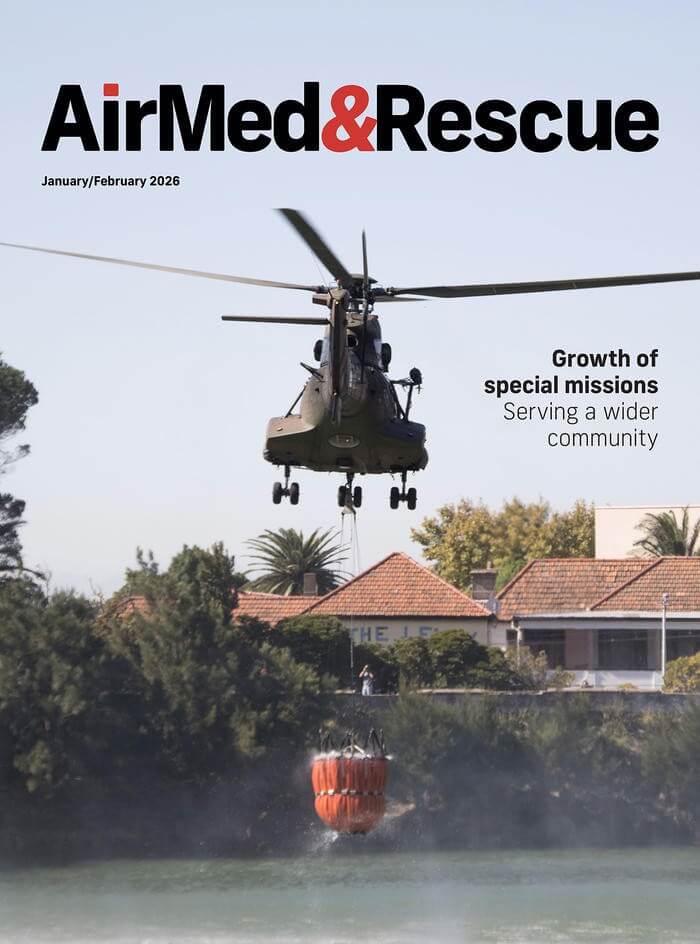
January 2026
Issue
A new year and a new edition, and with it comes articles relating to special missions from all across the globe. We have features that look into the special missions in the Middle East and Africa; the benefits and differences associated with leasing helicopters; and the way that aerial firefighting is conducted at night.