

Industry voice: Reimagining HEMS partnerships

Private HEMS operators can bridge Europe’s healthcare gaps through meaningful partnerships with public health authorities, explains Maria Melillo, CEO of Medilink International Group
As European healthcare systems face unprecedented pressures – aging populations, constrained budgets, and growing demands for emergency medical services – the helicopter emergency medical services (HEMS) sector stands at a critical juncture. The traditional approaches to delivering lifesaving air medical transport are being challenged, and innovative partnerships between public health authorities and specialized private operators are emerging as the solution to bridge growing healthcare gaps.
The European challenge: doing more with less
Across Europe, governments are grappling with a fundamental paradox: how to enhance emergency medical capabilities while managing increasingly tight fiscal constraints. The Covid-19 pandemic exposed vulnerabilities in healthcare infrastructure, while demographic trends point to sustained growth in demand for emergency services. Rural and remote communities, in particular, face significant challenges in accessing timely critical care.
In this context, HEMS operations have become more crucial than ever. When every minute counts in a medical emergency, the ability to rapidly transport critically ill patients to specialized care facilities can mean the difference between life and death. Yet many European health systems struggle to maintain 24/7 HEMS availability due to the significant costs involved in aircraft acquisition, maintenance, crew training, and operational readiness.
The question facing policymakers is not whether HEMS services are essential – their value is unquestionable – but rather how to deliver these services more efficiently and sustainably.

The partnership model: proven experience across diverse markets
The answer lies in recognizing that effective HEMS operations require more than just aviation expertise; they demand deep understanding of healthcare delivery, patient care protocols, and the complex coordination required in emergency medical scenarios. This is where operators with genuine healthcare DNA and proven international experience can make a transformative difference.
At Medilink International, our HEMS services, operated through our subsidiary Gulf Med Aviation Services, are founded on the group’s three decades of hands-on experience in delivering direct medical care across more than 20 countries. This global heritage means we approach HEMS not merely as an aviation service, but as an integral component of the healthcare continuum.
Our operational experience spans diverse and challenging environments. In Ireland, we operate HEMS services for the National Ambulance Service in the southwest of the country, where we have to integrate seamlessly with established healthcare systems. In Malta, our home base, we provide critical emergency medical transport between the island of Gozo and the main island – a unique operational challenge that requires absolute reliability in an insular environment where alternative transport options are limited. Most recently, our partnership with Portugal’s National Institute of Medical Emergency (INEM) showcases how international expertise can enhance national emergency medical capabilities.
This breadth of experience across different healthcare systems, regulatory environments, and geographical challenges has taught us that successful HEMS operations require speaking the same language as our healthcare partners: the language of patient care, clinical protocols, and medical urgency. When we collaborate with institutions like the Irish National Ambulance Service or INEM, this shared understanding has to translate into streamlined communication protocols, optimized aircraft configurations for medical requirements, and maintenance schedules that prioritize operational availability over purely technical considerations.
Successful HEMS operations require speaking the same language as our healthcare partners: the language of patient care, clinical protocols, and medical urgency
The economic advantages are equally compelling. Specialized private operators can deliver enhanced services while generating significant value for public health systems. By leveraging global experience, advanced maintenance capabilities, and optimized operational procedures developed across multiple markets, providers can offer governments proven solutions that have been tested and refined in real-world conditions.
Innovation in safety, technology and operations
Safety stands as the foundational pillar of everything we do as HEMS operators. From the challenging inter-island flights in Malta to the diverse terrain of Ireland and Portugal, there has to be an unwavering commitment to safety that supersedes any commercial considerations. Our principle is simple: if we cannot be certain that an operation is safe, we will not perform it.
This commitment is embedded in our European Union Aviation Safety Agency (EASA) approved safety management system and supported by dedicated safety specialists who ensure the highest safety standards are applied across all of our services and locations. HEMS crews undergo regular training and stay current on all safety matters relevant not only to their specific roles but also to other service areas that critically influence operations.
Beyond safety, the future of HEMS lies in embracing technological advancement while maintaining operational excellence. Modern aircraft like the Airbus H135 and H145 represent quantum leaps in capability compared with legacy platforms. These aircraft offer superior performance, enhanced safety features, reduced environmental impact, and, crucially, improved patient care environments.
Beyond safety, the future of HEMS lies in embracing technological advancement while maintaining operational excellence
Innovation extends to operational models. Risk assessment protocols that exceed regulatory requirements, developed predictive maintenance systems that minimize aircraft downtime, and training programs tailored to the specific challenges of each operational environment are all key to HEMS success.
The integration of telemedicine capabilities represents another frontier where international experience provides valuable insights. By enabling real-time transmission of patient data to receiving hospitals, treatment decisions can be optimized, leading to improved patient outcomes across all operational theaters.

Vision for the future of European HEMS
Looking ahead, I envision a European HEMS landscape characterized by increased collaboration, technological integration, and outcome-focused partnerships. The successful models will be those that recognize HEMS as healthcare delivery rather than merely aviation services – a philosophy we’ve proven across our global operations.
Cross-border cooperation presents significant potential, and private operators with international experience can facilitate knowledge transfer, standardize best practices, and enable cross-border emergency responses. The European Union’s emphasis on healthcare cooperation creates an ideal framework for such initiatives.
Sustainability – both financial and environmental – will become increasingly important. Modern helicopter platforms like the H135 and H145 demonstrate significant advances in fuel efficiency, reduced acoustic footprints, and lower CO2 emissions compared with legacy aircraft. Operators who prioritize these proven efficiency technologies today will be better positioned to meet tomorrow’s increasingly stringent environmental and economic requirements.
Sustainability – both financial and environmental – will become increasingly important
Data analytics and artificial intelligence will enhance operational efficiency and clinical outcomes. Our multi-country operations generate valuable data on flight patterns, response times, and patient outcomes that can be analyzed to optimize deployment strategies and identify service improvement opportunities across different healthcare systems.
The future also lies in understanding that HEMS success transcends traditional aviation metrics. Our patient-centric approach must guide every decision, from aircraft selection to crew training to maintenance scheduling, regardless of the operational environment.
Partnership for progress
The evolution of European HEMS services requires genuine partnerships between public health authorities and specialized private operators with proven international experience. These partnerships must be built on shared values – commitment to patient care, operational excellence, and continuous improvement – rather than purely transactional relationships.
By combining aviation expertise with healthcare heritage and global operational knowledge, we’re proving that specialized private operators can enhance public health capabilities while delivering economic value across diverse markets and healthcare systems.
The future of European emergency medical services will be shaped by operators who understand that in HEMS, we’re not just flying aircraft; we’re saving lives. That mission, proven across continents and healthcare systems, demands nothing less than our absolute best, every day, on every flight.
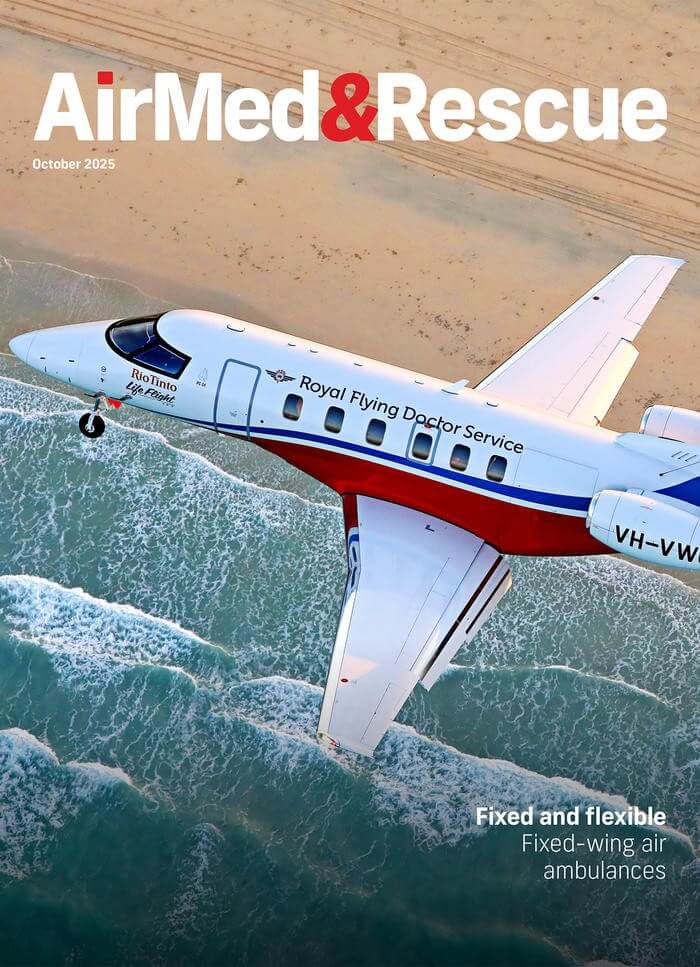
October 2025
Issue
In our October edition, we bring you news, features and more showcasing special missions from around the world. We have features that focus on the fixed-wing air ambulance platforms that are enhancing air medical operations; the care and considerations when transporting children with infectious diseases at risk of deterioration; the law enforcement agencies that use aircraft to find and track persons of interest; and the challenges of treating patients with hyper- and hypothermia.
Maria Melillo
Maria is CEO of Medilink International Group. With over three decades of experience in medical services delivery, Medilink International operates in more than 20 countries across Europe, the Middle East, and Africa, providing comprehensive healthcare solutions in challenging environments.