
Industry voice: Operational sustainability in air medical services: finding value beyond expiry dates

Sara Walsh, Clinical Service Manager and Chief Critical Care Flight Nurse at Gama Aviation, shares real-world examples of how repurposing clinical consumables from air ambulance operations can support wildlife care while reducing operational waste
Sustainability within aviation is frequently discussed through the lens of fuel efficiency, aircraft technology, and carbon reduction strategies. While these are vital components of the industry’s long-term environmental goals, sustainability can also be influenced by smaller operational decisions made within daily service delivery.
Within air medical operations, clinical consumables and equipment must meet strict regulatory standards to ensure patient safety. Once items reach their expiry date, they are removed from operational use and can no longer be utilized in the treatment of human patients. In many cases, however, these items remain functional and capable of providing value in other contexts.
While reviewing stock management processes, I identified that we were disposing of a considerable number of consumables that remained in good condition. There had to be another way for this so-called waste to be put to good use elsewhere.
It wasn’t until we had an accidental delivery of some items that I decided to speak with my local veterinary practice to see if they could make use of them, as the supplier declined to accept their return. The veterinary practice mentioned that it donated all of its unused consumables to a local Royal College of Veterinary Surgeons (RCVS) registered wildlife hospital – Wildlife Rescue Moyles Court.
After that conversation, I knew I had to reach out to Wildlife Rescue Moyles Court to explore whether a similar partnership might be possible.
The work carried out at Wildlife Rescue Moyles Court is truly inspirational. A dedicated team of professional, qualified people and volunteers work tirelessly in all weather conditions, seven days a week, 365 days a year, to rescue and treat injured British wildlife. The RCVS hospital provides highly skilled veterinary treatment, supports rehabilitation, and ultimately aims to release animals back into the wild.
Despite operating with limited funding, Wildlife Rescue Moyles Court treats a wide variety of species, including swans, birds of prey, hedgehogs, and foxes. Regardless of the animal brought into their care, the team does everything possible to support recovery and return them safely to their natural environment.
Through our partnership, expired clinical consumables and older equipment from our air medical operations are donated to the RCVS wildlife hospital. While these materials can no longer be used within our regulated clinical environment, they remain extremely valuable within this charitable setting.
Recently, the wildlife hospital shared photographs of a swan receiving treatment using donated consumables. While a small example, it served as a powerful reminder that resources removed from one clinical environment can still play a meaningful role in another.
The wildlife hospital shared photographs of a swan receiving treatment using donated consumables. While a small example, it served as a powerful reminder that resources removed from one clinical environment can still play a meaningful role in another
For air medical operators, initiatives such as this demonstrate that sustainability does not always require large-scale technological change. Operational practices around stock management, equipment life cycle, and waste reduction can also contribute to broader environmental and social responsibility.
Repurposing suitable equipment and consumables through partnerships with RCVS wildlife organizations offers one example of how air medical providers can reduce waste while supporting important community services.
As the industry continues to develop more sustainable operational models, initiatives such as this highlight how small changes in practice can create positive impact beyond the aviation environment. In this case, supplies that once supported the care of critically ill patients are now helping to treat injured wildlife – extending the life of valuable resources while supporting conservation efforts within the community.

A small change with a significant impact
One particularly meaningful outcome of this partnership came after the donation of a patient monitor that had previously been retired from our air medical operations.
While the monitor remained fully functional, it was no longer suitable for use within our clinical governance framework. At the RCVS wildlife hospital, however, this piece of equipment has made a significant difference to how veterinary procedures are conducted.
During a recent conversation, the RCVS hospital’s Lead Veterinary Nurse and Co-Founder, Carla England, explained that for many years she had been required to manually monitor animals during procedures while simultaneously assisting the veterinary surgeon. This meant dividing her attention between observing the animal’s physiological signs and supporting the clinical procedure.
With the introduction of the donated monitor, she is now able to continuously observe vital signs during procedures, allowing her to assist the veterinarian more effectively while maintaining safer monitoring of the animal.
With the introduction of the donated monitor, she is now able to continuously observe vital signs during procedures, allowing her to assist the veterinarian more effectively while maintaining safer monitoring of the animal
It was a small reminder that equipment we often take for granted within air medical practice can have a profound impact when introduced into environments where resources are far more limited. For the wildlife hospital team, this single piece of equipment has enhanced patient monitoring during procedures and reduced the workload placed on already stretched volunteers.
Sustainability does not always require complex solutions. Sometimes, it simply begins with looking at what we already have – and asking how it might help someone else.
Sustainability does not always require complex solutions. Sometimes, it simply begins with looking at what we already have – and asking how it might help someone else
If a simple change in how we manage our expired equipment can support the incredible work of Wildlife Rescue Moyles Court while reducing waste, it is a change well worth making.
August 2026
Issue
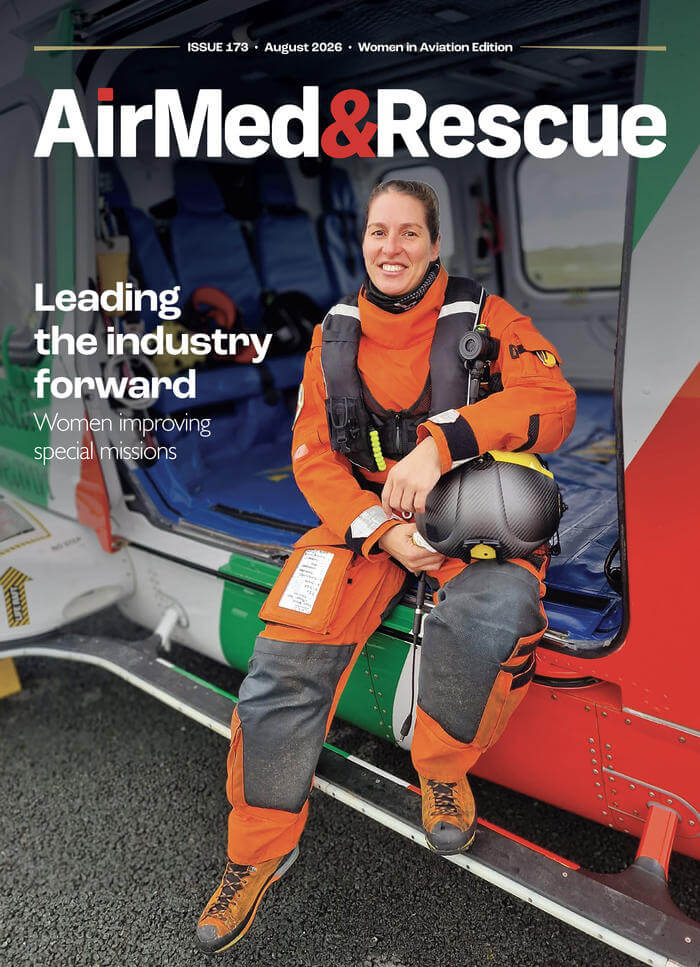
August is a special time of year, and it is my pleasure to present a special Women in Aviation edition of AirMed&Rescue. We have features on the importance of preventing and knowing the early signs of hoist spin; the leadership roles and the value of visibility of women in the industry; the inward-facing and external sensors improving special missions; and the variety and standards that flight suits have to meet.
Sara Walsh
Sara is Clinical Service Manager and Chief Critical Care Flight Nurse within the air medical division of Gama Aviation in the UK. She oversees clinical governance, operational readiness, and critical care delivery across fixed-wing air ambulance operations. Sara has a particular interest in operational efficiency, sustainability in healthcare aviation, and developing practical solutions that support both clinical excellence and responsible resource management. This sustainability project is very dear to her as she has a great passion for anything wildlife related.