
Industry voice: When wearable tech knows more than your roster

W Sander Starreveld, Principal of SIG Aviation, highlights the key indicators, monitors, and outcomes associated with fatigue risk in airborne medical, SAR, and special missions
Like most pilots, I have a complicated relationship with sleep. I know the theory cold – I have taught fatigue risk management to flight crews and civil aviation authorities for years. I know what ICAO Doc 9966 says about circadian disruption. I know the difference between sleep pressure and circadian drive. I can probably quote the EASA Flight Time Limitations (FTL) rules from memory… and then I bought a wearable device to monitor my sleeping patterns.
Pilots are, almost by definition, early adopters when it comes to technology. We live and breathe instrumentation, data, and systems. So when a new generation of wearable sleep trackers became accurate enough to be clinically useful, it was not long before I ended up wearing one. What I started seeing in my own data – nights of technically adequate rest that nevertheless produced poor recovery scores – sent me back to the research literature. That is where I found the 2024 Massar study, published in JAMA Network Open, and where what I already suspected professionally became something I could see confirmed in controlled data.1
The findings from this study matter across the full breadth of the special missions sector. Air medical is the obvious case, but search and rescue (SAR) crews sitting standby for a shout that may never come, law enforcement aviation units on unpredictable overnight taskings, and maritime patrol crews whose activation timing is dictated entirely by events outside their control – all of us share the same structural problem. Our rosters look manageable on paper, but our bodies tell a different story.
Same hour, very different outcomes
The Massar study team followed 96 hospital interns over eight weeks, tracking sleep with wearables and validated diaries, running daily cognitive tests on smartphones, and measuring mood, alertness, and reaction time throughout. The interns worked roughly 64 hours per week. The only variable was how their night duties were arranged.
One group (‘the call group’) worked standard daytime shifts with unpredictable overnight duties scattered throughout, roughly eight to 10 times over the study period. This is the direct operational equivalent of the on-call pilot: at home, expected to respond within 30–45 minutes, never quite sure whether tonight is the night the phone goes at 02:00 hrs.
The other group (‘the float group’) also worked mostly daytime hours, but their overnight duties were concentrated into predictable blocks of five to seven consecutive nights. Once they knew a block was coming, they could prepare for it.
The results favored the block model on every single measure. Sleep regularity, measured by the probability of being in the same sleep-wake state at any two points exactly 24 hours apart, scored 56.1 for the call group versus 69.4 for the float group
The results favored the block model on every single measure. Sleep regularity, measured by the probability of being in the same sleep-wake state at any two points exactly 24 hours apart, scored 56.1 for the call group versus 69.4 for the float group. That 13-point gap means the call group’s internal clock had no stable anchor, affecting hormone levels, cognitive capacity, and the quality of recovery during rest periods. Sleep quality scores crossed the clinical threshold for significant sleep difficulties in the call group; the float group stayed below it.
After an overnight call duty, participants reported 13% lower mood, 21% lower motivation, and 29% higher sleepiness. After a float block night shift, the same measures showed no statistically significant change. The night work itself was not the primary problem. The structure of that night work was.
Cognitively, attentional lapses, defined as reaction times over 500 milliseconds – the kind of gap that means missing a traffic collision avoidance system (TCAS) advisory or a terrain alert – more than doubled in the call group compared with the float group on controlled laboratory testing.
Why this hits pilots harder than doctors
The study used hospital interns, and three factors mean the risk translates more severely to cockpit environments.
A pilot woken from deep sleep and required to be airborne within 30 minutes may be completing pre-flight checks during the 15–30 minute window of post-awakening cognitive impairment. There is no senior colleague to absorb that gap. A fatigued intern can slow down and ask for help; the captain is the final decision-maker on every flight. And the study population had a mean age of 24.7. Although I hate to admit it, fatigue research consistently shows that older individuals take longer to recover from disrupted sleep, and I am no exception. Operational pilot populations skew considerably older. The impairments documented in the study are likely larger in practice than the data directly shows.
What operators can do
The Massar study data is most useful not as a scientific curiosity but as an operational toolkit. Three mitigations follow directly from it.
- Restructure your crew’s rosters
This is the lead intervention and the only one that addresses root cause rather than managing symptoms after the fact. The study’s core finding is that irregularity, not volume, is the primary fatigue driver under on-call scheduling. A pilot activated unpredictably two or three times a month may be accumulating more physiological fatigue burden than a colleague working a full week of consecutive night standby, because the scattered pattern prevents the circadian system from stabilizing. That is counterintuitive to most roster designers, and to most pilots, but the data supports it clearly.
Moving from scattered on-call duties toward block standby rotation, where pilots cycle through dedicated night standby periods cleanly separated from daytime operations, directly addresses this
Moving from scattered on-call duties toward block standby rotation, where pilots cycle through dedicated night standby periods cleanly separated from daytime operations, directly addresses this. It does not require changing duty hour limits. It may be achievable within existing EASA FTL frameworks. Even a partial move, grouping on-call nights into two- or three-night mini-blocks rather than distributing them randomly across the month, reduces the irregularity burden without major restructuring.
For operators running a fatigue risk management system (FRMS), this finding also supports adding sleep irregularity as a formal hazard in its own right, separate from sleep deprivation. Standard FTL frameworks count hours. They do not measure whether sleep timing is consistent. An FRMS that treats all configurations producing equivalent rest hours as equally safe is underestimating the risk of scattered on-call patterns.
- Establish a formal napping policy
The study found that naps during night shifts improved median vigilance reaction times by approximately 16 milliseconds, regardless of whether the pilot was on a block or on-call schedule. In a domain where typical reaction times run at 250–350 milliseconds, that is a real and measurable safety margin.
Most operators do not have a napping policy. Some have cultures that actively discourage it. This is where the evidence should change practice
Most operators do not have a napping policy. Some have cultures that actively discourage it. This is where the evidence should change practice. The required elements are not complex: quiet rest facilities with environmental controls; clear alarm protocols; and a defined buffer between waking and departure to allow sleep inertia to clear before the crew assumes command. The harder requirement is cultural: management must treat napping as an approved safety countermeasure, not with stigmatized ‘lazy pilot’ prejudice. Without that signal from leadership, the policy exists on paper and nowhere else.
- Improve pre-duty fitness assessment
Standard regulatory declarations ask whether a pilot is fit to fly. They do not ask whether the pilot slept at 01:00 or 05:00 hrs, whether they were activated twice in the past three nights, or what their current alertness level actually is. The Massar data shows that the same pilot can perform very differently depending on the structure of their recent sleep history, and that the difference is measurable.
Validated tools such as the Karolinska Sleepiness Scale can be embedded in electronic pre-duty systems without adding significant burden. Structured questions about sleep timing and quality over the previous 48 hours, and about recent activation history, give both the pilot and the operator a more accurate picture of actual readiness than a binary ‘fit/unfit’ declaration. For SAR and law enforcement operators where a duty declaration may precede an immediate operational tasking, this matters.

The broader point
EASA’s FRMS route, ORO.FTL.120 and its associated guidance, exists precisely for operators whose scheduling structure creates fatigue risk that prescriptive regulations do not fully address.
The Massar study provides unusually clean, longitudinal, within-participant evidence of how on-call structure produces cognitive impairment independent of duty hour totals. That is exactly the kind of data that supports an FRMS safety case, and that can support rostering change proposals to management, regulators, or union partners.
Medical, SAR, and law enforcement operators cannot eliminate unpredictable demand. That is the nature of the work. What they can control is how their rostering responds to it
Medical, SAR, and law enforcement operators cannot eliminate unpredictable demand. That is the nature of the work. What they can control is how their rostering responds to it. Block-based standby scheduling, a genuine napping policy, and honest pre-duty assessment can reduce real flight safety risk, without reducing operational availability.
The tech device knew. The question is whether our management and roster makers will catch up.
References:
Massar SAA ChuaXY, Leong R, et al. Sleep, Well-Being, and Cognition in Medical Interns on a Float or Overnight Call Schedule. JAMA Network Open 2024;7(10):e2438350.
October 2026
Issue
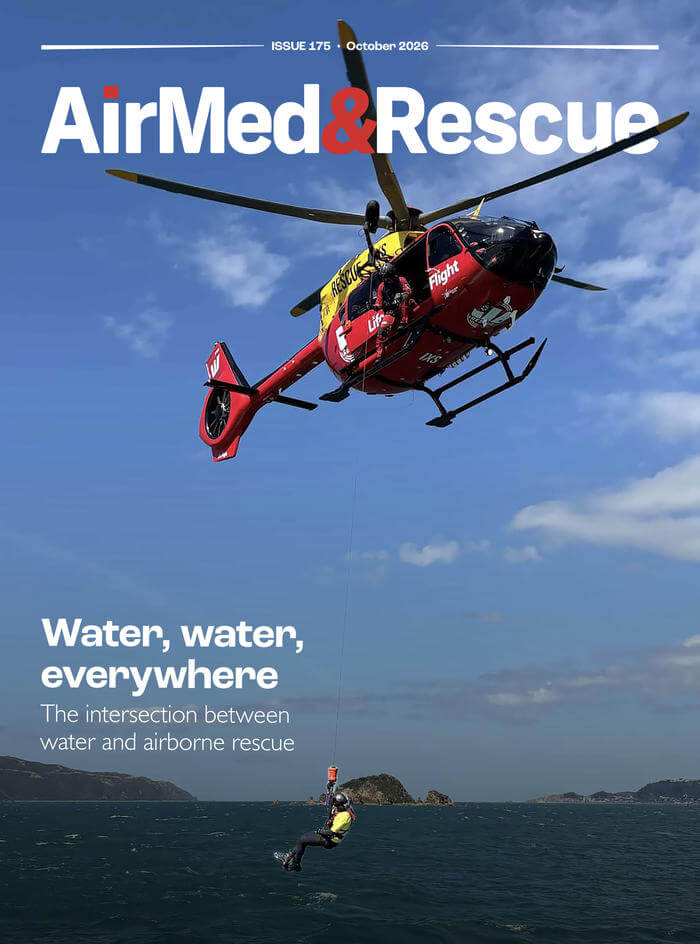
The latest edition of AirMed&Rescue is packed full of content to keep you occupied in October. We have features on the challenges that swiftwater presents when trying to rescue someone; how sensor technology is affecting and improving aerial firefighting missions; why operators choose to have a varied fleet of aircraft to perform special missions; and what can be done to improve the accessibility and awareness of mental health assistance programs for safer and sustainable working conditions.
W Sander Starreveld
Sander is an Aeronautical Engineer and Captain with a master’s in risk management. He has been an Aviation Safety Consultant with over 25 years of experience in flight operations and regulatory oversight. He is the Principal of SIG Aviation, an independent consultancy advising civil aviation authorities and air operators on safety management and regulatory compliance.