
Industry voices: Bridging the distance: Why South Africa needs the Diploma in Retrieval and Transfer Medicine

Dr Neville Vlok, Specialist Emergency Physician, and Kaleb Lachenicht, Emergency Care Practitioner, detail the complexity of retrieval medicine and the subsequent value of a qualification that demonstrates clinical competence and retrieval-specific knowledge
The patient lies in a rural South African hospital; she is critically ill and bleeding internally due to a ruptured ectopic pregnancy. The nearest gynecological surgeon is four hours away by road. The province’s only helicopter is grounded by weather. The advanced paramedic sent to fetch her has never sat a formal exam in retrieval medicine. That she reaches the operating theatre owes more to luck than design. That this scene repeats itself across South Africa and Sub-Saharan Africa reveals a structural gap that no amount of individual talent can permanently fill.
Retrieval medicine – defined as the assessment, stabilization, and safe transfer of critically ill patients between facilities – is among the most demanding branches of emergency care. It asks practitioners to cram an intensive care unit into a vehicle, to juggle the physics of altitude against human physiology, to make high-stakes decisions without specialist backup, and to do all this at speed, often at night, sometimes in conditions that would even test a seasoned mountaineer. A specific, internationally recognized qualification for these competencies is not a bureaucratic flourish. For South Africa, the Diploma in Retrieval and Transfer Medicine (DRTM), offered by the Faculty of Pre-Hospital Care of the Royal College of Surgeons of Edinburgh (RCSEd), provides an existing, tested framework around which a fragmented system could cohere.
The cost of improvisation
South Africa’s geography is unkind to the critically ill. The country spans 1.2mil km2. Tertiary hospitals cluster in cities and district facilities sprawl across provinces the size of European nations. A dualistic health system in which private care covers 10–15% of the population, public for the rest, deepens the divide. KwaZulu-Natal’s only public Level I Trauma Center sits in Durban, vast distances from rural district hospitals. In the Eastern Cape, patients have waited eight hours for an ambulance that never came. In some districts, transfers to higher-level care are available only on certain days of the week.
South African studies report high rates of adverse events when critically ill patients are moved by pre-hospital providers lacking advanced training
The consequences are measurable. South African studies report high rates of adverse events when critically ill patients are moved by pre-hospital providers lacking advanced training. Even in the better-resourced private sector, equipment-related and physiological complications reach alarming levels. Researchers developing a neonatal retrieval curriculum identified poor educational preparedness among advanced life support providers as a key driver of poor outcomes, with a lack of appropriate interfacility transport ranking among the top 10 avoidable causes of under-five mortality.
The making of a qualification
The DRTM was not dreamed up in an academic committee. Clinicians from Scotland’s Emergency Medical Retrieval Service (EMRS), who operate across vast, challenging terrain that genuinely resembles rural Sub-Saharan Africa, helped conceive it. The exam has two parts. Part A is a 180-minute written paper of up to 180 single-best-answer questions, testing clinical reasoning under pressure. Part B is an objective structured practical examination of up to 16 stations, most lasting eight minutes. The syllabus covers everything from the unstable trauma patient to the ventilated neurological case requiring altitude-aware ventilator management. Candidates must know retrieval coordination and the quirks of land ambulances, helicopters, and fixed-wing aircraft. Pediatric retrieval is included; neonatal, given its specialism, is not.
The DRTM is not just for doctors. It is open to nurses, paramedics, and allied professionals who hold full registration and can show six months of full-time retrieval experience in the past five years
Crucially, the DRTM is not just for doctors. It is open to nurses, paramedics, and allied professionals who hold full registration and can show six months of full-time retrieval experience in the past five years. In South Africa, where advanced paramedics often run transfers alone, a qualification that validates paramedic competence alongside that of physicians has real practical value and impact.
Why now?
First, standards. South Africa lacks a dedicated national qualification in retrieval medicine. Competence is assumed rather than assessed. Researchers have called for formal standards in critical care transfers, citing the absence of validated frameworks as a patient-safety risk. The DRTM provides a ready-made, internationally credentialed benchmark.
Second, paramedicine in South Africa has already undergone professionalization with three levels of qualifications being offered by tertiary institutions, but physicians remain largely absent from the pre-hospital sector. South Africa’s pre-hospital professionals, both in the public and private services, demonstrate incredible clinical resourcefulness. The problem, however, is structural: no formal recognition of retrieval competence, no standardized way to measure it, no credential to prove it. A shared qualification creates a common language of competence across public and private sectors, and across professions.
Third, air medical specificity. South Africa’s retrieval environment demands fluency in air transport medicine: the effects of altitude on gas-filled cavities, the behavior of ventilated patients in pressurized and unpressurized cabins, patient preparation, and crew resource management in noise-saturated cockpits. These are central competencies that the DRTM syllabus covers directly.

Institutional collaboration
A qualification is only as useful as the ecosystem that supports it. South African universities that offer emergency care degrees could host DRTM preparatory pathways, supervised placements, and logbook frameworks. The RCSEd has shown willingness to engage internationally. Formal agreements would give that engagement permanence.
Private services such as Netcare 911, ER24, and Rocket HEMS operate at the leading edge of retrieval practice. Encouraging their clinicians to pursue the DRTM would validate existing competence and set a professional benchmark. For provincial health departments, especially the Eastern Cape and Limpopo, where retrieval capacity is acute and adverse events persist, partnerships with the RCSEd could involve subsidized exam fees, local venues in Johannesburg or Cape Town, and joint investment in training. This would represent a credible commitment to improving retrieval outcomes that is auditable, equitable, transparent, and internationally recognized.
The model exists. Scotland’s EMRS has made the DRTM an expected professional milestone. Australia’s LifeFlight and Greater Sydney Area HEMS have already integrated it and developed their own qualification. The pathway is there. What is needed is the institutional will.
The standard the system requires
Retrieval medicine has a peculiar hazard: competence by proximity. A practitioner who has done many transfers may believe experience alone suffices. But retrieval sits at the intersection of critical care, transport physiology, logistics, and human factors. Unsupported by systematic knowledge and structured assessment, experiential learning creates blind spots that appear at the worst moments.
Unsupported by systematic knowledge and structured assessment, experiential learning creates blind spots that appear at the worst moments
The DRTM closes those blind spots. It demands not just clinical competence but retrieval-specific knowledge such as coordination protocols, platform considerations, and the ethics of transfer decisions. For South Africa, where distance to definitive care is measured in hours, and where the retrieval team’s skill can mean survival or avoidable death, that standard is not a luxury.
It is precisely what the system requires.
The Diploma in Retrieval and Transfer Medicine is administered by the Faculty of Pre-Hospital Care at the Royal College of Surgeons of Edinburgh. Examinations are held annually at the end of April in Edinburgh, Scotland.
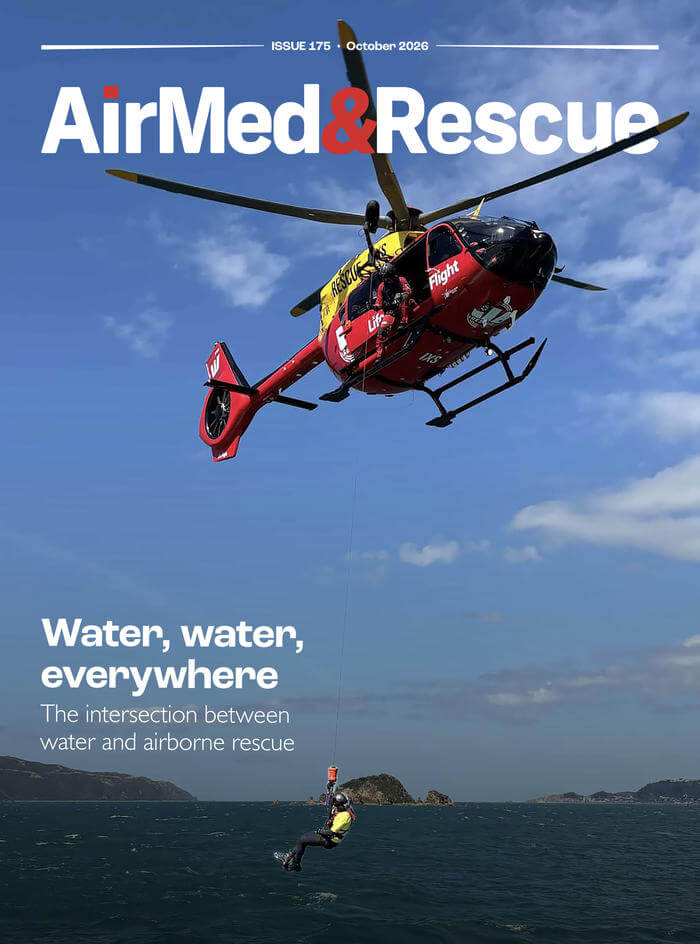
October 2026
Issue
The latest edition of AirMed&Rescue is packed full of content to keep you occupied in October. We have features on the challenges that swiftwater presents when trying to rescue someone; how sensor technology is affecting and improving aerial firefighting missions; why operators choose to have a varied fleet of aircraft to perform special missions; and what can be done to improve the accessibility and awareness of mental health assistance programs for safer and sustainable working conditions.
Dr Neville Vlok
Dr Vlok is a Specialist Emergency Physician and pre-hospital enthusiast. He currently serves as the Medical Director of a busy emergency department, President of the ECMO Society of South Africa, an educator in a variety of settings, and an active researcher and consultant for air medical services. He holds an MMed and MPhil degree in Emergency Medicine from the University of Cape Town and a Fellowship of the College of Emergency Medicine (South Africa). Dr Vlok finds particular joy in improving systems of care and advocating for expert critical care irrespective of the patient’s geography.
Kaleb Lachenicht
Kaleb is a Critical Care Practitioner, educator, and clinical leader with a passion for emergency and retrieval medicine. He serves as the Chief Clinical Officer at Rocket HEMS and Director of Education at EPIC EM. Holding a Bachelor of Technology in Emergency Medical Care and a master’s degree in Health Sciences Education, Kaleb is particularly passionate about simulation-based education, human factors, and building high-performing teams in high-pressure environments.