
Interview: Building partnerships for a sustainable future

Mandy Langfield talks to Kriss Lawler, General Manager of StarFlight Tasmania, who is a 28-year veteran of Tasmania Police, where he served across many roles including as a member of the police and ambulance helicopter aircrew. He has been heavily involved in building StarFlight presence and operations on the ground, working closely with the Tasmanian Government and partners Ambulance Tasmania and Tasmania Police to bring this new partnership to life
As General Manager of StarFlight Tasmania, what are the key operational priorities you focus on to ensure consistent readiness, safety, and clinical effectiveness across the service?
At StarFlight we’re laser focused on safety. It is central to everything we do. In Tasmania we’re working with two separate government agencies, both of whom have their own people embedded at every level of the operation. A key priority of mine is therefore to work in partnership with our clients to ensure we’re aligned procedurally, functionally, and culturally. It’s that alignment and strong relationship that enables us to deliver safe operations in every respect.
StarFlight operates within a wider emergency and health system. What have been the most important lessons in building effective coordination with hospitals, Ambulance Tasmania, and other agencies such as Tasmania Police?
Tasmania is a small state and, as a result, there is much closer integration between the different agencies such as Ambulance Tasmania and Tasmania Police. For example, we often have police officers and paramedics on flights, which doesn’t typically occur in other Australian states. This multi-agency response does have its advantages due to the different skill sets brought to each mission, particularly in terms of mitigating risk. Overall, the most important lesson is that building relationships based in trust and respect across different agencies takes time and it’s something we work towards every day.
Tasmania presents distinct geographic and weather-related challenges. How do factors like terrain, coastal conditions, and rapidly changing weather influence flight planning and mission execution?
Local knowledge is key as the geographic and weather-related challenges require complex planning regarding fuel loads, holding fuel, turbulence, and freezing levels. When recruiting for this contract with the Tasmanian Government we focused heavily on that local knowledge component and have been really pleased to bring so many of the former contractor’s staff across to our operation.
Air medical success depends heavily on alignment between flight crew and medical crew. How do you structure collaboration and communication to optimize performance in high-pressure retrieval missions – particularly when it comes to training for these high-stake missions?
Success in this environment is built on treating flight crew and medical crew as one integrated team. We structure collaboration through standardized briefings, clear role delineation, and aviation-specific communication protocols to ensure information shared is concise, timely, and unambiguous under pressure.
By embedding structured debriefing and continuous learning into every mission, collaboration becomes both normal and expected
Crucially, alignment is forged through joint training efforts where scenario-based training is a feature. Human factors and non-technical skills training underpin this approach, reinforcing behaviors such as assertive communication, workload management, and empowering people to speak up. By embedding structured debriefing and continuous learning into every mission, collaboration becomes both normal and expected. That in turn delivers safer, more effective outcomes when the stakes are highest.
Helicopter emergency medical services (HEMS) remains one of the most risk-intensive aviation sectors. What safety systems, human factors practices, or operational risk mitigations have been most important in StarFlight’s model?
StarFlight’s safety model is built around layered risk management rather than reliance on any single control. At the system level, this includes robust operational governance, clearly defined weather and tasking requirements, and structured flight-risk assessment processes that actively challenge any form of ‘success at any cost’ mentality. Just as critical are human factors practices – standardized briefings, disciplined cockpit and cabin communication, and a strong emphasis on non-technical skills such as situational awareness, workload management, and a joint-purpose approach to service delivery. Underpinning all of this is a culture that encourages reporting, learning, and continuous improvement, ensuring that safety standards are not static but constantly evolving in the complex Tasmanian environment.
Underpinning all of this is a culture that encourages reporting, learning, and continuous improvement, ensuring that safety standards are not static but constantly evolving in the complex Tasmanian environment
Are there specific aircraft capabilities, avionics upgrades, or mission-support technologies that you see as essential for modern air medical operations in regional and remote settings? What made you choose the Bell 412 platform as your aircraft?
Our helicopters need to respond to a wide range of missions, from critical incidents to medical evacuations and search and rescues (SAR), and we needed an interim aircraft solution to achieve that whilst our new aircraft are manufactured. The Bell 412 offers the sort of versatility and adaptability we need here in Tasmania.
In terms of technologies, infrared cameras are becoming increasingly important, especially for missions like finding missing walkers in the Tasmanian bush, and we’ve been able to integrate that capability into our interim fleet, which has been a terrific outcome for our clients.

Many air medical services are experiencing increasing demand and complexity. How is StarFlight Tasmania adapting its resourcing, staffing, and operational model to remain sustainable long-term?
Creating a sustainable model is a key priority for StarFlight. It’s why we are focused on establishing a local training academy providing accredited programs, as well as clear career pathways for the next generation of pilots, engineers, and aircrew officers.
StarFlight currently has 31 staff in Tasmania, with plans to offer several engineering apprenticeships in the very near future. Prior to launching in January 2026, we focused on recruiting local Tasmanians, particularly from the former operator, Rotor-Lift, to ensure we retained as many highly experienced Tasmanians as possible because their institutional knowledge is so important. The training plans and the retained staff have given us a solid foundation for the future and ensure we’re contributing to skills development across the industry.
The training plans and the retained staff have given us a solid foundation for the future and ensure we’re contributing to skills development across the industry
Looking ahead, where do you see the biggest opportunities for innovation in Australian air medical retrieval, whether through telehealth integration, data-driven performance improvement, or next-generation aircraft capability?
StarFlight has ordered three new Airbus H145 helicopters in order to provide an advanced platform for aeromedical operations in Tasmania. They will be in service from late 2027 and provide superior mission performance for HEMS, SAR, and law enforcement in Tasmania. Aircraft aside, the Tasmanian Government has invested in the latest-technology EO/IR camera systems for installation. That will significantly enhance search capability and be a valuable addition to the state’s existing law enforcement technologies.
We have a lot of work in front of us to deliver a smooth introduction of these capabilities and are looking forward to working in close collaboration with Ambulance Tasmania and Tasmania Police to make that happen.
July 2026
Issue
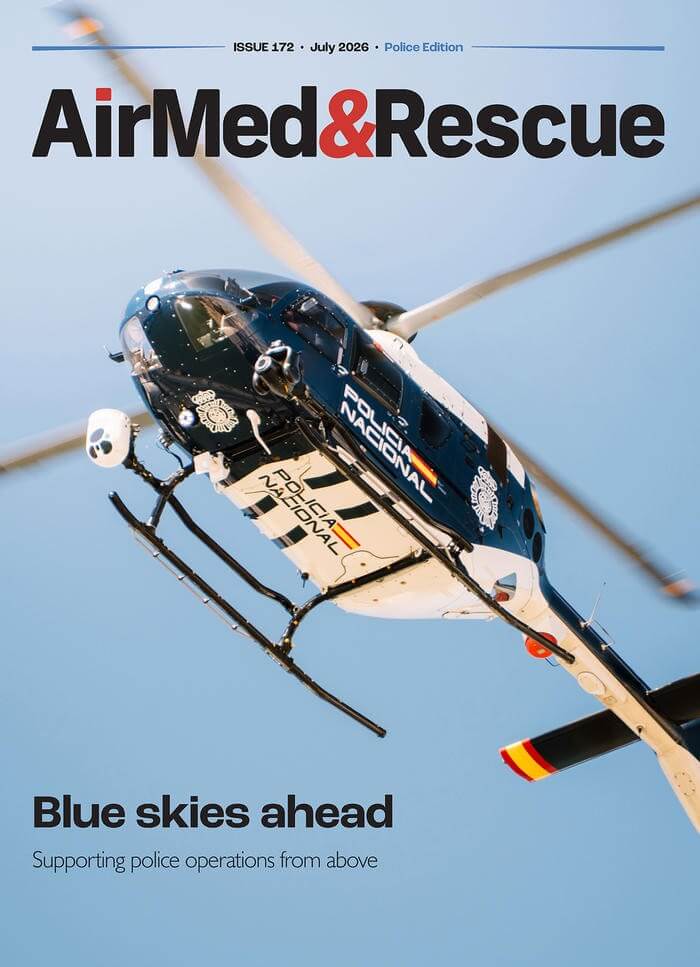
As another July rolls around, it’s wonderful to bring you the airborne policing edition of AirMed&Rescue. We have features on the development and strategies used during aerial missing person searches; the active threats that affect aviation and law enforcement services particularly; the bread and butter of police aviation, the patrol and support operations; and the increasing use of drones as a force multiplier and sometimes as a first responder.
Mandy Langfield
Mandy Langfield is a Director of Palladium Media Partners and former Publishing Director at Voyageur Group. She has written extensively on international travel and health insurance, medical assistance provision, and air medical transportation. She was Editor of AirMed&Rescue from December 2017 until April 2021. Her favourite helicopter is the Chinook, having grown up near an RAF training ground.