
Interview: Making a real difference in time-critical moments

Dr Paul Onion talks to Mandy Langfield about his desire to treat patients, his sense of purpose, and the rewards of working for Yorkshire Air Ambulance, a charity air ambulance service
What first attracted you to working for an air ambulance service?
At school, I originally wanted to be a paramedic. I was fascinated by emergency medicine too, so I decided to focus my university choices on a path that would allow me to combine both interests. Joining the air ambulance service eventually became the perfect way to bring those two passions together. It’s the ideal blend of challenge, teamwork, and purpose.
What really drew me in was the unpredictability. No two jobs or days are ever the same. One moment we might be flying over the Yorkshire Dales, and the next we’re landing in a busy city or along the coast. Every mission brings something new, testing my skills and keeping me constantly on my toes.
It’s incredibly rewarding to know that we’re providing hospital-level care right there at the scene – care that patients wouldn’t otherwise receive until they reached the emergency department. In those truly time-critical moments, we’re able to make a real difference.
Another huge motivation for me is the fact that the service is entirely charity-funded, supported by the people of Yorkshire. It’s humbling to know that the community makes our work possible, and it gives me a real sense of pride to give something back in return.
But what really keeps me inspired are the people I work with – the doctors, paramedics, pilots, charity team, and volunteers. It’s true teamwork in every sense. Together, we combine aviation and cutting-edge medicine in some of the most challenging conditions imaginable.
And, of course, there’s the bonus of seeing Yorkshire from above. From the rolling Dales to the rugged Moors, the bustling cities to the coastline – the views never get old. It’s a constant reminder of the incredible region we serve and the people we’re here to help.

Have you always worked with Yorkshire Air Ambulance (YAA) or have you worked with other helicopter emergency medical services (HEMS) providers as well? If so, what did the differences between the services highlight and what skills/techniques/tactics did you learn or transfer?
YAA is the only HEMS provider I’ve worked for, but my journey here has been shaped by a wide range of pre-hospital experiences that helped me build the skills and mindset needed for the role.
Before joining YAA, I spent part of my medical elective with the ambulance service, observing road crews to gain a deeper understanding of pre-hospital care. That experience gave me a real appreciation for the challenges faced by crews on the ground and the importance of teamwork and communication.
During my pre-hospital emergency medicine (PHEM) training year, I spent 12 months entirely immersed in pre-hospital work – from sitting alongside call takers and ambulance dispatchers to joining cardiac arrest teams, working with ambulance crews, hazardous area response teams (HARTs), and attending multidisciplinary meetings and working groups. It was an intense but invaluable experience, culminating in the Fellowship in Immediate Medical Care (FIMC) exam and a comprehensive training portfolio.
Alongside this, I’ve volunteered for over 15 years with a car-based critical care scheme, working as part of a doctor–paramedic team. That experience has been instrumental in developing both my clinical and non-clinical skills.
Clinically, it taught me how to make calm, measured decisions in fast-moving, often hostile or unpredictable environments – whether that’s poor weather, challenging terrain, or complex patient scenarios.
Clinically, it taught me how to make calm, measured decisions in fast-moving, often hostile or unpredictable environments – whether that’s poor weather, challenging terrain, or complex patient scenarios
Non-clinically, it gave me a broader understanding of how the different parts of the emergency system fit together. Knowing the capabilities and scope of practice of others around me allows for smoother teamwork and better outcomes for patients.
Each of these experiences has fed directly into my work with YAA. They’ve shaped how I approach every mission – with a deep respect for the people I work alongside and the systems that support what we do in the air and on the ground.
How has technology and innovation improved the way you deliver emergency medical care in a pre-hospital setting?
Technology has completely transformed the way we deliver emergency medical care in the pre-hospital setting, allowing us to work faster, safer, and more effectively. Flying the latest D3 Airbus H145, for example, gives us precision and confidence – auto takeoff, precision landing, GPS tracking, weather radar, and mission-planning software all help us operate safely, even in poor weather conditions. At night, night vision goggles open up opportunities for missions that would otherwise be impossible.
On the medical side, innovations like point-of-care ultrasound have been game-changers. We can quickly gain intravenous access, assess lungs for pneumothorax, evaluate cardiac function during a cardiac arrest, and deliver nerve blocks more safely. Video laryngoscopes also increase our chances of successful intubation, especially in challenging pre-hospital airways.
Training has evolved too. Our highly immersive simulation suite replicates real-world environments, with video projection, realistic sounds – from cars to crowds to crying patients – temperature control to mimic hot or cold conditions, and even smells, like petrol, to make the scenarios as realistic as possible.
Other innovations, like automated CPR devices linked via Bluetooth to defibrillators, improve shock delivery. We can perform blood transfusions in the field using warm blood – far safer and more effective than cold. Equipment continues to get smaller and lighter, allowing us to carry more into the helicopter while staying within weight limits.
Finally, our computer systems track interventions at both the service and individual level. This helps us identify areas for governance, service improvement, and personal development, ensuring we continue to evolve and deliver the highest standard of care.
Technology isn’t just a convenience – it’s central to what we do. Every new innovation directly impacts patient outcomes, making a difference when every second counts.

Pre-hospital critical care often involves making rapid decisions with limited information. What clinical frameworks or decision-support tools do you rely on most in those first few minutes on scene?
While there are frameworks and tools to guide us, nothing can replace experience gained over many years on scene. With time, you learn to filter out the chaos and focus on the patient in front of you, identifying what matters most in those first crucial minutes.
A big part of this is reading the scene as you approach the patient. Observing subtle clues about the environment and mechanism of injury can give early hints about likely pathology, while a rapid but thorough clinical assessment of the patient’s physiological signs – heart rate, blood pressure, oxygen levels, Glasgow Coma Scale – and anatomical injuries, like a penetrating chest wound or suspected unstable pelvic fracture, can help guide the urgency and type of intervention.
Human factors play a huge role as well. Maintaining situational awareness, managing cognitive bandwidth, and working effectively as a team are essential. We split roles deliberately: I focus on primary assessment, paramedics start interventions, and the technical crewmember maintains an overview of the scene.
One of the key principles I rely on is doing ‘enough’ – but not too much. Every intervention has to be justified by a risk-benefit analysis. For example, a life-threatening, non-compressible hemorrhage needs rapid transport to an operating theatre, whereas a patient in cardiac arrest may benefit from targeted on-scene interventions to give them the best chance of a meaningful long-term outcome. Balancing immediate action with strategic thinking is at the heart of pre-hospital critical care – and it’s a skill that grows only with experience.
Can you discuss some of the advanced interventions your team is now able to perform at the roadside, and how these compare to what’s available in a hospital emergency department?
Many of the interventions we perform on scene today were once only available in a Major Trauma Centre. Over the past two decades, advances in pre-hospital medicine and air ambulance capabilities have allowed us to bring these lifesaving treatments directly to patients – meaning they receive advanced care far sooner, which can significantly reduce mortality and long-term morbidity.
Some of the interventions we now provide at the roadside include automated CPR, video laryngoscopy, pre-hospital emergency anesthesia (PHEA), point-of-care ultrasound, thoracotomy, hysterotomy, canthotomy, surgical airways, amputations, chest drains, ICU-level ventilation, blood transfusions, arterial lines, vasopressors, and a wide range of drugs and advanced analgesia
Some of the interventions we now provide at the roadside include automated CPR, video laryngoscopy, pre-hospital emergency anesthesia (PHEA), point-of-care ultrasound, thoracotomy, hysterotomy, canthotomy, surgical airways, amputations, chest drains, ICU-level ventilation, blood transfusions, arterial lines, vasopressors, and a wide range of drugs and advanced analgesia.
Arguably, advanced decision-making is just as important as the technical skills we bring to the scene. Knowing which interventions to perform when, and how to balance on-scene care with rapid transport is critical in maximizing a patient’s chance of survival and a meaningful recovery. Being able to deliver this level of care at the roadside is a testament to how far pre-hospital medicine has come – and it’s incredibly rewarding to know we can make such a profound difference when seconds matter most.
What does the YAA medical crew include in terms of doctor/paramedic/flight nurse? How are the skills of each team member complementary?
Our medical crew at Yorkshire Air Ambulance is a finely tuned team, combining a range of highly specialized skills to deliver critical care in some of the most challenging environments.
The doctors on our team are all hospital-level consultants in emergency medicine or anesthesia/intensive care, bringing years of experience. Complementing them are specialist paramedics in critical care, whose day-to-day work focuses on treating critically unwell patients. Their expertise in scene management, patient assessment, and delivering interventions in unpredictable conditions is invaluable.
Our pilots come from both military and civilian backgrounds, with several thousand hours of flying experience. Their role is central: getting the medical team and equipment as close to the patient as quickly and safely as possible, in all weather conditions, day or night. Without their skill, much of the advanced medical care we provide simply wouldn’t be possible, particularly in remote or hard-to-reach locations.
We also have a technical crewmember, primarily in the ‘co-pilot’ seat, who supports navigation and aircraft safety. Their secondary role is as an emergency care assistant on scene, helping with patient treatments and working alongside the doctor and paramedic. Our air desk dispatchers, who dispatch the aircraft, are critical care paramedics – another vital link in the chain.
Clinically, the team works in a highly complementary way. Doctors bring clinical depth, leadership, and knowledge of hospital pathways, while paramedics provide technical expertise, scene management, and hands-on critical care delivery. All of our skills, equipment, and medications are designed to be accessible and usable by both doctors and paramedics. Intensive training and simulations ensure that everyone knows their role during time-critical interventions, whether that’s pre-hospital emergency anesthesia, thoracotomy, or complex trauma care.
After every mission, we debrief as a full team – from 999 call and dispatch, to flight, to on-scene care and transport back. Every team member contributes, reflecting openly on learning points and ways to improve
After every mission, we debrief as a full team – from 999 call and dispatch, to flight, to on-scene care and transport back. Every team member contributes, reflecting openly on learning points and ways to improve. It’s this culture of collaboration, openness, and continuous learning that ensures we keep getting better, together, for the patients we serve.
With evolving trauma and cardiac arrest protocols, how does YAA integrate current research and evidence-based practices into its on-the-ground (and in-the-air) medical care?
At Yorkshire Air Ambulance, keeping our care evidence-based and aligned with the latest research is a top priority. We have a dedicated clinical lead for research and development, to drive innovation and ensure we’re constantly moving forward.
Many of our doctors also work in Major Trauma Centres, which allows them to stay up-to-date with the latest trends, research, and protocols, and then translate that knowledge directly into the pre-hospital setting. In some cases, we’re even able to implement certain interventions more rapidly than local emergency departments.
We’re fortunate that donations from the general public help fund innovations, which means we can adopt new equipment, skills, and techniques quickly when needed. Being a relatively small, highly motivated team makes this process much easier than in a larger hospital with hundreds of staff – change can happen efficiently, without compromising patient safety.
Our clinical governance team also plays a crucial role, continually identifying gaps in our capabilities and helping us develop solutions. This structured approach ensures that every mission benefits from the most current, evidence-based practices, whether we’re on the ground or in the air.
Can you share a moment or case that really stands out in your career – one that highlights the impact of the air ambulance service?
We attend countless challenging and memorable jobs, but the ones involving children are always the most emotive – especially as a parent myself. One case that really stands out was a child hit by a car in a remote location. He was incredibly unwell, and the scene was emotionally charged, with his family present.
He required emergency anesthesia, thoracostomies, a blood transfusion, and treatment for multiple limb injuries. These interventions would not have been possible without a critical care team on scene, and without them, he may have either lost his life or suffered significant long-term disability. Being 90 minutes away from the Major Trauma Centre by road, the speed and expertise of helicopter transfer was critical in getting him the time-sensitive treatment he needed.
The most rewarding part, by far, was seeing him and his family again when he visited our air base – especially knowing the remarkable recovery he had made. Moments like that remind me why this work is so meaningful and why every second we save truly matters.
What advice would you give to young doctors or medical students who aspire to work in pre-hospital or emergency medicine?
My advice is simple: go for it! All those years of university and medical training are worth it.
It’s an incredibly rewarding career, full of challenge and immense satisfaction
It’s an incredibly rewarding career, full of challenge and immense satisfaction. There’s a real sense of achievement in knowing that, as part of a dedicated team, you’re delivering lifesaving and life-changing care to patients. No two days are ever the same – every job, every location brings something different, which keeps the role varied and exciting.
It’s a competitive specialty that demands resilience, adaptability, and the ability to work under pressure – often in difficult conditions like darkness, rain, or strong winds. But alongside the challenge comes a unique privilege: delivering critical care outside the hospital, working in tight-knit teams, and experiencing situations that test your skills, teamwork, and decision-making in ways no other part of medicine does.
For anyone considering it, I’d say: embrace the challenge, learn as much as you can, and enjoy every moment. The work is tough, but the rewards – both for your patients and for your own growth – are immense.
June 2026
Issue
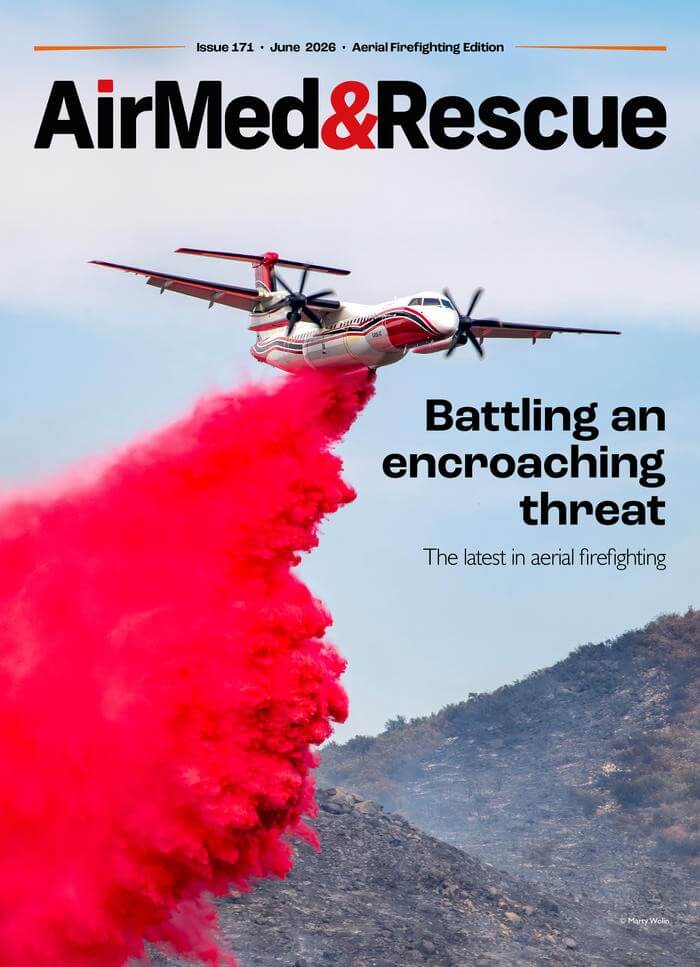
As the northern hemisphere heats up for another hot summer, I’m pleased to bring you the aerial firefighting edition of AirMed&Rescue. We have features on how climate change is accelerating firefighting technology; the improvements in Australian firefighting capacity; and getting ahead of wildfires before they become unmanageable.
Mandy Langfield
Mandy Langfield is a Director of Palladium Media Partners and former Publishing Director at Voyageur Group. She has written extensively on international travel and health insurance, medical assistance provision, and air medical transportation. She was Editor of AirMed&Rescue from December 2017 until April 2021. Her favourite helicopter is the Chinook, having grown up near an RAF training ground.