
Interview: Finding the best solutions for crews, patients, and community

Lee McMurray, Program Manager at Stanford Medicine Life Flight, discusses with Mandy Langfield the value of being part of a world-renowned healthcare system, a recent milestone in his leadership journey, and how innovation can make a difference to patient outcomes
Can you tell us about your journey to becoming Program Manager at Stanford Medicine Life Flight and what drew you to the field of air medical services?
My interest in aviation started as a young boy through my family’s aircraft brake business, Appalachian Accessories. We attended airshows at Oshkosh and Lakeland each year, and my love of aviation grew, specifically for rotor-wing aircraft. I was fascinated by how helicopters could land almost anywhere and maneuver in ways fixed-wing aircraft couldn’t.
In high school, I spoke with military recruiters about becoming a pilot but discovered I was partially colorblind, enough to disqualify me from military aviation. Around the same time, I took an EMT class during my senior year and discovered a passion for pre-hospital emergency medical services (EMS). This led me to find a way to merge careers in medicine and aviation. I worked as a firefighter/paramedic in Kingsport, Tennessee, while simultaneously working part-time as an ICU nurse before gaining emergency department (ED) experience in Austin, Texas, Washington DC, Boise, Idaho, and Boulder, Colorado. After attending my first Air Medical Transport Conference in St Louis, I knew this was my path. I’ve since gained flight/critical care transport, education, and administration experience with Duke University, Vanderbilt, and Air Methods before joining Stanford.
What have been the most significant milestones or challenges in your career leading the Life Flight program?
One of the most interesting aspects of flight programs is understanding how they integrate into larger organizational structures and navigating the required processes to drive change. I’ve been fortunate to experience different models, from community-based programs to large academic hospital-based systems. Across all settings, there’s a consistent challenge: advocating for your team within the broader organization. When you have a dozen nurses in a system of 5,000 employees, your needs must be vetted by multiple stakeholders who may lack the experience or context to understand your unique requirements. Items that seem like obvious choices to us often require approval from numerous committees and panels because we’re a niche unit with a small team. Not many nurses come to work in flame-retardant clothing, attend underwater egress training, and care for an ECMO patient and a pediatric drowning before lunch. We have distinctive needs in support, supplies, training, and logistics. That said, our new Airbus H145 D3 represents a significant milestone in my leadership journey. We engaged various teams and companies to deliver a state-of-the-art platform emphasizing safety, capability, and flexibility for our crews, patients, and community.
We have distinctive needs in support, supplies, training, and logistics
Stanford Life Flight has a reputation for innovation – how do you work with multi-disciplinary teams (pilots, clinicians, engineers, and manufacturers) to customize helicopter interiors for optimal patient care and crew safety?
This aircraft was a labor of love involving a small army of people. We engaged our clinical and aviation teams to develop a comprehensive wish list, then filtered by necessity versus ‘nice-to-haves’ while exploring interoperability opportunities, such as ensuring our stretcher system could be accommodated in ground units to streamline patient movement. We evaluated multiple airframes based on useful load, max gross weight (critical since many of our hospitals utilize rooftop helipads), patient access, speed, supply chain support, and direct operating costs. We established relationships with completion centers and modification/engineering firms to transform our vision from paper to reality, determining what was permissible from aviation and certification standpoints.
Can you walk us through a specific example where customizing an aircraft’s interior directly improved patient outcomes or workflow efficiency?
The interoperability of our aircraft stretcher system with local ground EMS units and our mounting solutions have yielded immediate, significant improvements in crew satisfaction and patient outcomes.
We ensured our stretcher could be secured by multiple securement solutions, both manual and powered, found in local EMS units, allowing streamlined patient movement from referring bedside to ambulance to aircraft. We also incorporated the same mounting options found in the aircraft onto the stretcher for ground use. This allows flight crews to secure various equipment directly on the stretcher until arriving at the aircraft. This innovation eliminates the need to move and secure medical equipment multiple times during each leg of transport, decreasing physical demand on crews and wear on medical equipment.
These improvements have directly contributed to decreased turnaround times, reduced complications in patient movement, and improved metrics for our stroke and type A dissection patients, conditions where efficiency significantly impacts outcomes
These improvements have directly contributed to decreased turnaround times, reduced complications in patient movement, and improved metrics for our stroke and type A dissection patients, conditions where efficiency significantly impacts outcomes.
How do you balance regulatory requirements, operational constraints, and the unique needs of your medical teams when designing or refitting aircraft?
We must identify the best solutions within certification constraints. We abandoned more than a few projects and enhancements due to certification limitations. Some completion centers have existing supplemental type certificates (STCs) but are limited in novel enhancements due to being ‘locked’ into certification constraints. Other centers struggle to create new STCs based on new, more stringent regulatory requirements. You must find the balance between ‘capable enough’ and ‘a dream that will never get certified’.
What are some best practices or innovations you’ve seen in air medical transport that have had the greatest impact on patient care quality and safety?
Having flown in numerous aircraft as a clinician, I believe large patient compartments make a tremendous difference. While not all programs can operate larger aircraft for various reasons, the ability to continually assess, monitor, and treat your patient in-flight is optimal for patient care, in my experience. Larger aircraft can also be beneficial for clinical teams to bring additional personnel and equipment that benefit complex patients requiring NICU-level care or ECMO support.
How does your team train and maintain readiness for high-stakes, time-critical missions, particularly in complex or challenging environments?
Our team engages in diverse training methods to maintain readiness, including in-hospital clinical experiences, cadaver labs, simulation exercises, and underwater egress training. Being part of a world-renowned system like Stanford allows our team to foster relationships with experts in nearly every clinical field, which greatly benefits their personal and professional growth. We’re constantly exploring new technologies and opportunities to enhance safety and operational training.
We’re constantly exploring new technologies and opportunities to enhance safety and operational training
Looking ahead, what advancements or trends in air medical transport do you think will most influence how programs like Stanford Life Flight operate in the next decade?
Electric vertical takeoff and landing (eVTOL) aircraft will be the space to watch. Currently, weight and power density limitations don’t permit critical care transport as we know it today, but I anticipate rapid advancements. In the near term, we could potentially utilize eVTOL aircraft for patient discharges, transporting multiple patients simultaneously to open beds within the system faster, and improve throughput.
May 2026
Issue
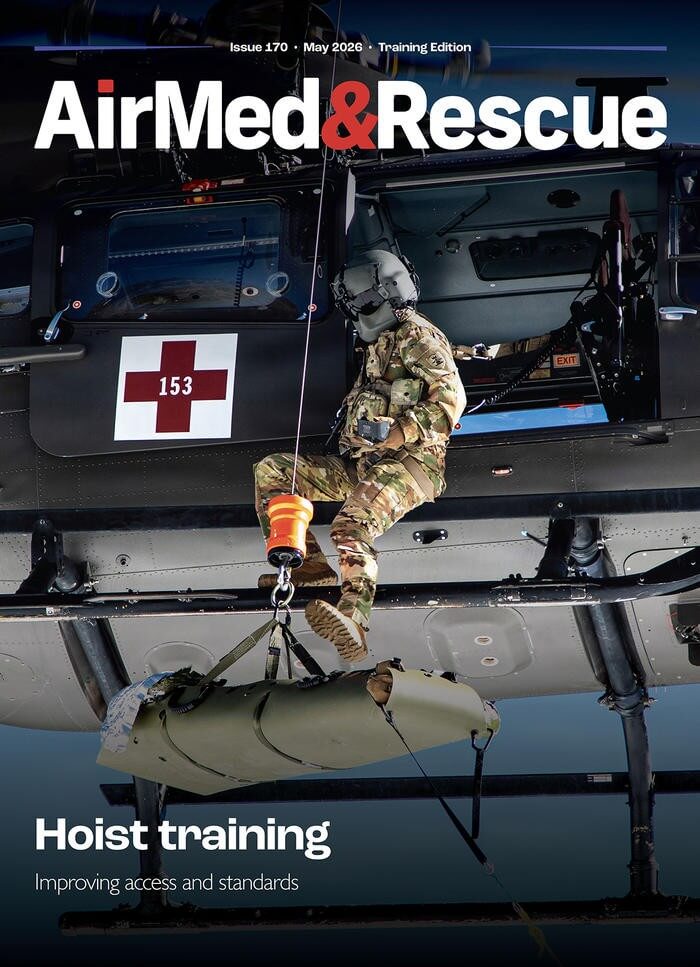
Training for special missions is on another level, so it’s a great pleasure to bring you the training edition of AirMed&Rescue for May. We have features on night flights for police aviators; the simulators for military special missions training; the systems and scenarios for hoist operations; and engineering training for airframe and powerplant mechanics.
Mandy Langfield
Mandy Langfield is a Director of Palladium Media Partners and former Publishing Director at Voyageur Group. She has written extensively on international travel and health insurance, medical assistance provision, and air medical transportation. She was Editor of AirMed&Rescue from December 2017 until April 2021. Her favourite helicopter is the Chinook, having grown up near an RAF training ground.