
Interview: Normalizing conversations about mental health

From a very early age, Andy Elwood knew he wanted to help people. This led to a career as a search and rescue winch paramedic with the Royal Air Force and HM Coastguard, and now a Psychological Safety and Mental Health First Aid Specialist. He tells Jon Adams about his motivations and the importance of mental health
You started your career as an emergency medical technician for a ground ambulance service. What interested you in that line of work?
I had an incredible sense of purpose to help other people but I wasn’t sure what I wanted to do, or how I was going to do that. All the advice I had was if you’re not sure what to do, get the best job you can, and get in a graduate trainee program. So, my first real job was with Marks and Spencer selling ladies’ lingerie as a graduate trainee. After a couple of years, I realized that was not for me. So I decided to have a fresh start and wanted to do something different and I tried to get in touch with what I really wanted to achieve in life.
I had an incident in my childhood when I was five years old and I felt really helpless. My mother was crying one morning, I didn’t know what to do. This was really out of the ordinary for us and Dad couldn’t do anything to console her. It turned out it was the morning after her brother had been murdered in a terrorist incident. This feeling of helplessness that I couldn’t help someone I loved has really stayed with me and I think it’s driven me in my career to help other people and have a positive impact.
I had to get back to what makes me tick. I wanted to help people. I like a bit of adventure as well. Back in those days, I liked a bit of fast driving so I thought of combining the things into one: the ambulance service.
This was followed by being a search and rescue (SAR) winch paramedic and Medical Emergency Response Team paramedic with the Royal Air Force; why did you transition to air medical operations?
I was really enjoying the ambulance service, but I was injured on a job. There was a really heavy patient coming down an awkward set of stairs and I think my crewmate didn’t have his half of the load that night and I injured my shoulder, so I was off work for a little bit. I was still employed by the ambulance service, but after a while they said it doesn’t look like your shoulder’s going to get better enough, we’re going to offer you this contract on driving the minibus, taking people to hospital appointments, but we’re not going to get you back in emergency ambulances.
That wasn’t enough for me. So I went back into corporate life and was doing other management positions, but again, I realized being stuck in an office all day wasn’t for me.
I tried to reconnect to my dreams, which again is coming back to adventure, excitement, adrenaline, and also helping people as well. So I fell for the advertising campaign to join the Royal Air Force and to try to be a SAR winch paramedic.
I was a real late joiner, running about in basic training as an old man with all these young fellas, trying to keep up. But actually, I was quite surprised how fit I was and how able I was to do that. And I was blessed really that I got streamed into the rotary wing. From then on, I just pushed myself forward. SAR was my dream. This is what I wanted to do.
I was based up at Lossiemouth [in northeast Scotland] for most of my career, in the mountains. There is really challenging weather up there in the Scottish winters. And as a paramedic, you maybe have 45 minutes’ to an hour’s flying time to get to some patients and you’re still the first on scene because it’s so remote up there. Absolutely fantastic work.
There is really challenging weather up there in the Scottish winters. And as a paramedic, you maybe have 45 minutes’ to an hour’s flying time to get to some patients and you’re still the first on scene because it’s so remote up there. Absolutely fantastic work
An opportunity then came forward in the Air Force: we were short of paramedics out in Afghanistan on the battlefield rescue helicopter, the Medical Emergency Response Team (MERT). And I thought, why not take the extra venture? A totally different environment to be working in, not flying as part of the aircrew, but part of the crew that get off wherever the helicopter lands on the battlefield and go and tend to the casualties that were there. So a real change-up, but no doubt the pinnacle of my career and probably the most challenging time of my life as well. But some amazing times and memories and new coping skills and achievements because of that.
After almost a decade with the military, you continued your career as a civilian SAR winch paramedic with CHC on contract with the HM Coastguard. Where were you based and what sort of work did you do?
I was based up in Shetland [the Scottish North Sea archipelago]. That’s the only place that there was a winch paramedic job with the Coastguard. We’re so far north we’re mostly doing island-based work, a lot of land-owned (inland-based) work, on the oil rigs a lot, and some remote shipping. It was more long-distance, more time with the patient, getting a more in-depth history, with more medical patients rather than trauma patients, which was my bread-and-butter previously.

How did you find life as a civilian? I know that many former military personnel find the change difficult, or is the sector fairly well suited to encouraging and supporting ex-forces staff?
I think I was blessed in a way for two reasons. Firstly, I didn’t have a 22-year career in the military from when I left school right through, so I had experience of civilian life before I joined the military. I was a bit older when I joined, so I had a slightly different perspective of military life there as well. SAR is different to a lot of military life also. And then when I left and moved in with the Coastguard, there were a lot of ex-military people in there, so you didn’t really feel so alone. It’s different, no doubt, but it’s very similar.
A further transition was into training and education, in aviation standards, in first aid, and in mental health, which is where you focus most of your efforts as a practitioner, instructor, and advocate. What is it about education that you like and why this move away from being a paramedic?
During my SAR career, I was a trainer in the Air Force and in the Coastguard, both on the aviation side and on the medical side. And I got a lot of joy out of helping people along the same route that I had journeyed on. Best job in the world, as far as I’m concerned, being a winch paramedic.
I also found that my knowledge confidence and experience increased whenever I really had to understand something, whenever I had to be able to explain it to someone else and help them understand it in their own way, feel competent with it, but also confident to use it for real in these very dynamic, one-off situations that they would find themselves thrust into as a winch paramedic in SAR.
One night we were out training down on the south coast on a 24-hour shift. It was a bit of a bumpy night and there were different people on board. I think I was being assessed, and I think there was a pilot being assessed as well, so it was a very busy sortie. It was the first time I really had the feeling that I’m not sure if I want to go down on this deck tonight. There’s no-one that needs to be rescued. It all feels like it’s getting a bit rushed. There’s a lot of pressure and I was just thinking, I’m not really feeling like it. And that was unusual. I thought that there’s something behind that, and I seemed to get this moment of clarity. I have got nothing to prove to anybody. I can say, no, I’m not going to go down on this deck tonight. There certainly was an element of you’re only as good as your last rescue. And I decided that night, I had nothing to prove and I could choose what I wanted to do. I still got winched down and we achieved what we needed to do and came back. But that really got me thinking after that, why am I here? What do I really want to achieve? What would I really like to do?
I came back to my dreams again, thinking about adventure. And I always had this other dream that I would love to run my own business. And I’d done some of that in my time off. You get a lot of time off in SAR. When I was working for CHC I’d been out to Jordan, supporting running a company delivering training to the civil defense. That was fantastic. I really enjoyed delivering that. And I thought, I’d love to have my own company. I’ve got all these skills. That is something that I want to do to and it felt like an adventure again. I felt motivated again.
I have this sense of purpose to help other people. And to be honest with you, I’m confident I am saving more lives now with Mental Health First Aid than I ever did keeping the wire straight or dangling under a SAR helicopter
I have this sense of purpose to help other people. And to be honest with you, I’m confident I am saving more lives now with Mental Health First Aid than I ever did keeping the wire straight or dangling under a SAR helicopter. With the Mental Health First Aid, there’s been such a need for it. People need education on how to look after themselves, how to support others, spot the warning signs. And that has been the predominantly successful part of my business in its initial phase and, typical me, not satisfied, and I’m in the process of moving to the next level with how we’re evolving the business.
Can you explain a little about Mental Health First Aid, what it is, what people can do to help, and how people can look for signs of poor mental health?
Mental Health First Aid is 25 years old. We started in Australia back in 2000. It’s in almost 30 countries around the world now and over eight million people trained worldwide. It’s a tried, tested, approved way, both by mental health professionals and also people with lived experience that have received the help. It’s all about people being able to spot the signs in others. Whenever they do, they have got the knowledge and the toolkit and the confidence to step forward, make an approach, and offer a supportive conversation.
It uses super simple techniques, predominantly about listening without judgment, communicating without judgment – does the person who is showing signs and symptoms that they may be experiencing poor mental health feel that they can trust the first aider to open up and talk about what’s really going on for them? Mental health first aiders are making a massive difference at the moment because it’s so difficult for people to access the help that used to be out there. But many of us are lucky and many of you will have an employee assistance program through their job. That is great that we’re usually able to access help that bit sooner.
Poor mental health is really common; one in four people in the UK experience poor mental health each year. It’s slightly less for people in work, which is one in five. We’re always focusing on how common poor mental health is, but what we don’t often take in is a real positive message. If we turn that around, three out of four people are well, so most of us are well most of the time, and that’s four out of five of us at work. There’s a reason why most of us are well most of the time, because we’re looking after ourselves, we’re caring for ourselves. So there’s that whole message to give out. But the other one is that just because you’re experiencing poor mental health this year, one in four in the general population doesn’t mean you’re stuck there. That’s a short-term thing. You can improve that. You can take back control whenever you access the help that’s out there and you can get yourself back into being one of the three out of four experiencing positive mental health.
Being able to find someone to trust often helps us overcome the stigma that is built up around mental health to find some support. My own experience can illustrate this. I wasn’t feeling quite like myself, hadn’t been for quite a while, in the Coastguard SAR. It was only when a colleague asked me, ‘What’s going on, Andy?’ I said, ‘Well, I just haven’t been sleeping well lately.’ He asked me a brilliant question. He said, ‘How long has that been going on?’ And I had to think about it. When I totted it up, it was between two and three years. Now, as soon as I said that, I thought, I need to do something about this. It has been going on too long.
I had thought, this is just what getting old is about. I’ve not been sleeping so well. I don’t have the same energy, the same focus, concentration. I’m not enjoying things that I used to. I find it difficult to get out of bed in the morning. I’ve got aches and pains, struggle getting down the stairs. And I’m really irritable. I’m turning into a grumpy old man. And my colleague said to me then, ‘Do you think, Andy, you might have depression?’ And I pushed back about it straight away. This wasn’t the answer I wanted. This wasn’t how I wanted my life to go. I’d always considered myself a positive person, full of life and energy. And I didn’t want that to be true. So the biggest stigma that I felt was actually the self-stigma. And I think that’s what it is for many of us out there. Some of us will experience stigma from other people and the judgment from other people. For me, it was the self-stigma.
It took me quite a while to accept this and reach out for the help that was available through my employee assistance program at work. The biggest step was picking up the phone, dialing the number. Once I did that, had a really short conversation, answered a few simple questions – it was less than 10 minutes on the phone, no judgment. And they said, ‘Andy, we’ve got a set of 10 sessions for you available for some therapy, we’re going to send you a list of qualified people. You can have a look at them, choose who you want to work with, try a few of them out, see who you have a connection with, who you can trust. And it won’t cost you a thing.’
But the biggest thing is actually picking up the phone and dialing the number. But once I did, it was super simple. And that made a real difference for me. It’s hard work going there. You’ll be taking a look at yourself, but there’s no-one else who can turn your life around, rather than yourself. You have to decide to do it for yourself. The therapist hasn’t got all the answers, but they have got some great questions for you to think about, work on to improve your situation, to improve your outlook, to improve your future. And that really worked for me.
I recommend to anyone to find out the details of your employee assistance program, how to access it. There’s lots of practical things, things around legal advice, financial advice, bereavement advice, all sorts of things. It’s not all about therapy
I recommend to anyone to find out the details of your employee assistance program, how to access it. There’s lots of practical things, things around legal advice, financial advice, bereavement advice, all sorts of things. It’s not all about therapy. It can help you if there’s an end of a relationship, you want to get access to see your kids, for example, or financial issues, and bereavement is a biggie as well. Maybe on the legal side, you’ve got a dispute with a neighbor. It helps in so many different ways. You’re worth it. It’s part of your enrollment package. Please access it. For the managers out there, for the union reps, whatever’s applicable, wherever you’re working, find out about this as well. The more you know about it, the more options you can offer to people in your organization.

Do you find that the mental health of people in aviation and particularly high-stress roles such as those in special missions is at higher risk of injury?
Short answer is it’s really complicated. I think in the emergency services, we’re more at risk because of the high tempo, and the type of incident that we attend. There’s often a lot of high pressure and high stress in those kind of environments. But a lot of it is to do with the shift work. The research has shown that’s not good for us, even if you’re not working in the emergency services. Sleep is so, so important. Sleep is the one tide that rises all other health boats. It’s proven it’s not just a certain quantity – seven to nine hours for most adults – but it’s also the quality of that sleep as well. When our sleep is disrupted, that is not so good for our physical health, not so good for our brain health, not so good for our mental health. So the shift work is a big factor in that.
To set ourselves up proactively to be able to deal with more stress on an ongoing basis and to be less likely to be triggered by traumatic incidents is four simple things to do: nutrition, exercise, training, and sleep (NETS)
All the research that has been done through various organizations and the emergency services is that it’s not all about the trauma. It’s those other things in our personal lives that actually contribute into this; those stresses that we all have – the financial ones, the relationships at work, the relationships at home, where we’re living – all these things that are part of everyday life, they add up and it’s really important to look after those. Psychological safety and neuroscience research shows that for us to set ourselves up proactively to be able to deal with more stress on an ongoing basis and to be less likely to be triggered by traumatic incidents is four simple things to do: nutrition, exercise, training, and sleep (NETS).
Nutrition, eating a good diet. If we eat a rainbow of whole foods, we’re getting good gut bacteria, good variety in there. We’re increasing our immune system, and that’s good for our gut health. That’s good for our brain health. And living with a pet, as I know many of us do, the muck and germs that they bring into the house and all the dirt, that is actually good bacteria. That’s good for our physical health, good for our mental health, our brain health as well.
Exercise is really good for our brain health. It is really good for mental health as well as our physical health.
Training, that’s about brain training. This is the mindfulness that we hear people talking about, the meditation. We don’t all have to be doing that with our legs crossed, chanting, or burning incense. That works for some people, but equally, for me, riding my motorbike, that is being mindful. I am not focusing on my inbox, the difficult conversations I’ve had this morning, what bills I need to pay. I’m just focused on what I’m doing right now in the moment. Similarly, if I’m spannering on my classic Land Rover, that’s my hobby, I’m wondering what’s gone wrong with the electrics this time – again, I’m not thinking of all the other distractions in my life that I could worry about, I’m just focused on this right now. Cooking is another great one. When we’re using our senses, it’s really great at grounding us in the moment. Music is a great grounder. We can have a playlist that, if we’re feeling stressed or anxious, can dial things down for us. If we’re feeling low, we can have something more energizing, uplifting, to get us back on form and more like ourselves. Brain training is great – if we’re doing Sudoku puzzles, any kind of puzzle stimulating our brain, that’s good for physical health and reducing our risk of Alzheimer’s and dementia in the future as well. Wordle is another great one to do.
Sleep, proven by neuroscience to really reduce our risk of stress, of being triggered into feeling unsafe in a psychological environment. We’re very aware of that in aviation with our fatigue regulations.
Signs and symptoms can be very individual, but mental health is about how we think, feel, and behave. It’s not always easy to tell how someone is thinking or feeling, so we tend to pick up on the behavior changes for someone. If we know what their benchmark is, if they’re varying away from that, it’s one of the first things that most of us are able to pick up on. That might be them coming in late, having a few more sick days, making little mistakes, having little near misses, being involved in an accident, something’s going wrong because they don’t have the same focus and concentration. The research shows us that people may also procrastinate, not have the same decision-making capability, their memory isn’t as sharp as it used to be. Instead of being a team player and onside, if that’s your benchmark, they may be a bit more irritable, pushing back on things, snappy at people. But for many of us, the first symptom that shows up is we’re just not sleeping well. So in some research that was done in the emergency services, they don’t tend to open up to a trusted colleague that they’re experiencing poor mental health; rather, the number one way of opening up is telling someone you trust that you’re just not sleeping well, saying ‘I don’t remember the last time I got a good night’s sleep’. Bear in mind the shift work, but if someone is telling you that, just like how I presented to a colleague, be interested in them when they tell you this. How long is always a great question. I encourage mental health first aiders to use that all the time. It helps us quantify how long this is going on, what the risk is to them, what the consequences might be. And it gives the person another perspective, just like it did for me.
The industry is really male dominated, and it can be really hard to find people to speak to. It’s changing, but it still is. The research shows that men are more at risk of suicide: three out of four suicides in the UK are men. And that plays out right around the world. And the reasons seem to be that we’re more likely to bottle up our feelings. We don’t have the same emotional literacy, emotional intelligence. It wasn’t part of our growing up experience. We’re more likely as men to turn to substances to numb ourselves, just to try and cope with what’s going on. And then, crucially, when it comes to thoughts of suicide, we’re more likely to choose a lethal means as well.
We can break down the stigma by normalizing, talking about mental health, how we’re feeling. My work as a [men’s health charity] Movember ambassador over the years has been to follow the model that has been central in getting people on board and creating safe environments for men to talk. To be a better man, you need to be a man of more words. Even if all we can say to people is I’m really angry about this, I’m really upset about this, that is better than saying nothing at all, better than bottling it up. If we can be non-judgmental, if we’re supporting someone when they talk about this, ask a relevant question, remove distractions, don’t interrupt. Top tip is we’ve got two ears, one mouth. Use them in that proportion and you’ll be doing a good job at listening. If we’re stuck to ask a good question, my three little words, get-out-of-jail-free card is ‘Tell me more’. It’s a statement rather than a question. It shows you’ve heard what they said, you’re interested, you want to know more.
If you had one piece of advice for people working in airborne special missions, what would it be?
So I’ve got one piece of advice, but it comes in three steps.
There’s three things to do that I’ve found through all the work, support, training, delivery I’ve done and my own personal experience. The first one is increase your own self-awareness. Know what keeps you well. The five ways of wellbeing are: connecting with people; being physically active; taking notice, i.e. mindfulness or living in the moment; keeping learning – that’s good for our brain health, reduces dementia, Alzheimer’s risk, it’s good for mental health as well; and give something back – give your time, whether it’s formally volunteering, whether it’s giving some money to charity, whether it is giving someone a smile, asking how they are. When we’re helping someone else, we’re feeling better ourselves. You get more bang for your buck when you combine more than one of those into one activity. Easiest thing, exercise with a friend. Do your hobby with a friend. Know what keeps you well, do some of that. Know what your warning signs are.
Having a support network is so, so important
The second step is talking to someone. And this is important for two reasons. By talking to someone, we are offloading. A problem shared is a problem halved. We’re reducing what’s in our stress container. That gives us more brain capacity to choose a way forward, to have clearer vision as to what’s involved, deciding what’s urgent or who could help us. Although a recovery journey is very individual, none of us can do it alone. Having a support network is so, so important. Your employee assistance program and the ambulance chart (aace.org.uk/wp-content/uploads/2025/09/AACE-Mental-Health-Continuum-09.2025-V1.pdf) will help you do that. That can be used as a self check-in. In the UK, you’ve always got 24/7 Samaritans number 116 123 to call, and the 24/7 ‘Shout’ service: just text the word ‘SHOUT’ to 85258. Trained volunteers are there 24 hours a day to offer you support.
The third one is about how you talk to yourself. Be your own best friend. Be your best teammate. Many of us say things in our own head that we wouldn’t dream of saying to anyone else. Try and speak more kindly to yourself. Be alongside yourself. Support yourself. Encourage yourself to get through this difficult time. Everything is temporary. It will pass. You will come through the other side. So being your own best friend, being kinder to what you say, and don’t believe everything you think. They’re just thoughts. They will pass. You are still here. It’s one day at a time, one step at a time. There is a lot of hope – things can and do get better when we reach out for the help that is there.
There are several free resources on my website here: andyelwood.com/resources
April 2026
Issue
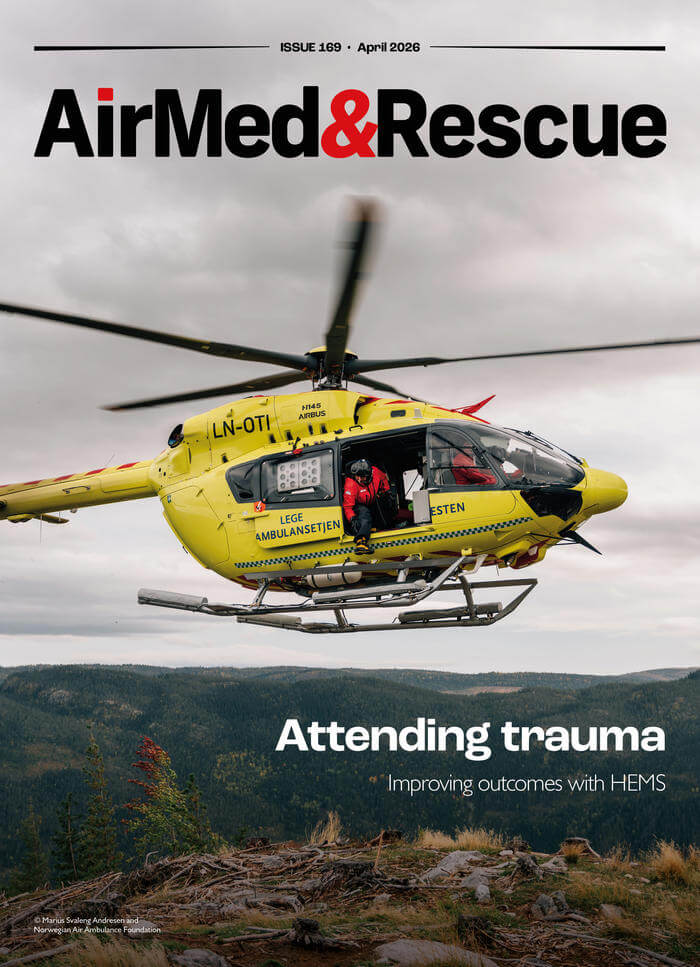
Launching into spring, we have another great edition covering the world of airborne special missions. We have features on the European approach to aerial firefighting; how maintenance, repair, and overhaul companies are still managing the complex supply chain environment; neonatal transfers in regions that are not conducive to easy ground transport; and how helicopter emergency medical services deal with attending to traumatic accidents and injuries.
Jon Adams
Jon is the Editor of AirMed&Rescue. He was previously Editor for Clinical Medicine and Future Healthcare Journal at the Royal College of Physicians before coming to AirMed&Rescue in November 2022. His favorite helicopter is the Army Air Corps Lynx that he saw his father fly while growing up on Army bases.