
Interview: High-performance HEMS

Bill Long, Aviation Director for Essex & Herts Air Ambulance, tells Mandy Langfield about the challenges facing the UK charity and the priorities and goals of the organization going forward
You oversee aviation operations in a highly demanding pre-hospital environment. What are the key operational priorities that guide your day-to-day decision-making?
My key priority is safety. According to the UK Civil Aviation Authority (CAA), helicopter emergency medical services (HEMS) is a factor of 10 more risky than other forms of air transportation, so safety is always going to be paramount for me. After that it’s about providing the right people with a serviceable aircraft so they can get the clinicians airborne to deliver their lifesaving care.
What’s challenging is we never know when we’re going to be needed, so there can be a lot of time spent waiting to be deployed, but then we need to be ready to go within minutes when we are.
How has the role of aviation in critical care evolved during your tenure, particularly in terms of response capability and clinical integration?
I’ve only been in the air ambulance community for a relatively short period of time; however, I was previously a police pilot at a time when there wasn’t as good coverage from air ambulance charities as there is now and we would often go to major road traffic collisions to provide support. In those earlier days, the model for air ambulances was very different – it was about turning up, stabilizing the patient, and taking them to hospital to get the care they needed as quickly as possible.
What’s been really exciting is seeing how the system has evolved and put a greater focus on pre-hospital care. Our clinicians are bringing the hospital to the roadside. The helicopters have played a critical part in enabling this. With the AW169 we are able to transport up to three clinicians – this means we can dispatch doctor-led teams to perform procedures at the side of the road, improving outcomes for patients. We also have more space inside the helicopters and are able to carry more complex medical equipment, allowing for that more intensive treatment at the scene. We can also now operate at nighttime in the winter using night vision imaging systems (NVIS).
With the AW169 we are able to transport up to three clinicians – this means we can dispatch doctor-led teams to perform procedures at the side of the road, improving outcomes for patients
How will the recent move to Essex & Herts Air Ambulance getting its own air operator certificate (AOC) change operations for the charity?
We are committed to ensuring our service is the best it can be, and securing our own AOC plays an important part in this. It took a lot of hard work but it means we have greater control over our own operations, can set our own standards and be even more responsive to local needs. Notwithstanding the impact of the war on fuel costs, we expect to see savings on aviation costs in the medium term which could be up to 10%, which is substantial for a charity that relies solely on donations from people and organizations to keep our helicopters flying.
Another critical aspect to the AOC is that we now employ our pilots directly, which will improve our ability to recruit and retain the best talent. We now have a full and stable cadre of 13 pilots, at a time where there is a global shortage of pilots. It also means we find ourselves supporting our neighbors when they can’t get enough staff – including recent shifts in Dover and Norfolk for some of the team.
What are the biggest challenges you face in maintaining safety and compliance while operating in complex and often unpredictable environments?
We are a small team when you consider the scale of the operation – our aviation team is made up of 19 people, including 13 pilots. Given those pressures, we’ve found that having experienced staff is critical. Safety and compliance have to be the foundation of everything we do, and we’ve worked hard to create a safety culture that is integrated across the whole organization.
Can you walk us through how your team balances rapid response times with the rigorous safety protocols required in air medical transport?
Safety comes first – then we get the job done. It comes back to the importance of having the right team. We have very experienced pilots who have been involved in HEMS for some time [and] can balance the moral pressure to ‘get there quickly’ with doing things properly. We also work in pilot teams of two for each mission, which allows us to balance safety and urgency. It works. The aircraft gets off very promptly – we are usually airborne within four minutes – but there’s no rushing; the team’s experience allows them to work quickly.
Safety comes first – then we get the job done. It comes back to the importance of having the right team
How do you approach crew resource management (CRM) and team coordination between pilots, clinicians, and ground support?
We train our teams regularly and coordination is a big part of that. Teams go to the simulator together every six months. Everyone plays a vital role – whether pilots, clinicians or ground – so we invest in training together. Technically, clinicians are classed as ‘medical passengers’, but we treat them as members of the crew, building their level of aviation knowledge and using them as an extra pair of eyes. In our busy airspace north of London, the biggest risk is collision, so it helps to have everyone on board looking out for other aircraft as we fly.

Technology is rapidly advancing in aviation. What innovations have had the most significant impact on your operations, and what are you most excited about for the future?
NVIS has been a game changer. It started as a military tool but now allows us to fly after dark in winter and really enhances safety. The level of automation in the aircraft also helps ensure our pilots can focus on situational awareness while the helicopter flies itself. I’m excited for where some of this will go – uncrewed systems could have an impact, as could the electrification of helicopters. We will review all these innovations as they unfold and look at how they might enhance our service for patients – but safety will always come first.
Training and retention are critical in this sector. What strategies have you found most effective in developing and sustaining a high-performing aviation team?
Ours really is a high-performing team but we put the time into working and growing together. We work hard to make sure everyone feels valued and that they can achieve some work-life balance in a demanding role. It’s why we’re so excited to be able to now employ our pilots directly and make them truly part of our organization.
Ours really is a high-performing team but we put the time into working and growing together. We work hard to make sure everyone feels valued and that they can achieve some work-life balance in a demanding role
At the beginning of the AOC process, we invited an England Rugby coach in to talk to everyone about how they develop high-performing teams. There were some really helpful ideas around the importance of always understanding what the goal is and making sure everyone understands the part they play in that. We’ve taken on board three mantras from rugby: ‘Sweep the sheds’, which is about everyone playing their part and staying humble; ‘Leave the shirt in a better place’, which is about always striving to improve; and ‘No-one is bigger than the shirt’, which reminds us that the organization and making pre-hospital care the best it can be is what matters.
Looking ahead, what is your strategic vision for the aviation operations side of Essex & Herts Air Ambulance over the next five to 10 years?
We want to embed the AOC into the fabric of the charity – and look at how it might allow us to extend our service to provide greater coverage for the people of Essex and Hertfordshire.
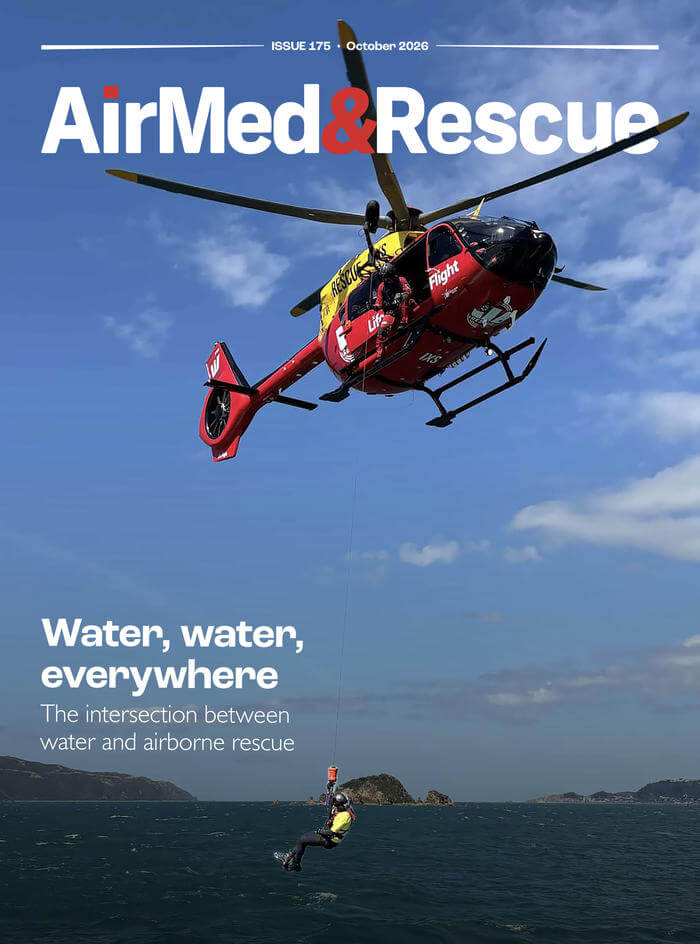
October 2026
Issue
The latest edition of AirMed&Rescue is packed full of content to keep you occupied in October. We have features on the challenges that swiftwater presents when trying to rescue someone; how sensor technology is affecting and improving aerial firefighting missions; why operators choose to have a varied fleet of aircraft to perform special missions; and what can be done to improve the accessibility and awareness of mental health assistance programs for safer and sustainable working conditions.
Mandy Langfield
Mandy Langfield is a Director of Palladium Media Partners and former Publishing Director at Voyageur Group. She has written extensively on international travel and health insurance, medical assistance provision, and air medical transportation. She was Editor of AirMed&Rescue from December 2017 until April 2021. Her favourite helicopter is the Chinook, having grown up near an RAF training ground.