
Interview: Many disciplines

Search and rescue for the Canadian Armed Forces is a multifaceted specialty. Sergeant Dave Rix, RCAF Search and Rescue Technician, tells Mandy Langfield about the demands of a job where he has to reach and save otherwise unreachable patients
Given that search and rescue technicians (SAR techs) are recruited from across the Canadian Armed Forces, how does prior military trade experience translate into operational readiness within a Royal Canadian Air Force (RCAF) SAR crew?
Honestly, less than people might expect. I spent 12 years as an avionics technician before becoming a SAR Tech, and almost none of my trade skills carried over technically. What did carry over was the preparation I’d done on my own time: civilian skydiving, scuba, hiking, fitness, and volunteering with ground SAR. Medics naturally bring relevant clinical training, and combat arms backgrounds tend to bring an advantage in land navigation, survival, and mental and physical toughness.
Navigation, survival, and mental and physical toughness are tested hard at SAR Tech Land Survival (previously known as selection), run at Jarvis Lake, Alberta, in the dead of winter. The course is designed to push candidates to their physical and psychological limits, and what it’s really filtering for isn’t your background or skills – it’s determination, and whether you can keep functioning at your limit.
The trade skills required for operations are taught on course and refined during on-the-job training (OJT) at our units. Having a background in a certain discipline can make it easier during certain phases, but we’re all brought up to the required operational standard by the end of our training.
Operational readiness, however, is more than trade skills. It’s heart – your ability to dig deep and accomplish the mission no matter the circumstances. That isn’t trade-specific; it’s an intrinsic character trait.
The SAR tech pipeline combines an intensive selection phase with an approximately year-long core course. How are advanced paramedic competencies integrated alongside technical rescue disciplines during training?
The course is built in phases, and the sequencing is deliberate. Medical comes first – roughly four months of intensive paramedic training that forms the foundation everything else is built on. What follows – dive, arctic, mountain, parachuting, and ground ops – each introduces a new technical discipline first, then reintegrates the medical toward the end of that phase. By mountain phase, candidates aren’t just running rope rescues; they’re managing a simulated injured climber on a rock face, full primary survey and packaging, while running the technical extraction.
The course culminates in a final ops evaluation phase spanning several weeks, rotating through simulated ground, mountain, and parachute missions, with each candidate taking a turn leading the team through everything learned over the preceding year. Rescue and medicine are assessed together, because in the field they always happen together.
Operating across platforms such as the CH-149 Cormorant and CC-130 Hercules, how do SAR techs adapt their rescue profiles and medical delivery to the capabilities and constraints of rotary- versus fixed-wing assets?
The medical kit travels with us regardless of platform, but how and when we use it changes completely. Rotary wing gets us almost anywhere via the hoist, but fuel often limits time on scene. We generally bring minimum equipment to the ground, prioritizing a rapid primary survey, only the necessary immediate treatments, and efficient packaging, with detailed care continuing once aboard.
The medical kit travels with us regardless of platform, but how and when we use it changes completely. Rotary wing gets us almost anywhere via the hoist, but fuel often limits time on scene
Fixed wing is the opposite profile. An operational jump means the helicopter is hours away and the patient’s condition warrants parachuting into an austere environment. On the ground, you may be on scene for many hours or days, managing hypothermia, long-term treatments, and monitoring vitals with no hospital nearby. Larger medical equipment and survival bundles can be dropped from the aircraft as needed. We’re cross-trained on both, which gives us the flexibility to adapt smoothly between the two profiles.
From a clinical perspective, what are the key considerations when delivering patient care during hoist operations in dynamic environments such as maritime or mountainous terrain?
The environment dictates much of the clinical approach. On stable ground, you have the time and footing to run a proper primary survey, package methodically, and stage equipment before the hoist. Mountain scenes are different – on an exposed slope or rock face, the priority is getting the patient off the terrain before anything beyond essential interventions, and care happens in stages: stabilize enough to move, package for the rope rescue, finish the assessment and necessary treatments on stable ground, then hoist into the aircraft.
Maritime is different again. Patients could be hypothermic from cold-water exposure or extended time aboard a vessel in distress, so thermal management starts immediately.
The underlying principle is the same: do only what the moment requires, package quickly, and continue care once the patient is aboard
The underlying principle is the same: do only what the moment requires, package quickly, and continue care once the patient is aboard.
In multi-agency missions involving pilots, flight engineers, and joint rescue coordination center (JRCC) coordination, how is crew resource management (CRM) applied to maintain situational awareness and minimize risk during high-tempo rescue operations?
The foundation is simple: everyone focuses on their part of the mission. The aircraft commander leads the aircraft and the overall mission – fuel, weather, routing, power, time on scene, coordination with other resources. The SAR tech team lead manages the rescue plan itself: hoist locations, parachute landing zones, patient care, time, personnel and equipment requirements, and risk mitigation. The sequences themselves are deeply standardized and rehearsed until second nature, which frees up bandwidth for the dynamic mission management no checklist can anticipate. Roles shift dynamically and there’s real overlap, but the crew keeps open lines of communication and defers to the expert in each area.
JRCC coordination adds another layer. They’re often working with incomplete information that develops throughout the mission – we might launch on nothing more than an emergency locator transmitter (ELT) hit, then an overdue aircraft is reported, then three patients – and the picture builds in real time as we replan around it.
SAR techs are trained to deliver advanced pre-hospital care in remote and hostile environments. How does this differ from conventional helicopter emergency medical services (HEMS) practice, particularly in prolonged field care scenarios?
Conventional HEMS is built around short transport times – typically minutes. Our care often extends for hours or days, with none of the infrastructure that practice assumes: no warm ambulance, no ER 15 minutes away, often no clean surface to organize equipment. Often it’s two SAR techs and a critically injured patient, with no help coming for hours or longer. You pop a tent or build a shelter and a fire, because that’s the only infrastructure that exists.
Once stabilized, the job shifts to sustained management – a structured reassessment covering hydration, thermal management, infection risk, and re-dosing. Warmed fluids are a priority, since hypothermia is part of the lethal trauma triad and a real, constant threat in a cold forest. Keeping a patient calm and talking to them matters when you’re their only continuity of care for hours. We’re the entire system of care for as long as the environment and situation demand it.
Once stabilized, the job shifts to sustained management – a structured reassessment covering hydration, thermal management, infection risk, and re-dosing. Warmed fluids are a priority, since hypothermia is part of the lethal trauma triad and a real, constant threat in a cold forest
With responsibilities spanning parachuting, diving, mountaineering and arctic survival, what systems are in place to maintain currency and prevent skill fade across such a broad competency spectrum?
Maintaining proficiency across so many disciplines is one of the trade’s biggest ongoing challenges. A layered currency structure keeps it possible, with requirements on quarterly, semi-annual, annual, and biennial cycles – from parachute descents and medical modules quarterly to saturation mountain and parachute exercises annually, to full proficiency recertification across flight, dive, mountain, and medical skills every two years. Even with that structure, gaps between formal currency are inevitable, and calls sometimes happen well outside the recent-practice window. It falls to individual SAR techs to find time in an already busy schedule for extra training whenever they can.

With aircraft like the CC-295 Kingfisher incorporating advanced sensor suites capable of long-range detection, how has this changed the SAR tech’s role in search phase versus rescue phase operations?
The fundamentals of the search phase haven’t changed – sensors improve efficiency; they don’t replace the human eye. During low-level visual searches, our spotters still have a far wider field of view than any camera operator, scanning for anomalies like a broken treetop or an out-of-place color through the canopy. But, once a spotter calls the crew onto a point of interest, the sensor confirms it immediately; no need for multiple low passes. A boat can be identified from five miles away where it’s barely visible to the naked eye, and the search radar can detect and classify vessels out beyond 100NM en route. At night, infrared has transformed water searches, where finding an uncooperative target with no light was traditionally near-impossible.
The rescue phase has changed as well. The sensor operator can call accurate equipment drops, and the CARP (Computed Air Release Point) system calculates release points from wind, weight, and parachute parameters. Drop zone assessment has also improved: hazards once invisible to the naked eye can now be identified earlier, letting us make better-informed risk decisions before committing to a jump.
SAR missions often involve extended standby periods followed by high-intensity deployments – how does the RCAF manage fatigue, cognitive load, and decision-making under pressure?
Standby itself is manageable – training at the unit by day; weekends on call from home within response range. The challenge is timing: taskings often land in the evening, after a full day with little sleep already banked. The crew duty day is 15 hours from when the first crewmember reports, extendable to 18 at the aircraft commander’s discretion. Before every flight, each crewmember fills out a fatigue questionnaire – hours of wakefulness, sleep debt, etc. – which the aircraft commander uses to evaluate the team’s readiness before accepting the mission. Those protections apply to the aircraft and crew, though; once a SAR tech is on the ground with a patient, they’re managing their own fatigue tactically.
Standby itself is manageable – training at the unit by day; weekends on call from home within response range. The challenge is timing: taskings often land in the evening, after a full day with little sleep already banked
Sleep debt compounds with circadian disruption and can take days to reset – mostly you manage it through strategic napping and accepting you’ll run suboptimal for a stretch afterward.
Training is realistic enough to ensure the people making decisions can make them under pressure, and aircraft commanders and team leaders have been tested extensively under stress before being placed in their roles.
And when you’re in a situation where you must make tough calls, there’s a certain clarity in the moment – because there’s no other option than to be decisive.
Looking ahead, how do you see emerging technologies – such as uncrewed aerial vehicle (UAV) integration, artificial intelligence (AI)-assisted search planning, and enhanced medical monitoring – reshaping the operational and clinical role of the SAR tech?
Technology will keep making us more efficient – better sensors, AI-assisted search planning, and medical monitoring that gives us more data with less equipment. I expect UAVs and AI to eventually take over much of the search phase, and, at the very least, it will be drastically more effective and efficient. How soon the military adopts it is another question.
Regardless, the core of this trade – the rescue itself – isn’t going anywhere soon. We still need to get on the hoist and physically rescue the patient. We still need to parachute into remote areas, set up a rope rescue system, and provide medical care. Even with a theoretical advanced AI medical diagnostic system, someone still has to administer the treatments. The tools will keep evolving; the person at the end of the hoist still has to be there, and that, I don’t see changing any time soon.
The core of this trade – the rescue itself – isn’t going anywhere soon. We still need to get on the hoist and physically rescue the patient. We still need to parachute into remote areas, set up a rope rescue system, and provide medical care
The SAR tech trade is a uniquely demanding one – not because of any single discipline, but because of how many have to be carried at once, on no notice, in environments that don’t forgive mistakes. Land survival finds people who can function at the edge of their limits, the year-long course builds the skills, and the operational community refines them over a career. Technology will keep changing how we search, plan, and treat, and we should welcome every improvement. But the heart of the job – going where almost nothing else can reach the patient and providing care until they’re safely in better hands – will continue to come down to a small team, often just two SAR techs, willing to be there when it counts. That’s what the trade has always been about, and that’s what keeps drawing the next generation to it.
Thank you to AirMed&Rescue for the opportunity to share a small window into the trade. It’s a privilege to wear the wings, and an even greater privilege to help train the next generation of SAR crews who will go on to do this work for years to come.
September 2026
Issue
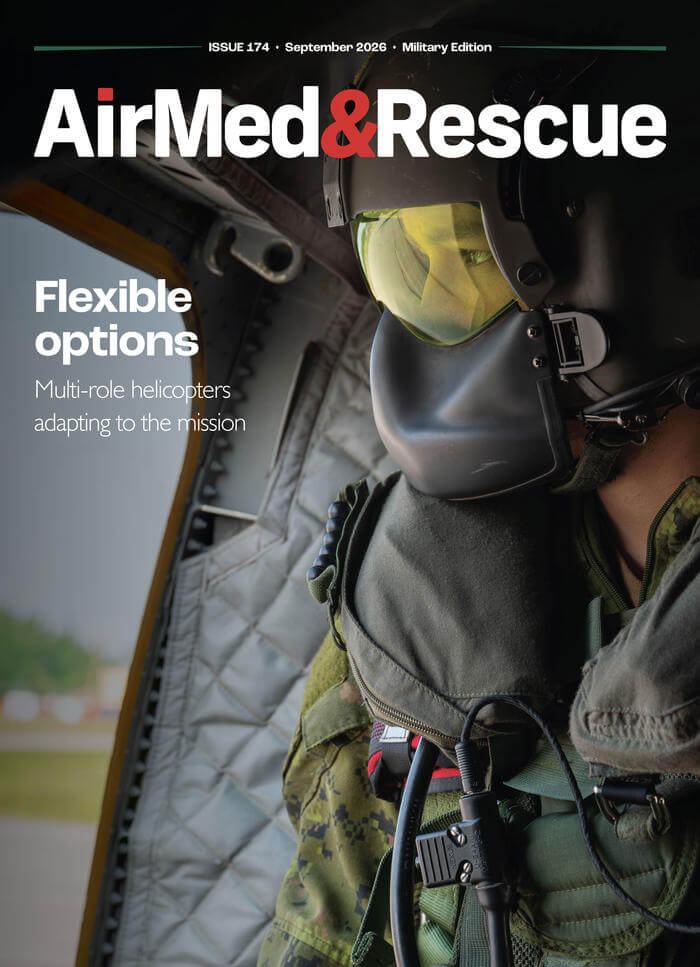
As we reach the equinox, I’m happy that we have an interesting military edition of AirMed&Rescue for you to read on those longer nights. We have features on the benefits of governmental institutions having a multipurpose helicopter; why military operators are at the forefront of exploring optionally piloted aircraft; how uncrewed aerial vehicles are serving as platforms for sensors that can operate in extreme situations; and on the equipment that is essential to carry on board an emergency medical services aircraft.
Mandy Langfield
Mandy Langfield is a Director of Palladium Media Partners and former Publishing Director at Voyageur Group. She has written extensively on international travel and health insurance, medical assistance provision, and air medical transportation. She was Editor of AirMed&Rescue from December 2017 until April 2021. Her favourite helicopter is the Chinook, having grown up near an RAF training ground.