
Interview: Investing in New Zealand

Paul Baxter, CEO of Search & Rescue Services, tells Mandy Langfield about his work and the unique environment and challenges that face search and rescue operations in New Zealand
The introduction of the Airbus H145 D3 fleet is being positioned as a major step in capability. From your perspective, what operational gaps were you most trying to address with this procurement?
Our fleet replacement program is fundamentally about modernization and standardization. We currently operate what we understand to be the oldest and highest-hour BK117 in the world – serial number 7005, the first production airframe off the line, with more than 20,400 hours. While it is much loved by our pilots and crew, it is well past time to move to aircraft that are two or three generations more evolved, with significantly improved safety features and performance.
We are increasingly transitioning from a largely visual flight rules (VFR) operation to one with instrument flight rules (IFR) capability, and the H145 D3 offers avionics integration we simply do not have across our current fleet. Standardizing around the H145 across all eight of our bases also gives us greater flexibility in deploying aircrew and paramedics to maintain 24/7 operations, and simplifies training, maintenance, and logistics across the network.
New Zealand has one of the most geographically challenging environments for air ambulance operations. Where do you still see the biggest limitations in terms of reach, response time, or clinical capability despite this investment?
Offshore missions remain one of our most significant challenges. New Zealand has a vast coastline and extensive maritime rescue responsibilities, and those operations continue to test our endurance, planning, and coordination. Across the wider network of our partner providers this capability is getting better all the time, and the H145 D3 across all of our bases will give the national Rescue Coordination Centre more options when tasking these missions.
Our new aircraft have excellent tools for IFR flight; however, New Zealand’s supporting IFR infrastructure – low-level routes and navigation aids – is still slow in development. We will continue to rely on VFR flight and night vision capability for a significant proportion of our workload for some time yet.
In terms of clinical capability, I am very proud of where we sit. Our critical care paramedics are at the top of their game and well integrated into the New Zealand health system. The clinical side is not the gap – the gaps are in the broader infrastructure and systems that support air ambulance operations.
Much has been made of the aircraft’s IFR capability. In practical terms, how significantly does this change mission decision-making in poor weather, and what safeguards are in place to avoid over-reliance on technology in marginal conditions?
We are taking an intentionally cautious approach. Introducing a new aircraft type demands consolidated VFR proficiency, robust standard operating procedures, and elevated supervision before we extend into IFR operations.
Crew competency is the primary [restrictive factor]. While many of our pilots hold IFR ratings and have substantial experience, IFR duties will only be assigned after demonstrated currency in type-specific procedures, avionics and automation integration, and abnormal and emergency profiles – trained and tested in both the simulator and the aircraft.
Our Flight Operations Manager retains tactical control of mission assignment, aligning crew pairings, weather minima, and routing with current proficiency and recent experience. Internal weather minima will be tighter during the initial phase, and IFR capability will expand progressively on a pilot-by-pilot basis following a deliberate crawl-walk-run approach.
Risk controls include enhanced pre-flight risk assessments, targeted scenario-based simulator sessions, supervisory oversight, and structured post-flight debriefs feeding directly into individual pilot authorizations. We will publish clear transition criteria for each step – training complete, checks passed, recency met, stable reliability metrics – so expansion is performance-based, not schedule-driven.
Safety comes first. We will scale IFR operations when the evidence – our people, our procedures, and our aircraft data – shows we are ready, not before.
Government funding has supported fleet renewal across the sector, including recent allocations of NZ$14.7 million (US$8.6 million) and NZ$12.6 million. Do you feel this level of investment is sufficient and sustainable given rising demand and operating costs, or is there still a structural funding gap?
The funding boost is significant and very much welcomed. It demonstrates the government’s commitment to rotary-wing air medical services as a key component of the healthcare system. We will replace our entire fleet within the next couple of years as a result, and that is not insignificant.
It demonstrates the government’s commitment to rotary-wing air medical services as a key component of the healthcare system
The challenge for us, operating down this end of the world, is the ever-increasing cost of parts and the supply chain pressures the entire global helicopter industry is facing. These realities don’t disappear with a one-off capital injection, and they require ongoing attention to ensure the gains from fleet renewal are sustained over the long term.
To what extent does fleet modernization solve the issue of an aging national air ambulance system, and where are the risks that infrastructure, staffing, or hospital integration may lag behind aircraft capability?
Fleet modernization is a critical part of the picture, but not the whole picture. We are encouraged that investment is also flowing into supporting infrastructure – regional and rural helipads, for example – and the Aeromedical Commissioning Programme championed by Health New Zealand | Te Whatu Ora has identified infrastructure and system integration as key themes for targeted improvement over time.
Our recently opened Centre of Excellence in Taupō is another example of investment beyond the aircraft. It houses our H145 flight simulator, high-fidelity clinical simulation capability, and dedicated training spaces, and is central to how we prepare and equip our crews. With demand for air ambulance services up 22% in five years, this kind of wraparound investment in people, training, and infrastructure is just as important as the aircraft themselves.
Search & Rescue Services has also invested in a new H145 simulator at its Taupō training center. How is that changing pilot and critical care paramedic training in practice, and what measurable benefits are you hoping to see in safety or readiness?
The Entrol H145 simulator is new to us but already central to our fleet introduction and IFR development. It is proving its worth quickly and seeing excellent uptake.
It provides a cost-effective resource for training emergency procedures and aircraft functionality that simply cannot be safely or consistently replicated in the actual aircraft. Crews can experience realistic scenarios, repeat them, debrief, and improve in a controlled environment.
The simulator was acquired with a mixed reality hoist operator module, giving the full crew – pilots, aircrew officers, and paramedics – an immersive capability to train hoisting scenarios together. This advances the non-technical skills critical in a crew resource management context.
The simulator was acquired with a mixed reality hoist operator module, giving the full crew – pilots, aircrew officers, and paramedics – an immersive capability to train hoisting scenarios together
Our Centre of Excellence also houses a high-fidelity Laerdal clinical simulator, supported by technology that enables sessions to be managed, recorded, assessed, and delivered remotely across our eight-base network. This means we can support ongoing clinical skills training in all of our locations, regardless of how remote they are.

Across the sector, there is increasing scrutiny on workforce availability – particularly pilots and critical care clinicians. How acute is that pressure in New Zealand’s helicopter emergency medical services (HEMS) environment, and does new technology help attract or retain staff?
We are not currently experiencing difficulty attracting pilots, and retention is strong. I believe this is partly because the industry knows we are investing in new fleet and supporting infrastructure – people want to work with modern aircraft and in organizations that are clearly investing in their future.
Where we face challenges is finding suitably qualified and experienced critical care paramedics for some of our more remote locations. We are hopeful our investment in clinical simulation will help here
Where we face challenges is finding suitably qualified and experienced critical care paramedics for some of our more remote locations. We are hopeful our investment in clinical simulation will help here. Being able to support ongoing skills training across all locations through remote hosting and capture – and to offer that level of professional development even at more isolated bases – should help us attract and retain the right people.
The case for equitable access to emergency air medical care is often cited. In your view, where are the remaining inequities across New Zealand, and what would ‘fully equitable’ access realistically require beyond aircraft investment?
Equitable access sits at the heart of why we do what we do, and it is a challenge that extends well beyond any single organization or investment. Achieving it requires a whole-of-system approach – landing infrastructure, clinical integration with hospitals and primary care, reliable dispatch protocols, and continued development of IFR capability and supporting navigation infrastructure so that weather is less of a barrier to reaching patients.
We are focused on the areas within our control – expanding our fleet, building IFR capability, investing in training, and ensuring our crews are the best prepared they can be. We are encouraged by the broader system-level work being led by Health New Zealand | Te Whatu Ora through the Aeromedical Commissioning Programme, which is taking a coordinated approach to identifying and addressing the gaps that remain.

How do you balance the need for standardization around a single airframe type with the operational risks of dependency on one manufacturer, particularly for maintenance, parts supply, and long-term resilience?
Standardization around a single airframe gives us maximum flexibility in deploying aircrew and paramedics to maintain 24/7 operations across eight bases. The training, logistical, and operational efficiencies are substantial.
Parts supply is a global issue we are watching carefully – the entire industry is facing these pressures, not just one manufacturer. The risks can be mitigated through power-by-the-hour and service-by-the-hour arrangements, good use of warranty periods, and the fact that original equipment manufacturers (OEMs) understand and prioritize HEMS operations, especially in aircraft-on-ground situations.
Beyond that, we are actively exploring parts availability agreements, parts holdings, and investing in inventory ourselves in close partnership with the OEM. It is about building resilience into the system, not relying on a single supply chain.
We are actively exploring parts availability agreements, parts holdings, and investing in inventory ourselves in close partnership with the OEM
New Zealand’s terrain and weather extremes are frequently referenced as justification for advanced capability. Can you share examples where those conditions continue to push crews and aircraft to their limits, even with newer platforms?
New Zealand’s combination of steep, closely spaced mountains, narrow valleys, rugged coastlines, and vast remote areas creates a uniquely unforgiving operating environment. Weather is highly variable and fast-changing – strong winds, turbulence, low cloud, and winter freezing levels that often sit near practical operating altitudes. Sparse ground-based observations in remote regions, night operations over unlit terrain, and limited diversion options all increase uncertainty and crew workload.
Even with modern avionics, helicopter terrain awareness and warning systems, night vision capability, and improved performance, helicopters remain constrained by physics. Icing exposure, confined-area power margins, and endurance limits compress safety buffers quickly. These factors demand conservative decision-making, higher internal weather minima, meticulous fuel and escape planning, and elevated supervision – regardless of how capable the aircraft is. The environment does not change just because the platform has improved, and our crews understand that better than anyone.
Looking at the broader ecosystem, where do you see the biggest bottlenecks today – dispatch, landing site availability, hospital handover, or interagency coordination?
There are opportunities for improvement across several of these areas, and they are interconnected. Dispatch is one area where the system can continue to evolve. Record-high ambulance call volumes, changing clinical thresholds, and variable scene intelligence all contribute to inconsistency in how helicopter resources are tasked. As demand grows, ensuring dispatch criteria are transparent, clinically robust, and consistently applied will be important to making the best use of the capability that now exists.
Landing site infrastructure is also a factor, and we are encouraged to see investment flowing into regional and rural helipads
Landing site infrastructure is also a factor, and we are encouraged to see investment flowing into regional and rural helipads. The Aeromedical Commissioning Programme led by Health New Zealand | Te Whatu Ora has identified infrastructure as a key area for targeted improvement. These are complex, multi-agency challenges, and progress requires sustained collaboration across the whole system.
Finally, what would you point to as the most meaningful indicator over the next three to five years that this investment has genuinely improved patient outcomes, rather than just fleet modernization on paper?
One of the most tangible indicators we are tracking is our ‘mission declined due to weather’ metric. As our IFR capability expands, this should mean patients whose conditions warrant air transport, but who previously could not be reached due to weather, will benefit directly.
Anecdotal evidence from our crews is already showing that missions which would not have been contemplated in our legacy fleet are now being undertaken, as crews have increased confidence in the H145’s capabilities. Over time, translating that into measurable reductions in weather-related mission declines – and connecting that to patient outcomes – will be the clearest evidence that this investment is making a real difference for the patients and communities we serve.
September 2026
Issue
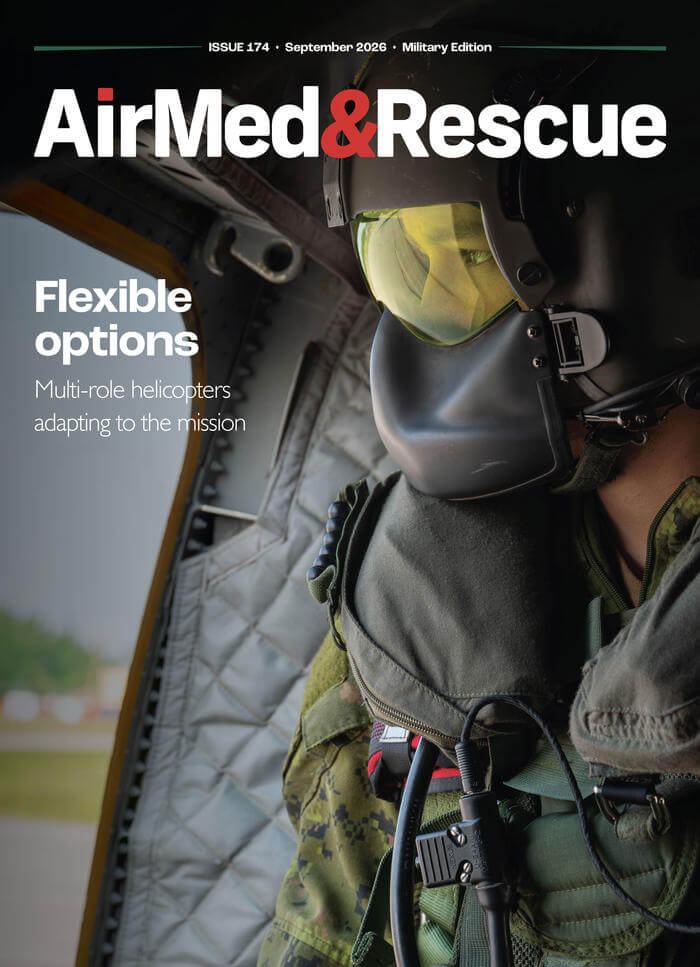
As we reach the equinox, I’m happy that we have an interesting military edition of AirMed&Rescue for you to read on those longer nights. We have features on the benefits of governmental institutions having a multipurpose helicopter; why military operators are at the forefront of exploring optionally piloted aircraft; how uncrewed aerial vehicles are serving as platforms for sensors that can operate in extreme situations; and on the equipment that is essential to carry on board an emergency medical services aircraft.
Mandy Langfield
Mandy Langfield is a Director of Palladium Media Partners and former Publishing Director at Voyageur Group. She has written extensively on international travel and health insurance, medical assistance provision, and air medical transportation. She was Editor of AirMed&Rescue from December 2017 until April 2021. Her favourite helicopter is the Chinook, having grown up near an RAF training ground.