

Interview: Supporting safety from every angle

Chris Baur, CEO of Hughes Aerospace and Industry Co-Chair, US Helicopter Safety Team (USHST), speaks to Mandy Langfield about the aims of the organization over the coming year
Your background in aviation covers a gamut of operational sectors, from the US Air Force to the Coast Guard, law enforcement and civilian airlines. Could you tell us a bit about your career progression over the years?
I started flying airplanes in college in 1979 and helicopters in the US Army in 1983. The Coast Guard years brought me into the search and rescue community, which I continued with the Air Force (Air National Guard and Reserve) until retiring from the military after 26 years. During the Coast Guard period, I was also flying corporate and charter flights in the New York City area during my days off; during my tenure with the US Air Force, my civilian job was serving as Pilot and Criminal Investigator for the US Customs Service (legacy Department of the Treasury). I was flying a variety of law enforcement missions in airplanes and helicopters, resulting in numerous seizures and arrests.
During this time, I experienced an amazing life of non-stop adventures that could fill several books; however, even endless adventures, which included chasing criminals, surveillances, dining from vending machines and sleeping in chairs, can become routine. Hence it was time for new challenges. I left US Customs and became an airline pilot, almost 30 years ago, starting out on the Boeing 727, enjoying most of my career as a Captain, serving as a Test Pilot, Air Line Pilots Association (ALPA) Committee Chairman, Technical Pilot, Instructor and Federal Aviation Administration (FAA) Check Pilot, flying the MD-80, Boeing 737, 757/767, 777 and 787 Dreamliner.
I am also the CEO of Hughes Aerospace Corporation, one of the largest independent Air Navigation Service Providers (ANSPs) in the world, developing, implementing and maintaining instrument flight procedures, for airports, heliports, airlines, air ambulance operators, advanced air mobility (AAM), and the military. In March 2023, I assumed the role of Industry Co-Chair for the USHST. Aside from airliners, I currently fly the Robinson R66 helicopter and the TBM turboprop.
For those who may not know, could you explain what the USHST does?
The USHST vision is a helicopter community without fatal accidents. It is a collaborative effort between government and industry, working together for the safety of our community. We have many programs, each with a unique focus.
- We develop helicopter safety presentations in collaboration with the FAA’s Rotorcraft Collective
- We have a channel on YouTube
- We deliver webinars with the FAA Safety Team (FAAST), providing both education and FAA WINGS credit
- Quarterly e-newsletter
- Helicopter Safety Enhancements or H-SEs. These are essentially white papers, well researched and published, with data-driven targeting of accident data
- USHST web page – a terrific communications hub and repository resources, always available
- Merchandise store – the USHST Foundation is a non-profit organization that offers USHST-branded high-quality merchandise for purchase, ranging from clothing to a limited-edition silver challenge coin. All proceeds are to support USHST safety programs
- USHST Foundation’s Helicopter Peer Pilot Mental Health Program – the industry’s first independent peer pilot program dedicated to helicopter pilots
- Advocacy for safety-enhancing programs such as weather cameras, accessibility to airspace, improved automation, and best practices.
The mental health of aviators continues to be an important topic of concern and conversation in our community. What is the USHST doing to try and enhance support for pilots – especially those in helicopter emergency medical services (HEMS), search and rescue (SAR) and aerial firefighting, who may see and experience traumatic events as part of their daily shifts?
Mental health has unfortunately been an elephant in the room for too long. If you fly, you will encounter turbulence, whether it’s in the aircraft or just navigating life. Strategically and tactically, pilots can prepare [for] and mitigate the effects of turbulence, including PIREPS to assist fellow pilots. The USHST Foundation’s Peer Pilot Program is the first independent peer pilot mental health program specifically for helicopter pilots in our industry. This program is a safe place, free of charge, free of judgement, and in the company of peers. Completely confidential, participation in this program does not involve your employer, the FAA or your medical.
Mental health has unfortunately been an elephant in the room for too long. If you fly, you will encounter turbulence, whether it’s in the aircraft or just navigating life
The program consists of a three-tiered approach, consisting of a web-based portal, the Resilience Hub, peer pilot counselors, and an experienced aviation-dedicated psychologist. The Resilience Hub is a private, self-help platform, where pilots can research mental health issues, increase self-awareness and discovery. They can also be connected with a trained peer pilot counselor, who can listen and provide directions if desired. When warranted, pilots can be connected with the program’s psychologist for clinical help. The USHST is dedicated to the prevention of accidents and incidents, and when it comes to mental health for helicopter pilots, you don’t need to go it alone.

The average fatal accident rate per 100,000 flight hours has fallen recently: from 2019–23 it was 0.69, and between 2020 and 2024 it dropped to 0.62. Marginal perhaps, but important that the trend is positive. What do you think have been the main drivers behind this drop?
The USHST’s Lee Roskop, FAA Aviation Safety Coordinator (Rotorcraft), has compiled this end-of-year accident data. While the trend is positive, we still have much work to do.
US fiscal year 2025 (FY25) summary so far (Oct–Dec 2024)
FY25 totals: 17 accidents, five fatal accidents, 12 fatalities
Accidents (includes both fatal and non-fatal accidents):
The FY25 estimated accident rate for Oct–Dec was 2.51 per 100,000 hours (30% lower than the same period in FY24 and 30% lower than the five-year average for the same period).
Fatal accidents:
The FY25 estimated fatal accident rate for Oct–Dec was 0.74 per 100,000 hours (24% higher than the same period in FY24 and 2% lower than the five-year average for the same period).
Fatalities:
The FY25 estimated fatality rate for Oct–Dec was 1.77 per 100,000 hours (98% higher than the same period in FY24, 28% higher than the five-year average for the same period).
USHST calendar year (CY) metrics
The end of December 2024 marked the end of the USHST’s latest five-year goal period (1 January 2020 – 31 December 2024).
USHST’s 2020–24 goal: Reduce the five-year average fatal accident rate to 0.55 per 100,000 hours by 2025.
USHST’s 2020–24 goal: Reduce the five-year average fatal accident rate to 0.55 per 100,000 hours by 2025.
Based on the FAA’s forecast hours for CY2024, the estimated five-year average fatal accident rate for CYs 2020–24 was 0.62 per 100,000 hours.
The single-year rates per 100,000 hours over the course of the five years progressed as follows:
- 2020: 0.79
- 2021: 0.76
- 2022: 0.58
- 2023: 0.58
- 2024: 0.44.
The CY2024 single-year rate of 0.44 was the lowest for the 25 calendar years on record where flight hours are available and 14% lower than the next lowest rate (0.51 in 2016). The CY2024 rate will be confirmed after the results from the FAA’s General Aviation Survey for 2024 are finalized (expected in late 2025).
For the years used in the final rate calculation, the USHST used helicopter accidents that meet the following criteria:
- US-registered aircraft
- Operating in the US/US territories (includes offshore).
What primary actions are being taken by the USHST to improve access to safety resources for flight crews?
The USHST has many initiatives to improve and enhance safety resources. Hughes Aerospace collaborated with the FAA to create ZK routes, which are low-altitude airways designed for helicopters, reducing the exposure of the aircraft to icing conditions. Hughes has successfully implemented several of these networks, and both Hughes and the USHST have been working with the FAA on adaptation for automation on both ZK routes and COPTER instrument departures. Since they are excluded from the 28 Day National Airspace System Resources (NASR) database, they do not appear in the electronic flight bags. We’ve been working with FAA Flight Standards on a separate repository (database) for these procedures. Hughes has provided their app at cost to USHST members, which includes a bundle of safety tools, access to charts, weather, including weather cameras, fixed radius transition, Federal Aviation Regulations / Aeronautical Information Manual, Helicopter Handbook and an artificial intelligence (AI) search engine: Ask Howard. We are asking the FAA to increase the number of weather cameras in the contiguous USA. Weather cameras have reduced fatal accidents by 80%, according to the FAA. We feel the FAA could also expand the use of the cameras to make ‘go’ decisions in lieu of a costly and not always accurate Automated Weather Observing System (AWOS) stations. The USHST has partnered with the FAA’s Rotorcraft Collective to produce meaningful safety videos discussing current topics. We’ve also produced both podcasts and webinars to reach pilots across multiple platforms.
Hughes has provided their app at cost to USHST members, which includes a bundle of safety tools, access to charts, weather, including weather cameras, fixed radius transition, Federal Aviation Regulations / Aeronautical Information Manual, Helicopter Handbook and an artificial intelligence (AI) search engine: Ask Howard
With a career spanning decades across many sectors of aviation, could you share any particularly memorable moments or flights that have remained with you as ‘teachable’ moments?
First responders and military personnel are unique individuals who are willing to put themselves in harm’s way, serving their community. Pilots and crews who are air ambulance, SAR, firefighters, or law enforcement cannot ‘un-see’ the challenges of their watches, forget the loss of those who could not be saved, or peers that are lost in the line of duty. This bit of burden never quite goes away and I would encourage pilots who recognize the burden, understand you are never alone and have peers who are ready to help.
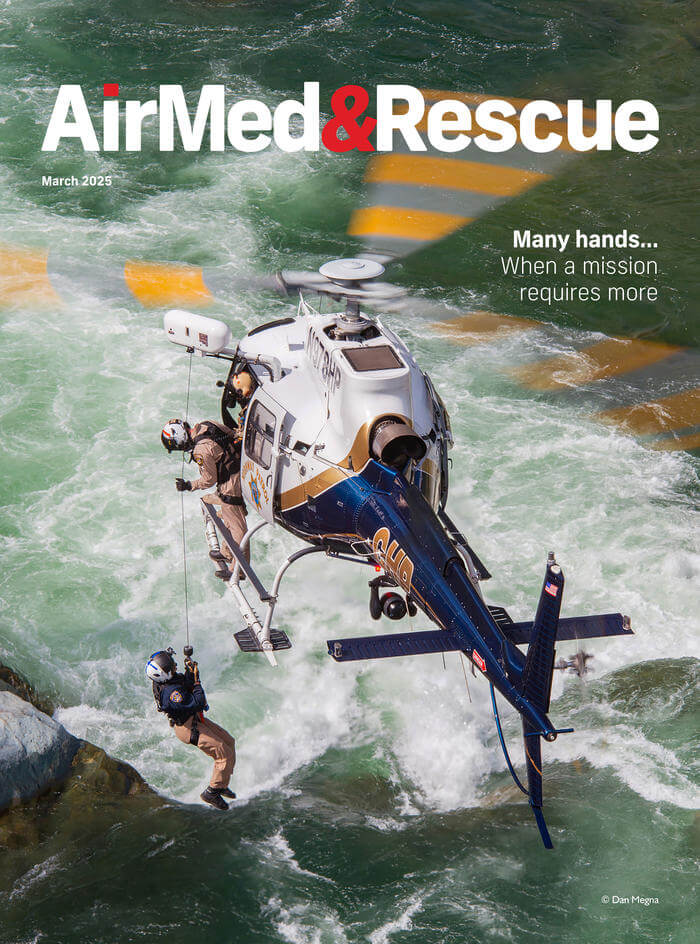
March 2025
Issue
Our March edition has features that let you discover the level of training provided by simulators; learn the ins and outs of medical interiors in aircraft; find out about how health and usage monitoring systems are changing special missions; and see how aerial firefighters communicate and coordinate their missions across multiple agencies and stakeholders; plus more of our regular content.
Mandy Langfield
Mandy Langfield is a Director of Palladium Media Partners and former Publishing Director at Voyageur Group. She has written extensively on international travel and health insurance, medical assistance provision, and air medical transportation. She was Editor of AirMed&Rescue from December 2017 until April 2021. Her favourite helicopter is the Chinook, having grown up near an RAF training ground.