
Interview: Leading from the front line

Mandy Langfield speaks to Stephanie Suzadail, Air Methods Flight Nurse with TriState CareFlight, about how her continued successes have been driven by a strong determination and an adoption of the modern tools at her fingertips
You’ve built a multifaceted career in medicine – could you walk us through the key milestones in your professional journey that led you into flight nursing and air medical transport?
A great deal of my professional journey really developed from my personal life. I’m going to be honest, I’ve had a great career full of success, but truly, a lot of my professional successes stemmed from personal losses. My entire career started when I was a heartbroken teenager starting in an emergency medical technician (EMT) class at night. Having just went through what felt like at the time the great loss of the love of my life, I sought something to fill the void. Cue night schooling at a community college to learn to be an EMT – where, within the first few weeks, I failed my first major test and was excused from the program.
This failure drove me to buckle down and work harder – a life lesson I carried with me through college, my career, and all my various extracurriculars. I did go on to pass that EMT certification and it was volunteering as an EMT in a firehouse college live-in program that I had my first experience with a flight crew. Until that point, I never considered it – I had read [Janice Hudson’s memoir] Trauma Junkie, but flight nursing seemed so far out of my reach. One night, we landed two helicopters for two critically injured children, and I watched the calm, steady professionalism of a female flight nurse in action. That experience inspired me and showed me what was possible.
My college life was one rife with misfortune, from a vehicle crash resulting in a traumatic brain injury to being flown myself as a patient after being treated for a stroke at 23. I failed many classes, changed my major plenty of times, and survived difficult mental health issues. Perseverance got me through it though.
My professional journey to flight nursing was otherwise typical of most flight nurses: I started in critical care, first intensive care unit (ICU) then emergency room (ER), where I fine-tuned my skills and knowledge. After getting all the requisite trainings, I finally became a young flight nurse!
I started in critical care, first intensive care unit (ICU) then emergency room (ER), where I fine-tuned my skills and knowledge
Among your professional qualifications and certifications, which do you feel have been most critical in preparing you for the unique demands of working in airborne medical missions – and why?
Definitely my Certified Flight Registered Nurse (CFRN) and my state Pre-Hospital Registered Nurse certification – these truly encompassed my care outside the hospital and incorporated collaboration with emergency services as well as operations.
In your experience, what are the biggest safety challenges that flight nurses face compared with more traditional in-hospital nursing roles – and how have you addressed them?
The tunnel vision for sure. On scene calls, hospitals nurses without pre-hospital experience may overlook larger dangers such as traffic, crowd control, environmental concerns like heat or cold, or just not know how to work with first responders themselves. When I was an in-hospital nurse, I had bright lights, climate control, space, and plenty of extra hands when things went to hell. I had resources if I couldn’t get an IV or had a combative patient. Once you get to the field, your priorities shift to ensuring safety first and great patient care second. The final hardest lesson was ‘good enough’ had to be good enough – any line I could get had to do because I didn’t have the time to get the best line. My IV lines were perfectly labeled and, more times than not, my wires were tangled. I had to let go of my Type A instincts and learn to embrace a Type B+ mindset.

Training is vital in high-risk environments. How do you assess whether a flight nurse is truly ready for the rigors of air medical transport, and what training gaps do you perceive still exist industry-wide?
Every flight clinician is different, so ‘ready’ is subjective to the person and, honestly, the service. Where I fly, we have few resources, extreme heat, confined cabin space in our rotor wing, and long transport legs. As a result, we need to have good situational awareness, prioritization, and endurance. Where I used to fly, sometimes the longest flight was half an hour, with many only being 15–20 minutes in developed areas.
For that reason, training in as close as [possible to] your actual environment is vital. Spending more time in areas where you have no experience is even more important. That and a constant drive to stay up to date with changes in our practice. Flight medicine is hard to get into but even harder to stay in – training is perpetual because change is inevitable.
Training in as close as possible to your actual environment is vital
Given how dynamic and unpredictable flight medicine can be, how do you stay current with evolving safety standards, regulation changes, and best practices – and what advice would you give to new nurses entering this domain?
At the risk of sounding so millennial, I follow people on social media. Okay, stay with me here – there are a lot of highly educated people out there who enjoy teaching, love to read the newest studies, and are easily accessible with the click of a direct message. These people are your conference speakers, your teachers, and your researchers, and they are right there.
Additionally, spend your job’s educational allowances on conferences, read industry journals, take advantage of those free webinars, and join your associations relevant to your fields.
Many organizations emphasize protocols and checklists for safety. How do you balance structured procedure with the need for rapid judgment calls in-flight – and can you share an example from your own career?
I am a big fan of the book The Checklist Manifesto [by Atul Gawande]. Standardizing care and procedures via checklists cognitively offloads seemingly mundane yet essential things, freeing up your ability to critically think. One such example is our rapid sequence intubation checklist. Intubation is a highly risky procedure in many pre-hospital situations – this list helps set me up for success on a first pass.
Lists also help you create habits over time – inevitably, I know step B will follow step A and so forth. That standardization forms muscle memory over time with the list as a redundancy; let’s be honest, at 2am, some of the wrinkles of my brain have smoothed out and having a resource is a godsend.
Looking ahead, what developments or innovations in flight nurse practice (training, technology, interdisciplinary collaboration, etc.) excite you the most – and how would you like to contribute to them?
One of the developments I'm most excited about is the growing role of artificial intelligence in flight nursing. We're already seeing it make a real impact in our industry. Tools like this help offload some of the mental workload in high-stress environments, allowing me to move faster, stay focused, and prioritize what matters most: delivering safe, efficient patient care. I'm excited to be part of shaping how these technologies are used in a way that supports clinicians without replacing clinical judgment.
I'm excited to be part of shaping how these technologies are used in a way that supports clinicians without replacing clinical judgment
Congratulations on being selected by the Association of Air Medical Services (AAMS) as part of the 40 Under 40 list! What a great recognition to have achieved already. What’s next in your career – where do you see yourself in five years?
I have contemplated education or a leadership position, but, at the end of the day, I believe in leading from the front line and honestly find immense joy and satisfaction from my work right here. I look forward to continuing my other work as a disaster and humanitarian nurse, conducting research with my agency, and continuing to act as a role model and mentor to the next generation of pre-hospital, emergency, and flight clinicians.
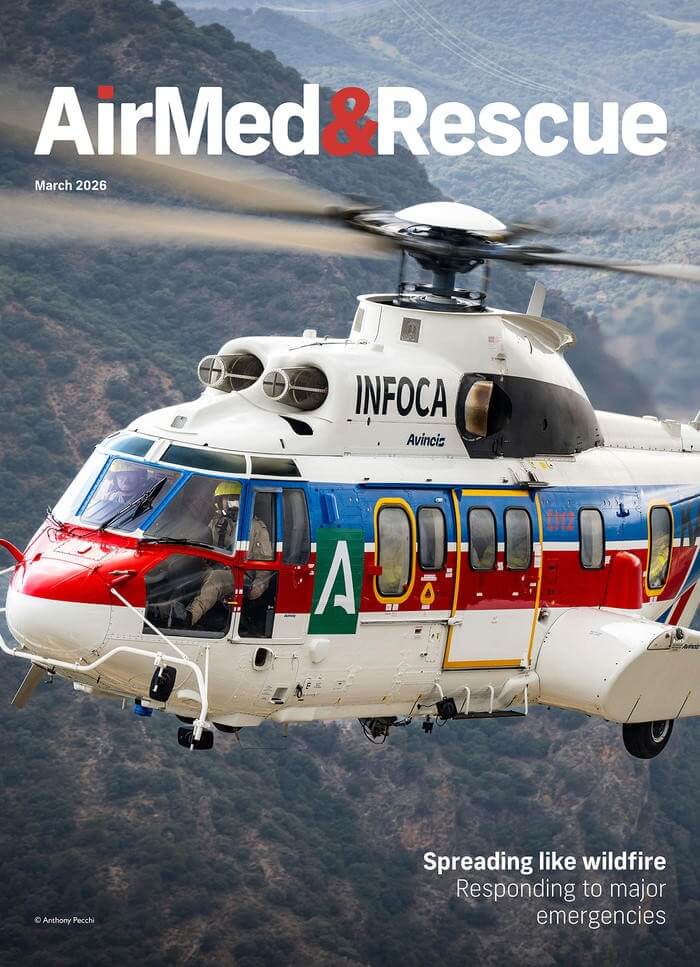
March 2026
Issue
This edition is bursting at the seams with articles from all corners of the special missions sector. We have features on the California wildfires that ravaged the state last year, what the cost–benefit analysis looks like for single-engine rotorcraft and autorotations, how the mission dictates the modification needed to the platform, and what can be done to further prevent the problems associated with inadvertent entry into instrument meteorological conditions.
Mandy Langfield
Mandy Langfield is a Director of Palladium Media Partners and former Publishing Director at Voyageur Group. She has written extensively on international travel and health insurance, medical assistance provision, and air medical transportation. She was Editor of AirMed&Rescue from December 2017 until April 2021. Her favourite helicopter is the Chinook, having grown up near an RAF training ground.