
Interview: Training and experience

Mandy Langfield talks to Cody Berg, Sales Director – Aerospace at Vita Aerospace, and Charley Shimanski, former Director of Training at Air Rescue Systems (ARS), and President of the Air Rescue Commission at the International Commission for Alpine Rescue (ICAR)
Can you share a bit of background information on yourself first – let’s start with what ignited your passion for the emergency services/first responder industry.
Cody Berg: I fell backward into emergency services. When talking to the Navy recruiter many years ago, I mentioned I wanted to fly in helicopters and hunt submarines using sonar. The recruiter, he had the exact job I wanted, but quietly replied, ‘You’ll have to go through rescue swimmer school to do this. Are you a good swimmer?’
I swim like a tugboat: I’ll get to where I’m going, but it’s slow, loud, and inefficient. The [US] Navy aviation rescue swimmer pipeline at the time had a 50–60% attrition from boot camp to joining the fleet, depending on who was quoting the statistics. It was my intense desire to fly in helicopters that fueled my success in rescue swimming. Our first helicopter deployments were four weeks into search and rescue (SAR) school and I’ve been hooked ever since. Fast-forward 24 years later and I still look up when there’s a helicopter flying by because they’re just so damn cool.
Charley Shimanski: In my earliest days of climbing mountains in Colorado, I learned the hard way that bad things can happen, even to those who are experienced and prepared. As I transitioned to professional positions like CEO of the American Alpine Club, I had friends who died in the mountains. Joining the Alpine Rescue Team became my way of giving back to the outdoor community that I love so much. It has been the most rewarding privilege of my life.
What’s your professional experience in the emergency services sector?
Shimanski: Early in my career as a volunteer SAR member, we experienced an aviation-related crash, and a line-of-duty death on my watch as Incident Commander during a search. It became clear that education of rescuers in helicopter rescue was lacking, and I took on the role of Education Director for the Mountain Rescue Association (MRA). We developed the MRA’s online training system, which now has over 11,000 students enrolled worldwide.
Serving as Mountain Rescue Program Coordinator for Flight For Life Colorado – the first hospital-based critical care helicopter program in the country – has given me the opportunity to work alongside critical care aviation professionals who are passionate about their work and embrace the many challenges of flying among Colorado’s 54 mountains taller than 14,000ft (4,250 meters).
I also was privileged to serve as the Executive Vice President for Disaster Services for the American Red Cross in Washington DC. Hurricane Sandy occurred on my watch and I led an amazing team of tens of thousands of Red Cross staff and volunteers who responded to that event. My regular briefings of President Barack Obama and Federal Emergency Management Agency (FEMA) Administrator Craig Fugate taught me the importance of top-down, empathetic leadership of extraordinary people who just want to be the best part of someone’s worst day.
Tell us about your roles at Vita Inclinata?
Shimanski: As Training Director for ARS, I was responsible for new training development, internal safety management systems, and customer outreach and support. I led an amazing team of helicopter rescue specialist instructors who teach and perform at the highest possible level. Our trainings, and the many hundreds of live hoist loads we performed during those trainings, would leave our trainees excited about their new skills in performing complex rescue operations.
Berg: I have three distinct roles at Vita Inclinata. Business development is one, working with organizations to determine their training goals and how our team can help them achieve those goals. Mission, experience, aircraft, equipment, and budget all go into creating a customized and safe training event that challenges operators and meets team training objectives.
I am also the Vita Rescue System (VRS) trainer and support team. When an organization purchases one of our VRS load stabilization systems, I provide the initial training to their operators. In practice, the VRS is very simple to use as we ensured the operation is down to a single-button push to stabilize the litter, basket, or rescue bag – but there is an initial learning curve ensuring it integrates into mission checklists and communications flows, as well as with the equipment the team is using.
We have exceptional instructors who put in tons of cycles in each course. I truly enjoy getting out with the operators who are out there every day doing their best to bring everyone home
Finally, I am privileged to be a part of our ARS training team. We have exceptional instructors who put in tons of cycles in each course. I truly enjoy getting out with the operators who are out there every day doing their best to bring everyone home.

What are the biggest challenges you face in your role, and what are your plans for overcoming these obstacles?
Shimanski: One of the biggest challenges faced was the turnover of customers’ personnel involved in helicopter rescue programs. Keeping a strong and cohesive cadre of pilots, hoist operators, rescue technicians, and medics is difficult enough without turnover, but becomes more challenging when new crewmembers are frequently coming on board. As such, ongoing training for customers becomes even more critical.
Berg: I see two big challenges in my role. The first is presenting new equipment and concepts to folks. New techniques, procedures, and equipment can sometimes be an obstacle to organizations becoming more efficient and safer because ‘new’ can feel too complicated. We have quite a few partners who have shown that doing the ‘new’ hard work and training can result in faster deployments and recoveries, safer hoists and short hauls, and less time spent in a hover in the rescue environment. These improvements don’t happen overnight, but when they do people are amazed by them.
We have quite a few partners who have shown that doing the ‘new’ hard work and training can result in faster deployments and recoveries, safer hoists and short hauls, and less time spent in a hover in the rescue environment
Another challenge is budgets. Military, fire/law enforcement, civilian… we’re all constrained by the dollar bills that make the rotor head spin. I’ve really enjoyed working with folks and finding effective ways to use grants or other public safety-related options to improve readiness and mission capabilities. Aviation and aviation rescue is an expensive world. Efficiency and safety can help keep the price tags down, and efficiency and safety are improved with quality training.
The VRS is enhancing the safety of hoist missions through elimination of spin risk; what sort of training do you offer operators interested in the product, and are you always traveling to demonstrate the product in person?
Berg: We provide training to all those who purchase the VRS and as part of ARS’ different training modules, including short-haul mission training and Fluid-Dynamic Hoist training. We often travel to customer locations to host the training, so that it’s their helicopters and additional equipment we use. This ensures rescue teams are entirely comfortable with using VRS and know how it integrates into their specific systems.
How long does it take to train a new crew on the system, and how customizable is the training program?
Berg: It takes about a day to train the operators. We’ll start with some classroom or hangar time to discuss the system and general functions, along with equipment familiarization. Then we’ll rig an aircraft and system with the rescue device and do some dry runs. Finally, we’ll get in flight and practice approach and departures with the system, use of the system in different environments like water, vertical surface, or confined areas, depending on the missions of the organization. We’ll also discuss emergency procedures and contingency operations.
As mentioned above, the VRS is very simple to use as we ensured the operation is down to a single-button push to stabilize the litter, basket, or rescue bag.
Depending on the organization and its missions, we can change up the training program as needed, as long as the crews have a chance to operate the system and become familiar with it prior to using it for a live mission.

You’ve been working on hook and hoist airframes in different locations and jurisdictions; do you have a favorite airframe on which you’ve worked, and if so, why this one?
Shimanski: Every aircraft is unique in its own way. With Flight For Life, I love our Airbus H125 B3e model because it is built for high-density altitude – a condition that reduces an aircraft’s performance due to low air density, which is common at higher altitudes.
At the same time, I was fortunate to train under the Air Zermatt Bell 429 helicopter, which is a light and fast twin-engine helicopter that meets the demands of the helicopter emergency medical services (HEMS) community quite well.
Berg: There are two. One is a specific tail number, and the other is a Navy airframe.
My first helicopter ride was when I was firefighting in Montana. During work-up training before the fire season started, a Montana Department of Natural Resources and Conservation helo came out for a day of familiarization. It was an old Vietnam surplus Huey, call sign 95 Mike. I understand it’s still flying on fires in Montana. I will always remember that flight because it was the moment I knew I wanted to be in helicopters.
The other frame is the Navy’s SH-60B. I’ve flown in many 60 variants, but the Bravo is my machine. I’ve seen sunrises and sunsets around the world and places many humans would never be able to go. I got to fly and work with truly amazing people who still impact my life. A big part of my 24 years in the Navy was riding in the back of a -60B and I would do it all again, the same way, if I had the chance.
You’re deploying products in multiple jurisdictions now. What regulatory issues has the company had to overcome to ensure the products comply with local regulations?
Shimanski: Each country has its own unique regulatory environment when it comes to the aviation industry and, not surprisingly, the regulations can differ from country to country. In Australia, it is the Civil Aviation Safety Authority (CASA), while the European Union is governed by the European Union Aviation Safety Agency (EASA), the European equivalent of the US Federal Aviation Administration (FAA). Each of these regulators worldwide work hard to ensure product safety, aviation standards, and training requirements are clearly defined and met, and Air Rescue Systems makes certain that it conforms to regulations wherever it provides trainings and equipment.
What do you enjoy most about working in the SAR sector?
Working in the SAR community has brought me countless rewards, but none greater than the privilege of working with the personnel that I engage with on a daily basis
Shimanski: Working in the SAR community has brought me countless rewards, but none greater than the privilege of working with the personnel that I engage with on a daily basis. My colleagues and fellow rescue team and flight program crewmembers are among the best human beings you will ever meet. We focus our work on responding to those who’ve found themselves in an emergency situation they did not expect; those who need support from a highly experienced team of critical thinking professionals who put themselves on the line to save a life. Who could ask for more?
March 2025
Issue
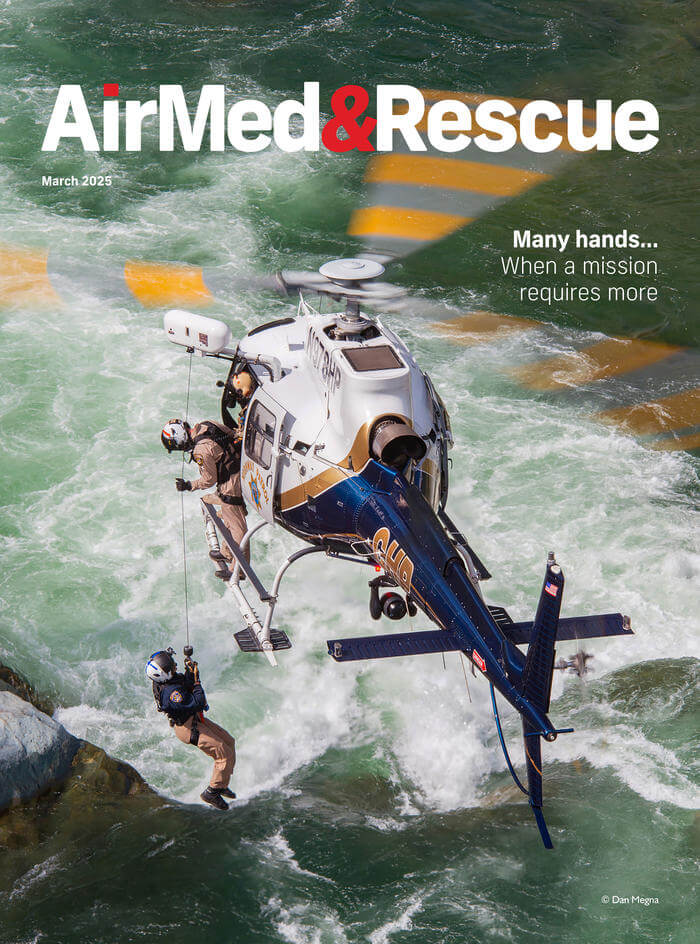
Our March edition has features that let you discover the level of training provided by simulators; learn the ins and outs of medical interiors in aircraft; find out about how health and usage monitoring systems are changing special missions; and see how aerial firefighters communicate and coordinate their missions across multiple agencies and stakeholders; plus more of our regular content.
Mandy Langfield
Mandy Langfield is a Director of Palladium Media Partners and former Publishing Director at Voyageur Group. She has written extensively on international travel and health insurance, medical assistance provision, and air medical transportation. She was Editor of AirMed&Rescue from December 2017 until April 2021. Her favourite helicopter is the Chinook, having grown up near an RAF training ground.