
Interview: From uniformed professional to veteran leader in industry

Former Indian Air Force Officer Wing Commander (Retd) Abhishek Dasari tells Mandy Langfield about his career in the military, the skills needed for the roles he had, and how veterans can transition to civilian life
Reflecting on your career, what were the defining moments that shaped your transition from a Flight Navigator to a Special Missions Combat Systems Operator, and how did each stage enhance your operational effectiveness?
Being posted to 48 Squadron Chandigarh as my first posting after commissioning helped me master tactical navigation in extreme environments on the AN-32 (2,600-plus hours). I specialized in aerial delivery operations across the Himalayan region in various aerial delivery and other transport roles. Subsequently I was posted to 33 Squadron Coimbatore, which maintains a bridge between the Indian mainland and Andaman and Nicobar Islands. Operating legacy Soviet platforms with limited navigation aids, I developed air navigational skills in zero-navigational-aid environments, delivering critical supplies to forward troops where precision was literally a matter of life and death. This built my foundation in high-stakes decision-making under resource constraints.
My second defining moment was as a result of consistent mission excellence leading to selection for C-130J special operations. My performance across both squadrons and ultimately [the] grace of my Lord Jesus Christ helped me earn a spot for the elite Special Operations Squadron. This transition represented a career inflection point, moving from routine transport to strategic special and tactical missions capability.
Starting from ‘ground zero’ on this American platform [the C-130J], I quickly mastered mission computers, digital flight planning systems, and integrated avionics – contrasting sharply with the AN-32’s manual pencil-and-paper methodology. This helped me gain dual proficiency across legacy and modern philosophies, enabling seamless platform transitions and mission versatility.
This dual capability directly translates to modern aviation operations, requiring both tactical judgment and advanced technology integration.
In your experience flying and managing missions on platforms such as the C-130J, what are the unique challenges and best practices associated with airborne special operations versus conventional transport sorties?
Regarding unique challenges, the greatest danger of automation in [the] cockpit is lack of understanding of what and how automation is happening. One needs to fully understand the systems before you touch the aircraft or enter into cockpit; there is no room for trial and error, unlike in the conventional transport aircraft. Do not completely trust the automation; that is why we are there, to oversee the automation and see whether the present automation fits the logic for [the] current scenario. Secondly, all computers work on the principle of ‘garbage in, garbage out’. To make the computer behave in a manner to achieve [the] desired result, one must know what to input in the computer accurately. Things as simple as entering wrong numerals or alphabets while inputting coordinates can result in catastrophes.
For best practices, you plan the entire mission on a Joint Mission Planning System a day prior and you verify that on an emulator and then a full motion simulator; such preparation instills confidence in the crew. For longer missions, like 10–12 hours, there is a provision for extra crew resting. This enables longer station time for any specialized mission. Also, the debriefings of the missions use [an] onboard mission recording and playback system, which helps you go through entire mission once again, the mistakes and good things that we did; it enhances learning. This is religiously followed for all special missions.
The debriefings of the missions use an onboard mission recording and playback system, which helps you go through entire mission once again, the mistakes and good things that we did; it enhances learning. This is religiously followed for all special missions
Crew resource management (CRM) is critical in high-stress missions. What specific CRM lessons learned from special missions environments would you recommend to both aircrew and associated medical or support personnel?
Yes, indeed, a high CRM is the bedrock for any mission on board the C-130J or, for that matter, any multi-crew cockpit while executing missions: it defines the success or failure of any mission and cannot be overemphasized.
A few CRM lessons that I would strongly advocate for aircrew and associated and medical/support personnel are:
- ‘Sterile cockpit’ and ‘business only communication’ during high-tempo moments
- Do not hesitate to voice your opinion; it may sound silly to you, [but] if you think it’s important, then say it
- Don’t be ashamed to announce you are disoriented; at times our perceived ego may prevent [us] from doing so
- Back up other crew, especially to instill confidence in each other that everyone is doing their job
- While you could be on a critical lifesaving mission, keep your wits about yourself; do not let emotions supersede your critical judgment of the situation, such as inclement weather [or] critical unserviceability on board
- The captain must assign individual duties to everyone in critical stages of flight; however, these must also be overlapping with each other to ensure [the] right supervision and compliance.
How did real-time intelligence, surveillance, and reconnaissance (ISR) and electro-optical and infrared (EO/IR) sensor operations influence in-flight decision-making, and what strategies do you consider essential for optimizing in-mission data interpretation?
One important aspect of CRM is using all resources effectively which are available at your disposal; one such resource is [the] EO/IR sensor, particularly during low-visibility operations. These sensors are a great force multiplier and arm you with extraordinary capabilities to look beyond the normal ranges and make a calculated risk, whether it’s in hilly terrains or looking out for a landing zone – it can be critical in a mission go or no-go. All data available to you by any means must be correlated and verified by another source; it could be human experience, binoculars, mapping radar, synthetic aperture radar, or EO/IR. Taking a decision purely based on one source data is not recommended.
All data available to you by any means must be correlated and verified by another source; it could be human experience, binoculars, mapping radar, synthetic aperture radar, or EO/IR. Taking a decision purely based on one source data is not recommended
Training and evaluation are core elements of operational readiness. Can you share insights into your approach for developing training syllabi and preparing crews for the physiological and psychological demands of special missions flying?
Developing training syllabi for special missions flying demands a balance between technical proficiency, systems understanding, and human factors conditioning. My approach begins with identifying mission-specific operational demands – terrain, altitude profiles, threat environments, and mission duration – and translating these into modular training objectives. Each module integrates simulator sessions, real-time mission emulation, and debriefings based on mission playback data. This iterative process ensures that learning is experiential and directly applicable.
To prepare crews for physiological and psychological endurance, I emphasize graded exposure to mission stressors. Training initially focuses on procedural mastery under controlled conditions, and progressively introduces elements like night operations, high-workload phases, or degraded system scenarios. Crewmembers are debriefed not only on technical execution but also on behavioral and cognitive responses under stress.
Physiological conditioning is another cornerstone – fatigue management, nutrition, hydration, and breathing techniques are included during long-duration or high-altitude missions. Psychologically, the training fosters resilience and team interdependence through CRM drills and confidence-building exercises. Every mission, especially under special operations conditions, is a test of both mind and machine – hence, training must develop emotional steadiness as much as tactical skill.

Risk management and safety oversight are inherent to airborne operations. What were your key learnings in managing operational risk under dynamic mission conditions, and how should these inform future doctrine?
Managing operational risk in special-mission flying comes down to three core ideas: anticipate, adapt, and standardize – all while accepting that some missions are inherently high-risk but must still be executed with disciplined control.
Key operational risk learnings:
- Pre-mission risk framing is non-negotiable. Before any special sortie, we treated risk as a structured process: identify hazards (weather, terrain, threats, fatigue), assess severity and probability, then apply layered controls – procedural, technical, and human
- Dynamic in-flight reassessment is essential. Conditions change faster in special operations than in conventional transport; therefore, the crew continuously recalibrates the risk picture, using real-time ISR, ATC inputs, and onboard systems, and is empowered to abort or re-route if the risk-gain balance shifts
- Human factors dominate residual risk. Fatigue, stress, and over-reliance on automation can silently erode safety margins. We mitigated this through strict CRM, clear ‘sterile cockpit’ phases, and mandatory fatigue-aware planning (crew rotation, rest periods, and workload-sharing).
Human factors dominate residual risk. Fatigue, stress, and over-reliance on automation can silently erode safety margins. We mitigated this through strict CRM, clear ‘sterile cockpit’ phases, and mandatory fatigue-aware planning (crew rotation, rest periods, and workload-sharing)
How these should inform future doctrine:
- Embed structured risk-assessment tools into every planning layer, from national/operational down to the flight-crew level, so that risk is quantified, not just ‘felt’
- Formalize time-critical risk-management protocols for airborne special operations platforms, ensuring that even under pressure crews follow a consistent mental checklist (hazard, control, decision, review)
- Integrate physiological and psychological resilience into doctrine, not as an add-on but as a core component of readiness. Training, rest, nutrition, and mental toughness programs should be doctrinally mandated for special missions aircrews.
With evolving threats and technologies, how do you see the role of airborne special missions adapting in the next decade, especially with respect to uncrewed systems and multi-domain integration?
Airborne special missions will remain manned at the core, but they will increasingly act as ‘mission quarterbacks’ for unmanned systems within a fully multi-domain, data-driven battle network.
I see special mission aircraft evolving from pure ‘platforms’ to airborne command and control (C2) and orchestration nodes for swarms of attritable UAVs conducting ISR, stand-in sensing, decoy, and strike tasks.
A single aircrew will increasingly supervise multiple unmanned assets rather than doing all [the] sensing themselves, using AI-enabled mission systems to allocate tasks dynamically and maintain situational awareness at the edge.
Future special missions will be planned and executed inside a persistent multi-domain combat cloud, where air, land, sea, space, and cyber sensors and effectors are fused into a single, shared picture.
The value of a C-130J-class platform will be its ability to plug into joint and coalition networks, ingest and curate data from space and cyber domains, and translate that into precise effects – drops, insertions, fires coordination, or medical support – in contested environments.
Unmanned systems will increasingly push forward into the highest-threat envelopes, allowing manned special mission aircraft to operate from dispersed, sometimes unconventional locations (including sea basing or improvised strips) and focus on coordination, logistics, and recovery.
Doctrine will likely emphasize distributed, low-signature operations with rapid repositioning, where manned–unmanned packages are tailored on short notice to specific tasks, from humanitarian access to precision special operations in anti-access and area denial (A2/AD) environments.
Aircrews will need deeper understanding of autonomy, data links, cyber resilience, and artificial intelligence (AI) decision aids, alongside traditional flying and mission skills, to safely command mixed manned–unmanned packages.
CRM and mission training will therefore expand beyond the cockpit to include remote operators, cyber and space specialists, and joint ground elements, making human–machine teaming and cross-domain coordination a core competency for airborne special missions.
Now that you have retired from active service, how are you leveraging your operational experience in advisory, project management, or cross-domain collaboration roles, and what advice do you have for veterans transitioning to civilian or industry roles?
I plan to use my flying and mission-management background primarily to bring structure, realism, and cross-domain thinking into projects and teams, and I encourage other veterans to do the same by translating, not downplaying, their service experience.
In advisory and project roles, I lean on skills that are second nature from special missions: clear tasking, time-critical decision-making, and running ‘mission cycles’ (plan, brief, execute, debrief) as project rhythms for civilian teams.
Cross-domain coordination from joint operations maps well into working with engineering, business, and customer stakeholders, where I treat each function like a different ‘service’ that must be integrated toward a common objective.
Cross-domain coordination from joint operations maps well into working with engineering, business, and customer stakeholders, where I treat each function like a different ‘service’ that must be integrated toward a common objective
I also try to bring a training and standardization mindset – documented procedures, realistic simulations, and lessons-learned loops – into organizations that may not be used to formal debriefs but benefit greatly from them.
Advice to veterans moving into civilian or industry roles:
- Translate your military roles into outcomes and skills a civilian manager understands: project delivery, people leadership, risk management, logistics, and stakeholder coordination, avoiding service-specific jargon
- Actively build a new professional network through LinkedIn, industry events, and veteran communities; many successful transitions come through relationships and mentorship, not just online applications
- Be deliberate about upskilling and credentialing – short courses or certifications in project management, operations, or your target industry often act as a bridge between your experience and employer expectations
- Finally, give yourself time to adapt your identity from purely ‘uniformed professional’ to ‘veteran leader in industry’; staying open to feedback and being willing to learn civilian norms makes the transition smoother and more rewarding.
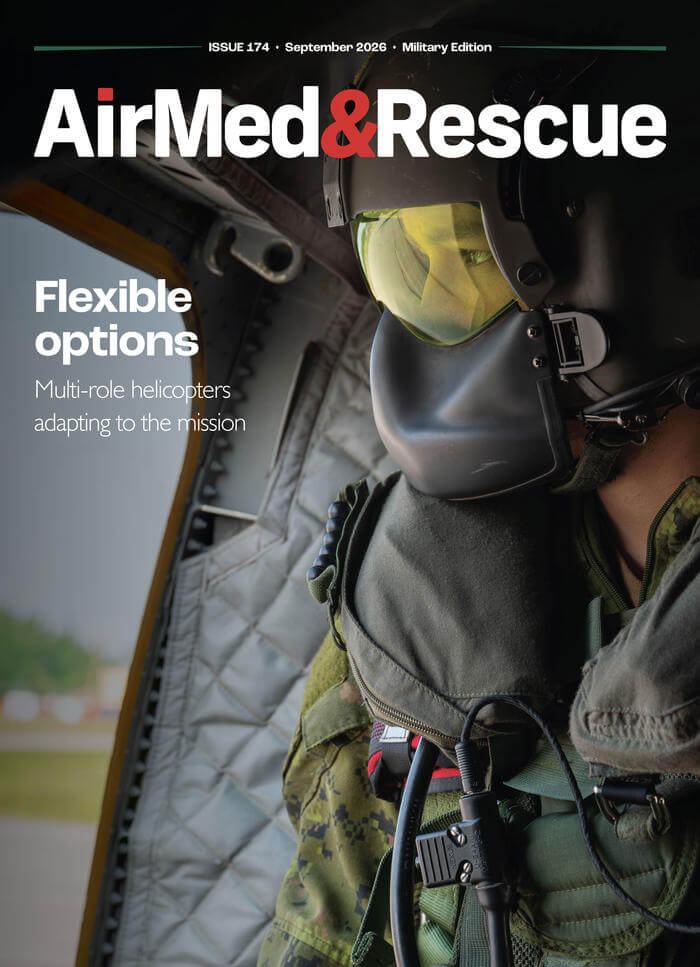
September 2026
Issue
As we reach the equinox, I’m happy that we have an interesting military edition of AirMed&Rescue for you to read on those longer nights. We have features on the benefits of governmental institutions having a multipurpose helicopter; why military operators are at the forefront of exploring optionally piloted aircraft; how uncrewed aerial vehicles are serving as platforms for sensors that can operate in extreme situations; and on the equipment that is essential to carry on board an emergency medical services aircraft.
Mandy Langfield
Mandy Langfield is a Director of Palladium Media Partners and former Publishing Director at Voyageur Group. She has written extensively on international travel and health insurance, medical assistance provision, and air medical transportation. She was Editor of AirMed&Rescue from December 2017 until April 2021. Her favourite helicopter is the Chinook, having grown up near an RAF training ground.