
Mental wellbeing and care for special missions crews

Continual high-stress, time-critical environments where decisions can be a matter of life or death can result in psychological harm, either as a result of a single mission outcome or as attrition over the years. The AirMed&Rescue editorial team explores what challenges face special missions crews, the barriers to care, and the support that exists
Air medical and rescue operations place extraordinary physiological and psychological demands on flight crews. Unlike in commercial or general aviation operations, air medical and rescue missions occur in high-stress, time-critical environments where crewmembers may have to make split-second decisions under fatigue, uncertainty, and emotional strain. The pressure to maintain aircraft availability, respond to urgent calls, and deliver lifesaving care creates a unique occupational context in which mental health and wellbeing directly impact both crew safety and operational capability. Yet historical barriers to mental health care, such as the fear of certification loss, concerns about medical screening, and occupational culture stigma around psychological vulnerability, may create avoidance behaviors that leave crewmembers managing significant stress without professional support.
Air medical and rescue professionals face particular vulnerability: they regularly encounter traumatic situations, operate on compressed schedules, often with limited recovery time, and work in safety-sensitive environments where regulatory scrutiny of medical fitness can possibly limit help-seeking. Recent regulatory evolution and the emergence of structured peer support programs offer practical pathways to address these barriers. Michael Benton, President and CEO of VyClimb Consulting, detailed some of the stressors that special missions crews experience and how this can lead to adverse effects: “Airborne special missions crews often operate in environments that much of aviation never see. The mission profile itself is the first stressor: short notice launches, degraded weather, unimproved landing zones, night operations, and patients or victims encountered on the worst day of their lives. That load is compounded by irregular shift work, circadian disruption, unpredictability of on-call schedules, second victim phenomenon, and likelihood of moral injury, all of which erode the recovery time the body and mind need between exposures.
“Repeated exposure to trauma without a structured way to process it is where the real vulnerability builds. A single difficult mission may be easier to process but a career of them, absorbed without deliberate decompression, is different. Add staffing shortages that push crews toward overtime, internal or external pressure to accept flights that should be turned down, and the result is a population with chronic stress that may not be addressed.
“Excess fatigue and unmanaged stress are adverse mental states, and they are consistently identified as preconditions for unsafe acts across many accident investigation frameworks in use today. A stressed or exhausted crew member is far more susceptible to complacency drift where crews are convinced that today’s shortcut is fine because the last hundred were.”
This article examines the scope of healthcare avoidance behavior among aviation professionals, the psychological and organizational factors driving it, the role of peer support programs as validated interventions, and the potential benefits of integrating mental health considerations into safety management systems.
Physiological and psychological demands
The global aviation industry is experiencing tremendous innovation to promote mental health, wellbeing, and safety, affirmed Major William Hoffman MD, Vice Chair, Mental Health Committee, Aerospace Medical Association (AsMA), and aerospace neurology specialist. “Thanks to the commitment of regulators, industry leaders, operators, labor organizations, researchers, and healthcare professionals, significant progress is being made toward a future that supports both aviation safety and the wellbeing of flight crews,” he said. “Historically, one of the main challenges has been the avoidance of medical care. Several studies conducted in the United States and Canada have reported high rates of delayed or avoided medical care among pilots, often due to concerns about potential repercussions on their medical certification or ratings.”
Pilot healthcare avoidance behavior
Hoffman et al in a 2023 academic paper entitled ‘Multinational comparison study of aircraft pilot healthcare avoidance behaviour’1 present research on American and Canadian pilots and point out that they are required to meet certain medical standards to perform their flying ratings, yet a subgroup exhibits avoidance behaviors for fear of losing their status. This phenomenon can impact pilot health, air medical screening, and aviation safety. The researchers conducted a comparison analysis of data collected from two independent, non-probabilistic, cross-sectional online surveys, which included any individual holding a pilot license: one survey for US pilots and one survey for Canadian pilots. A key finding was that “40% of Canadian pilots reported withholding information during air medical screening, compared to 29% of US pilots. Questionnaires and the medical interview are the primary tools available to screen pilots for relevant health conditions, the effectiveness of which is predicated on truthful disclosure,” Hoffman et al affirmed.
US pilots reported a higher percentage of pilots having sought informal medical care in the past than Canadian pilots (47% versus 32% respectively), a behavior that is not overtly against the rules for some pilots but which could serve as a marker for healthcare-seeking anxiety
Conversely, US pilots reported a higher percentage of pilots having sought informal medical care in the past than Canadian pilots (47% versus 32% respectively), a behavior that is not overtly against the rules for some pilots but which could serve as a marker for healthcare-seeking anxiety, according to Hoffman et al. “An open question is how health policy and delivery might influence pilot healthcare avoidance behavior given the structural differences between the US and Canadian healthcare systems,” they said.
Benton agreed that there was an issue of healthcare avoidance and that the solution can be found culturally: “Healthcare avoidance in our industry is rarely about a lack of resources. It is about the fear that seeking help for a mental health concern will be read as a disqualifying event rather than a responsible choice. Crews have watched colleagues lose flight status or feel sidelined after disclosing a struggle, and the lesson they take from it is to stay quiet.

“A positive safety culture is what changes this, and it works the same way as in operational error reporting. A genuinely just culture distinguishes honest human limitation from reckless behavior, and that distinction must extend to ‘I am not doing well’. An organization that only protects the operational disclosure has built half a safety culture.
“Concretely, that requires confidential peer support programs and employee assistance resources kept structurally separate from the fitness-for-duty and certification decision chain, leadership that talks openly about seeking care instead of treating it as a private failure, and accurate education about what regulators require, as opposed to the myths crews may believe about automatic disqualification. Until seeking help feels as safe as reporting a maintenance discrepancy, avoidance will continue and it will keep costing us good people who needed nothing more than support.”
Mental health protection
While healthcare avoidance behavior due to fear of loss of flying status has a relatively high prevalence, at the same time important solutions are emerging in terms of aviation peer support programs. “Structured programs that offer confidential, nonjudgmental support from specially trained peers while maintaining a focus on safety and operational readiness have become an increasingly important component of aviation safety systems,” affirmed Maj Hoffman. These programs are now mandatory in European aviation and are widely considered best practice. The International Peer Assist Aviation Coalition (IPAAC) provides valuable information on aviation peer support programs and organizes international meetings focused on promoting such initiatives globally.
Regulations are also evolving. “Recent changes made by the Federal Aviation Administration (FAA) regarding pilot access to psychotherapy may help reduce barriers to care for some pilots while maintaining a focus on aviation safety. AsMA has also emphasized the importance of mental health in modern aviation systems and the potential value of integrating mental health considerations into safety management systems (SMS). Many believe these efforts represent an important step toward advancing wellbeing and security for decades to come,” Maj Hoffman said.
Recent changes made by the Federal Aviation Administration (FAA) regarding pilot access to psychotherapy may help reduce barriers to care for some pilots while maintaining a focus on aviation safety
In a 2025 academic article entitled ‘Integrating Mental Health and Wellness into Aviation Safety Management Systems: Current Knowledge and Future Directions’,2 Hoffman et al state that integrating psychological health into SMS could improve safety and wellbeing by addressing system-wide stressors. “Benefits such as earlier intervention, reduced stigma, and stronger safety culture remain to be tested. Advancing this approach requires coordinated work across regulators, operators, clinicians, and safety experts, supported by shared data systems and scalable programs,” they said. “These efforts have the potential to support the health of personnel while also supporting safety in the future global aviation system.”
Another aspect to consider is the difference between the science behind various mental health interventions and the policies and practices surrounding them, according to Hoffman et al in a 2024 academic article entitled ‘Aerospace Medical Association Proposed Research Priorities for Mental Health and Safety in Aviation’.3 “For example, investigating the sensitivity of a mental health screening tool in airline pilots requires different research methods than investigating the optimal application or use of such a tool. These types of questions should be investigated separately and with due consideration of culture, access, and practice,” they stated. Lastly, the depth and complexity of mental health in aviation must be acknowledged. “While the current effort primarily focuses on factors on the level of the individual SSP [safety sensitive personnel], the cumulative systems-level implications are complicated by policy, culture, practice, and access. The scoping of research projects, the selection of outcomes, and the interpretation of results should be considered within this context.”
Safety through support
Healthcare avoidance behavior among aviation professionals – particularly the withholding of information during air medical screening due to fear of certification loss – could exist at high proportions within the population and, where present, represents a significant safety and wellbeing challenge that air medical and rescue operations cannot ignore. When crewmembers manage mental health conditions or psychological stress without professional support, their cognitive performance, decision-making, and resilience deteriorate precisely when those capabilities are most critical. The air medical and rescue environment amplifies these concerns with cumulative exposure to traumatic situations, variable schedules, and the safety-sensitive nature of the work.
When crewmembers manage mental health conditions or psychological stress without professional support, their cognitive performance, decision-making, and resilience deteriorate precisely when those capabilities are most critical
Structured peer support programs have emerged as validated, evidence-based interventions that provide confidential, nonjudgmental support while maintaining focus on safety and operational readiness. For air medical and rescue operations, peer support programs are particularly valuable, offering crewmembers access to confidential support from colleagues who understand the unique occupational stressors they face.
Regulatory evolution – including FAA changes regarding pilot access to psychotherapy – signals a broader shift toward recognizing that mental healthcare access supports rather than compromises aviation safety. Integration of mental health considerations into SMS offers the potential to facilitate earlier intervention and reduce stigma around help-seeking. However, advancing this approach requires coordinated effort across operators, regulators, clinicians, and safety experts, supported by accessible mental health resources and scalable peer support infrastructure.

Support and protection of staff mental wellbeing can be accomplished from a couple of directions, explained Benton: “On the personal side, this starts with treating recovery as a professional discipline rather than a luxury. Protect sleep, build a life and support network outside the base, learn your own early warning signs of chronic stress, and use the debrief and peer support resources that exist rather than waiting until a crisis forces the issue. Asking for help early is a sign of judgment, not weakness, and the best leaders I have worked with model that themselves rather than expecting it only from their crews.
“Systemically, the responsibility sits with leadership, and it needs to be engineered into the organization in the way any other safety risk is engineered. A functioning fatigue risk management system (FRMS) has to do real work rather than just checking a block. Confidential peer support teams and employee assistance programs must be genuinely accessible, and their use actively encouraged. Post-critical incident processes must account for the crews, their families, and the community touched by a bad outcome. Staffing plans need enough depth that coverage does not quietly default to overtime. An organization that protects its people’s mental health protects its margin for good decision-making in the air.”
A functioning fatigue risk management system (FRMS) has to do real work rather than just checking a block. Confidential peer support teams and employee assistance programs must be genuinely accessible, and their use actively encouraged
For air medical and rescue operations, crew wellbeing means operational safety. Organizations that actively promote mental health support, eliminate barriers to care, and integrate psychological health into their safety culture will better sustain crew resilience and ultimately support both personnel wellbeing and the safety of the critical missions air medical and rescue teams perform.
References:
- WR Hoffman, PK Patel, J Aden, et al. Multinational Comparison Study Of Aircraft Pilot Healthcare Avoidance Behaviour. Occup Med (Lond) 2023;73(7):434–438.
- WR Hoffman, R Bor, S Gordon, et al. Integrating Mental Health and Wellness into Aviation Safety Management Systems: Current Knowledge and Future Directions. J Occup Environ Med 2026;68(4):e320–e324.
- WR Hoffman, W Santilhano, A Tvaryanas, et al. Aerospace Medical Association Proposed Research Priorities for Mental Health and Safety in Aviation. Aerosp Med Hum Perform 2024;95(11):845–850.
October 2026
Issue
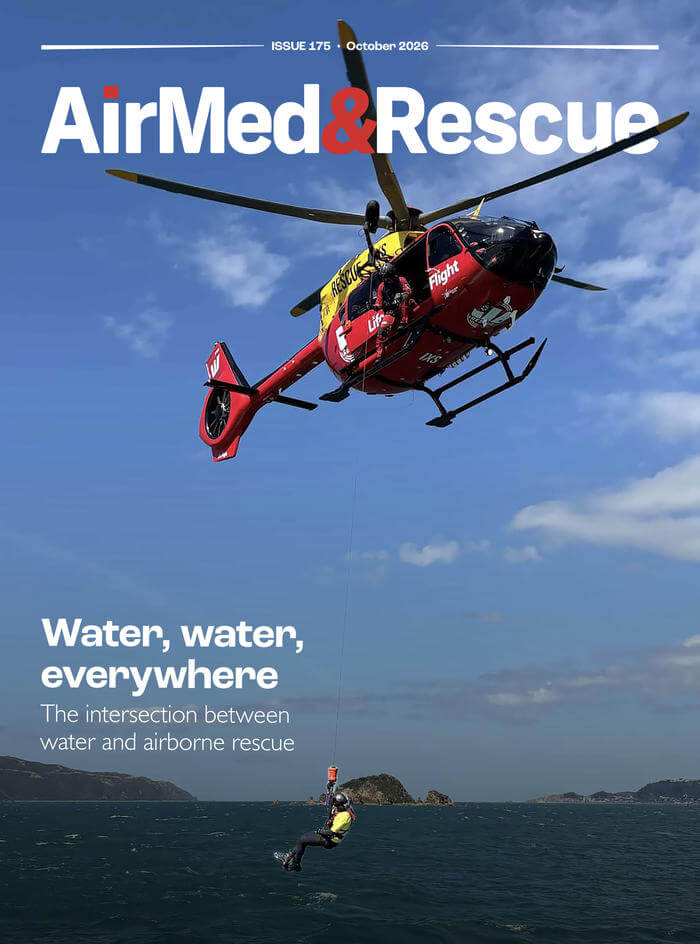
The latest edition of AirMed&Rescue is packed full of content to keep you occupied in October. We have features on the challenges that swiftwater presents when trying to rescue someone; how sensor technology is affecting and improving aerial firefighting missions; why operators choose to have a varied fleet of aircraft to perform special missions; and what can be done to improve the accessibility and awareness of mental health assistance programs for safer and sustainable working conditions.
Editorial Team
The AirMed&Rescue Editorial Team works on the website to ensure timely and relevant news is online every day. With extensive experience and in-depth knowledge of the air medical and air rescue industries, the team is ready to respond to breaking industry news and investigate topics of interest to our readers.