
Military investment in simulation

Amy Gallagher and Jon Adams report on the simulation training options available to military operators, with solutions that can improve training methods from the cockpit to the tail
Instructing the armed forces to conduct special missions by way of flight training, combat medical training, and rear-crew operations training includes simulation as a strong presence. Military organizations require sustained investments and critical assets in modes and applications of simulation training to successfully and safely conduct special missions in combat medical/rescue for multi-crew and rear-crew operations.
To elevate real-time operational readiness 24/7 while fortifying high-level comprehension with direct application of knowledge and skills, military organizations are integrating a matrix of simulation training with virtual reality (VR), augmented reality (AR), mixed reality (MR), extended reality (XR), and/or artificial intelligence (AI) simulation technology while incorporating these technologies into immersive training devices (ITDs).
Generating the synergy in a dynamic and adaptive environment also demands investments in the latest platforms, tools, equipment, and strategic planning while minimizing costs and protecting assets.
At scale
Safety and cost-effectiveness is very important when training large volumes of students with public money. As such, simulators provide an accessible and affordable option for governments to ensure that their pilots and crew get and retain the skills they need to execute their duties. It also provides an efficient use of resources in a climate that is increasingly full of other demands upon the time and energy of servicepeople.
“Simulation minimizes aircraft wear and enables realistic employment of sensors, weapons, and tactics in a controlled environment, without the constraints of airspace restrictions or operational security limitations,” said an FSI Defense representative.
Students can repeat the same operation until it is perfect, without incurring high costs
When balancing budgets, a simulator supplies much more value than training on live flights. Carlota Esteban, Business Manager at Entrol, said: “The benefits of having a simulator in-house are mainly operational and economical. On one hand, you will ensure operational proficiency while keeping a safe environment for training. Pilots can train the very worst situations that could be encountered while flying, something impossible or highly dangerous to be performed in the real aircraft. Plus, students can repeat the same operation until it is perfect, without incurring high costs. [Additionally], the hourly cost of the simulator is way less compared with an aircraft, [where] the fuel, insurance, and downtime of the [aircraft] increase the cost of training.”
Jonas Goercke, Head of Business Line Flight Training at Reiser Simulation and Training, described a digital-twin approach that aligns with the actual helicopters, recreating exact flight and avionics behavior and sensation responses for simulators. Digital twins can let pilots practice risky maneuvers they would avoid in real aircraft. Goercke said: “This allows us to position connected mission trainers as a cybersecurity-aware alternative to live flights.”
The mission and the immersion
Simulators and flight training devices (FTDs) can come in all shapes and sizes, but the ever-increasing sophistication of the emerging technologies is proving that complete immersion in a realistic environment is possible and is the best way for pilots and crew to feel like the training is properly representative of the work they are expected to complete.
Goercke said that it was pilot acceptance that required the high fidelity found in their simulated training experiences: “The simulated training benefit of high-fidelity ‘feel’ for pilot confidence and, ultimately, pilot acceptance must approach about 95% for pilots to accept and train realistically.”
Esteban explained how the correct physical sensations were essential to training in a simulated environment and so they spent a lot of time getting the interfaces between the physical and the virtual worlds correct: “Our FTD certified simulators, for example, consist of a replica of the real cockpit (including all the functional flight controls), a vibration system, our Enwall LED visual system with floor, the instructor station, and a rack of computers.” They added: “When it comes to VR solutions, our approach is clear: we opt for MR instead. We believe that the physical sensations of touching the controls is crucial for pilot training. However, we identify that certain training tasks can be better performed with the VR goggles on (for example, for depth perception). Therefore, our cockpits are fully functional with and without goggles, so that you can put them on for specific tasks during a training session and take them off when needed. In the end, we benefit from both modalities.”
For the technology to be convincing, it takes a lot of work, so Entrol develops the software as well as the hardware to deliver a simulation experience that can ensure that the training is effective: “In our simulators, we have developed our latest image generator: Envision. It is powered by Unreal Engine, and includes a mission package covering search and rescue, helicopter emergency medical services, firefighting, offshore, and law enforcement,” said Esteban.
Versatility and variety
The military mission is not a single task: it encompasses many disciplines, roles, and sectors, whereby all the stakeholders cross over and interact to ensure a successful outcome.
Furthermore, being able to train multiple people at once on a mission they are expected to share makes for a more efficient and realistic exercise than separating each skilled individual into silos. To efficiently manage multiple missions and environments, and multiple training requirements for multiple branches across the world, FSI Defense employs interactive aircrew training that is delivered across all branches of the US military and US Coast Guard, through one network: “Training supports multi-role mission environments for pilots, loadmasters [on the Boeing C-17], boom operators, and flight engineers [for the Boeing
KC-46], as well as gunnery and hoist operations,” said the FSI Defense representative.
To significantly reduce the travel logistics operations of physically transporting troops to a central training center, while conserving time, assets, and resources, FSI Defense simulators are integrated with a distributed mission operations (DMO) network, enabling geographically dispersed personnel to train together in a shared, high-fidelity synthetic environment.
One of our latest developments, the hoist operator station, was precisely developed to satisfy the needs of pilots and hoist operators to train communication
Entrol also designed in the function for rear crew to train with the pilots in the same simulated space, enabling the exercise to account for the human–human interactions that would be found on real missions: “One of our latest developments, the hoist operator station, was precisely developed to satisfy the needs of pilots and hoist operators to train communication,” said Esteban.
This extends beyond operational forces: the maintenance crew are able to benefit from simulation training that also means that an aircraft is not taken out of commission. Goercke explained the company’s dedication to a full-scale NH90 maintenance training replica created for ground-crew training: “Our one-to-one NH90 maintenance training rig is replicated to millimeter detail that permits about 1,500 maintenance tasks without using scarce aircraft.”
He emphasized that the device allows trainees to practice risky or rarely performed maintenance without grounding real aircraft for long recertification periods, and several nations have taken advantage of this to increase safety and aircraft availability.
Goercke explained that there was a shift in training priorities from pure aircraft handling to multi-crew coordination, and claimed that they could offer “everything for the right need”.
Reiser has recently developed a rear-crew training device, called hoistAR, which Goercke described as having a hoist trainer’s physical cable with haptic actuators, adjustable door cutouts for multiple helicopter types, green-screen external visuals, and the value of AR over pure VR for preserving hand visibility and realism.
Similarly, Esteban said, expounding another example of a solution that is clearly in demand from operators: “Our flight simulators replicate the aircraft’s cockpit, so that pilots can train as if they were in the real aircraft. However, with the hoist operator station added, hoist operators can also train key operations, including emergencies that could not be trained otherwise in the aircraft.”
The use of MR helps with this shift. Goercke argued that higher-fidelity MR devices could capture hours of training that would otherwise occur in costly full-flight simulators, improve crew resource management, and better support tasks like hoisting and ground search through immersive depth perception.

Improved learning
Where simulators also enhance the efficiency of training for service personnel is with the instructors. The increasing shortage of pilots and instructors continues to bring new solutions to the forefront. “Instructor shortages serve as one more driver for remote training adoption,” said Goercke.
Instructor shortages serve as one more driver for remote training adoption
Global aviation authorities, such as the European Union Aviation Safety Agency (EASA) and the Federal Aviation Administration (FAA), have approved distance training. The recent regulatory acceptance of distance learning by authorities opens the door to qualified remote type-rating content.
Goercke explained that capturing data during the training was enhancing the teachable moments in the lessons: “Our training management system (TMS; simplAIR) captures interaction data to identify student weak points and target instructor time more efficiently.” Reiser’s signature Avionic Cloud Trainer (ACT) simulating real aircraft cockpit behavior in combination with highly sophisticated learning content supports distance type rating, including H135 and H145 aircraft types. Pilots who train remotely are given the opportunity to familiarize themselves at home / on base while reducing the costs of expensive full-flight simulator hours.
The provision of the most effective and appropriate training package for the right situation and job to support a wide range of missions, including combat search and rescue, special forces operations, aerial refueling, airborne transport, and a variety of tactical flight operations, is mirrored by FSI Defense: “Our training is delivered through a tiered family of devices ranging from full-flight simulators (FFS), procedural training tools (PTT), MR, VR, XR, and desktop trainers (DTT),” said the FSI Defense representative.
Cost–benefit ratio
With the rapid development of synthetic training modalities for pilots, rear crew, airframe and powerplant technicians, and more, governmental organizations are not short of options. The advancement of the technology to include a Level D full-flight simulator or a pure virtual reality device and everything in between allows the armed services to train their personnel in fully immersive scenarios to scale and in a repeatable way to reinforce good behaviors. Additional benefits include the ability to schedule, plan, and deploy these training systems independent of the actual physical artifacts that would otherwise be taken out of commission, essentially making simulation training a force multiplier.
It behooves any organization (large or small) to investigate and learn what options are available for simulation training as this solution is only getting better and more accessible as the technology develops, saving time, money, and resources
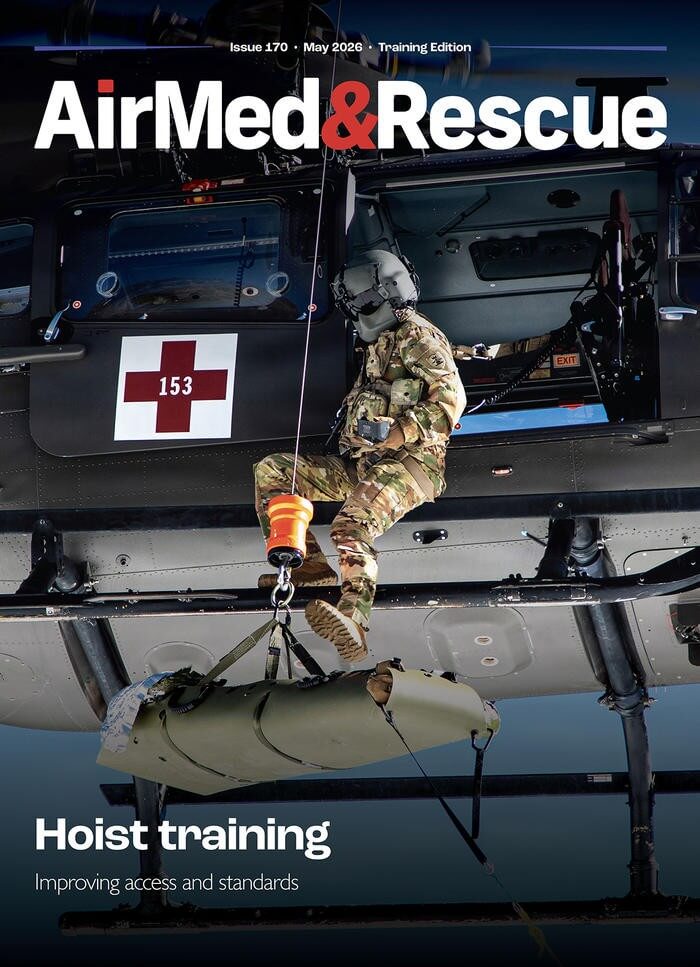
May 2026
Issue
Training for special missions is on another level, so it’s a great pleasure to bring you the training edition of AirMed&Rescue for May. We have features on night flights for police aviators; the simulators for military special missions training; the systems and scenarios for hoist operations; and engineering training for airframe and powerplant mechanics.
Amy Gallagher
Amy Gallagher is an internationally published journalist covering aviation, rescue, medical and military military topics, including training and technology, as well as evidence-based research articles. As a journalist by education and certified English instructor, Amy has worked in both agency and corporate communications, providing educational and promotional writing and training services.
Jon Adams
Jon is the Editor of AirMed&Rescue. He was previously Editor for Clinical Medicine and Future Healthcare Journal at the Royal College of Physicians before coming to AirMed&Rescue in November 2022. His favorite helicopter is the Army Air Corps Lynx that he saw his father fly while growing up on Army bases.