
A new chapter for hoist mission training

With missions becoming more complex and technology more advanced and accessible, operators, training organizations, and simulation specialists share with Lauren Haigh how simulation is reshaping hoist training
Increasingly complex missions, rapid advances in immersive technology, and the integration of simulation as a core training tool are driving the growth of rear-crew hoist simulation. Training programs that were once focused on pilots are now expanding to reflect the critical role of hoist operators for mission success.
“Historically, training concepts and simulation standards were heavily pilot-centric,” explained Tobias Seidl, Founder of 2B-S, which specializes in simulation and training center optimization. “This focus was largely driven by certification structures and regulatory frameworks rather than a lack of recognition of rear-crew importance. Today, operators increasingly acknowledge that hoist operators, winchmen, loadmasters, door gunners, and mission specialists require dedicated, role-specific training solutions, an area where simulation offers clear advantages. A key driver is the growing recognition that rear-crew performance is a decisive safety and mission success factor.”
Indeed, hoist missions are high risk and high stakes, and the need for repeatable and safe training for all crewmembers, not just pilots, is clear. As such, simulation is now becoming a core element of hoist training.
Tech transforming training
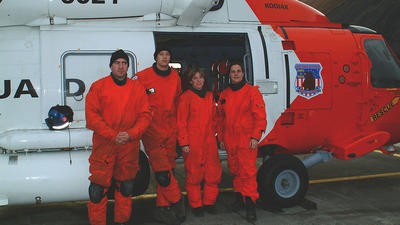
One reason rear-crew simulation has lagged behind pilot training has been the lack of technology able not only to deliver sufficient realism, but to do so at an acceptable cost. Jean-Claude Siew, Executive Vice President of Technology and Simulation at Bluedrop Training & Simulation, explained that this had now changed. “Hoist and rear-crew training was mainly neglected because there was a lack of interest for rear-crew training simulation training and the technology needed was not available. With the advent of virtual reality (VR) and mixed reality (MR), suddenly the level of realism and the cost point made it more interesting for simulation training,” he highlighted. “However, while pilot training was already very developed, it was key to complement VR/MR with high-fidelity haptics for the rear crew. These two technologies together transformed simulation training for rear crew.”
Brad Matheson, President of Priority 1 Air Rescue (P1AR), said that the combination of simulated and live was best suited for modern hoist training: “Since 1999, P1AR has delivered live‑flight search and rescue (SAR) and tactical mission training. In 2011, we expanded our capability by introducing both virtual and physical hoist simulators at our Search and Rescue Tactical Training Academy (SART/TAC) in Mesa, Arizona.
“Our Advanced Aircrew Mission Simulator (AAMS) is a reconfigurable, purpose‑built system designed specifically for rear‑crew mission training. It accurately replicates high‑fidelity cable physics essential for SAR operations with multiple helicopter airframes, an optional cockpit, FLIR and weapon systems, role equipment, mission profiles, and environmental conditions.
“The P1AR hoist procedural towers (HPT) are multi‑aircraft‑reconfigurable systems equipped with actual Breeze‑Eastern and Goodrich single or dual hoists. Students physically configure cabins, deploy and recover rescuers, manage rescue devices under real loads, operate tag lines, and rehearse emergency procedures using authentic equipment, capabilities that cannot be achieved through virtual training alone.”
Mission success hinges on training being designed around the operations that students will be eventually exposed to, said Trevor Abraham, Managing Director of Air Rescue UK: “Mission profiles drive the design of training scenarios, ensuring crews are exposed to the specific environments, risks, and task demands they will face operationally. This alignment builds competence and confidence, directly improving decision-making, coordination, and ultimately mission success.”
Missions determine requirements
For operators, mission demands are the driving force of hoist training requirements. At CHC Helicopter, hoist operations are central to SAR and helicopter emergency medical services (HEMS) missions. “These include maritime and overland rescue, medical recovery where landing is not possible, and emergency response for offshore installations,” explained Peter McDonell, Technical Crewman Global Standards. “Across CHC, the structure of technical crew – whether dedicated or multi-role – varies by region. In Australia, where we use the multi-role model, crews progress from rescue crewmember to hoist operator, building a 360-degree understanding of the mission from both inside and outside the cabin. That shared perspective is a cornerstone of safe, efficient, and well-coordinated hoist operations.” Such operational diversity means that training must be adaptable and scenario-based in order to meet the varied needs of missions.
Training is also shaped by fleets. For example, CHC operates a broad fleet of hoist-equipped aircraft tailored to local mission needs, including the S-92, AW139, AW189, H175, Bell 412, and AS332. This illustrates the variety of platforms and systems that training must accommodate. “While platforms vary by region and mission profile, we maintain consistent safety and training standards across all global operations,” commented McDonell. “We predominantly use electric hoists from Onboard Systems Hoist & Winch. Aircraft are further configured for their specific operating environment. For example, in support of the Australian Department of Defence, we operate AW139s equipped with dual hoists to provide essential redundancy for maritime and remote area missions.” This variability highlights the need for modular systems that are easily adaptable across aircraft types.
Adaptability is key to training provision, allowing operators, whatever they do, to find a solution that fits their missions. “P1AR provides full‑spectrum training across SAR, HEMS, aerial firefighting, aerial use‑of‑force/gunnery, NVIS, and more for commercial, para‑public, and Ministry of Defense customers. Synthetic training can be delivered at our SART/TAC facilities in Mesa, Arizona, or Bordeaux, France; conducted as live‑flight training at the customer’s venue; or delivered in our most popular ‘blended’ format – beginning with synthetic training at SART/TAC and progressing to live‑flight instruction on site. All training begins with Civil Aviation Authority-compliant and approved ground, synthetic, and flight components. During virtual and physical synthetic training, students repeatedly practice high‑risk hoist procedures and emergency scenarios, including hoist failures, cable fouled and shear events, engine failures, power‑loss situations, and night operations. This repetition builds judgment, muscle memory, communication, decision‑making, and crew coordination long before transitioning to the live aircraft,” explained Matheson.
This repetition builds judgment, muscle memory, communication, decision‑making, and crew coordination long before transitioning to the live aircraft

Environmental factors
Simulation is particularly valuable for recreating local operation conditions, enabling crew to experience decision-making in realistic environmental conditions. “In Australia, crews prepare for extreme heat, dust, mountainous terrain, confined areas, dense bushland, and low-visibility, overwater offshore winching operations. Each brings its own workload and environmental challenges,” McDonell noted. “That’s why our approach is grounded in hyper-realistic, environment-driven training. By preparing crews in scenarios that genuinely reflect their local operating conditions, we build adaptability, procedural robustness, and confident decision-making, even when the pressure is high.”
By preparing crews in scenarios that genuinely reflect their local operating conditions, we build adaptability, procedural robustness, and confident decision-making, even when the pressure is high
Special missions and hoist operations are not limited to a single environment, so training has to cater for any and all operations, said Matheson: “P1AR is an active practitioner with extensive experience conducting real air ambulance and SAR emergency response missions, as well as delivering live‑flight training to more than 15,000 students across 28 aircraft types in 40 countries. Our credibility is reflected in the trust placed in us by organizations such as the USCG, which designated P1AR as the Flight Mechanic ‘C’ School, along with US Air Force Global Strike for special missions aviators, the French Ministry of Defense, UK SAR, and others. These operators share inland and offshore mission requirements and, like many agencies we support, rely on us for ab initio through advanced SAR training. By combining virtual and physical synthetic devices with comprehensive courseware and progressive, mission‑relevant TLOs, we deliver a more structured and effective learning pathway for hoist operators. This approach improves student retention and performance – particularly in mastering hoist emergency procedures and advanced inland/offshore scenarios that cannot be safely replicated during live‑flight training.”
A shared commitment
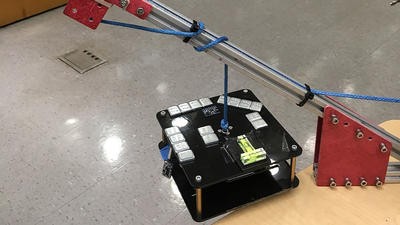
A significant development in hoist simulation is the ability to train multiple crewmembers simultaneously within the same scenario. “Our hoist operator station is designed to perform training for the pilot, co-pilot, and hoist operator at the same time. They all train in the same environment, regardless of the visual they are using,” outlined Carlota Esteban, Business Manager at Entrol. “The success of the session will rely on the proficiency of each member when performing their tasks and their ability to coordinate with each other.”
At CHC, simulation spans the entire technical crew life cycle. “All technical crew roles, including rescue crewmembers (RCMs) and hoist operators, use simulation for initial training and continuation training,” highlighted McDonell. “This is especially valuable because we are one of the few operators in the region open to recruiting RCMs who don’t have prior experience. We can teach skills but what we’re looking for are the attributes that make an exceptional crewmember: teamwork, composure under pressure, strong communication, and a commitment to safety and service.”
The attributes that make an exceptional crewmember: teamwork, composure under pressure, strong communication, and a commitment to safety and service
Seidl noted that this trend applied to the wider industry. “In initial training, simulators are used to build foundational skills and confidence before crews are exposed to live hoist or special mission operations, significantly reducing risk during early training phases. For recurrent training, simulation enables regular practice of abnormal and emergency procedures that are difficult or unsafe to train in live flight but are critical in real operations,” he explained.
Working as a team is a developmental process that benefits from progressive training in stages, explained Matheson: “By first mastering the fundamentals and part‑task hoist procedures, then advancing to full‑crew evolutions with pilots in the AAMS cockpit or rescue specialists in the HPT, and finally progressing into scenario‑based training, hoist operators develop skills and tactics more rapidly. They arrive at live‑flight training significantly more proficient while also reducing overall risk exposure.”
Clear benefits
The key advantages of simulation-based hoist training are repeatability, availability, safety, and cost. “Simulation allows us to build their capability step-by-step,” said McDonell. “New recruits receive early exposure in the aircraft for context, then transition into scenario-based simulation where they can practice, make errors, and build procedural confidence in a psychologically safe environment.” He said that the wet simulator provided a standout example of this. “This trains our Australian crews today and supported our Irish SAR teams during our years of operation there. It replicates sea-state movement, wave patterns, turbulence, environmental noise, and reduced visibility, giving crews realistic exposure to complex hoist-cycle challenges long before they encounter them in an aircraft. It’s a clear demonstration of simulation’s unique strengths: a safe space for error-based learning, confidence building, and procedural discipline without operational risk. It also isn’t dependent on aircraft availability or weather conditions, supporting faster and safer progression.”
Abraham agreed that simulation provides a safe environment to learn among other benefits: “Simulators allow repetition of high-risk or low-frequency scenarios in a safe, controlled environment without the cost and constraints of live flying. They enable immediate feedback, error correction, and exposure to a wider range of conditions than would be practical or safe to replicate live.”
Simulators allow repetition of high-risk or low-frequency scenarios in a safe, controlled environment without the cost and constraints of live flying
Cost efficiency is another key factor. “The hourly cost of the simulator is way more competitive than the one of the real aircraft,” stated Esteban. “The fast ROI of a simulator in-house has been proven by our customers all around the world. Not only does simulator training substitute costly aircraft sessions, it also helps in saving maintenance and operational risk costs while leaving the aircraft ready to fly on real missions.”
Impressive tools
Modern hoist training solutions combine multiple tools, with immersive technologies playing an increasingly important role. Advances in VR, MR, and extended reality (XR) now offer high resolution, low latency, and wide fields of view that were previously not possible. “Human-eye-resolution MR has been the breakthrough,” said TJ Moser, Federal Account Executive at Varjo. “With high-fidelity pass-through, stunning lifelike visuals, and precise tracking, crews can lean out a real cabin door, handle real equipment, and still see a fully simulated sea state, mountain with trees or cliff face. The technology finally matches the visual and spatial demands of hoist work.”
XR is invaluable when it comes to areas that are difficult to train live. “It’s ideal for procedures, communication, crew resource management (CRM), and decision-making under pressure,” Moser said. “It’s particularly valuable for high-risk or low-frequency scenarios that are too dangerous or too expensive to rehearse in the aircraft.”
Siew pointed out that scalability was another key advantage. “XR simulators can have a much smaller footprint than traditional wide-visual systems, making them more transportable and easier to deploy across multiple locations,” he stated.
Tailored training
Despite these widely beneficial advances, there is no one-size-fits-all approach to hoist training. “The goal is not finding the only perfect tool for everyone, but to understand operators’ training needs and adjust to them,” Esteban underlined.
Indeed, its effectiveness depends on programs being tailored to mission profiles, geography, and the composition of crews. McDonell noted: “Geography and climate heavily shape our training programs. Our crews operate in everything from Norway’s Arctic conditions to the extreme heat, terrain diversity, and vast distances of Australia, so training must reflect those real-world challenges.”
Dave Weber of Mountain Rescue Collective agreed. “Each role, each program, and each mission profile demands targeted training objectives. Every hoist role benefits from a multi-modal approach including formal study, mental rehearsal, low-fidelity simulation, high-fidelity simulation, and actual hoist iterations,” he explained.
Seidl said that from a system design perspective, flexibility is paramount. “A key design principle is modularity and scalability. Not every operator requires a full-motion simulator, but many benefit greatly from dedicated rear-crew trainers that can either stand alone or be integrated into a broader training ecosystem,” he stated. “Some of these systems are designed to support combined crew training with pilots, either within the same device or via a network connection between the device and a flight simulator.”
Some of these systems are designed to support combined crew training with pilots, either within the same device or via a network connection between the device and a flight simulator
The experience of the student within the hoisting sector is also a factor that can be adjusted easily in a simulated and educational environment to enhance learning outcomes, explained Abraham: “Training is tailored to the experience level of the student and the specific aircraft/platform they operate on, ensuring relevance and progression. Advanced simulation tools allow us to replicate platform-specific characteristics and adjust scenario complexity in real time to meet individual learning needs.”
While technological advancements provide strong potential to advance training, technology alone doesn’t guarantee that learning outcomes are achieved. This relies on an effective competency-based training architecture that encompasses scenario-based learning, performance assessment, and continuous feedback and briefing. Ultimately, while technology is a powerful enabler, instructional design, role definition, and system-level integration are key to effective results.
Making sure that the training course fits the student is valuable, so instructors need to have the experience and insight into the operations that are expected from the students, Matheson said: “Our experience executing real-world missions and live‑flight training gives us an unmatched understanding of what operators truly need to perform effectively. We deliver a proven COTS course catalog and tailor it to the specific aircrew composition and aircraft type involved. P1AR is more than a training provider or a synthetic hoist device vendor; P1AR delivers the full capability found at our SART/TACs. This includes courseware, qualification syllabi/TLOs, and guidance on integrating synthetic training devices into a unified, turnkey system that operators can implement within their own organization to conduct internal training.”

Growing demand
According to Seidl, demand for rear-crew and hoist training simulation has increased significantly in recent years, across both civil and military operators. “Hoist and special mission tasks remain among the highest-risk helicopter operations, yet opportunities for live training are increasingly constrained by cost, aircraft availability, environmental restrictions, and operations,” he outlined. “At the same time, mission profiles have become more complex. Rear crew are expected to perform demanding tasks in degraded visual environments, confined areas, offshore, urban settings, and hostile or contested environments. In the military domain, this includes additional task loads such as door gunner operations, external load operations, tactical insertions, and coordinated multi-aircraft missions. Simulation allows these scenarios to be trained more frequently, more safely, and in a more repeatable manner than live flight alone.”
Weber suggested that greater transparency within the industry had also played a role. “The increased sharing of best practices, incident data, and even video recordings of hoist operations has highlighted out-of-standard practices and driven additional training,” he noted.
As this upward trend continues, standardization is key to ensuring safety through the alignment of procedures and communication protocols. Harmonized qualification frameworks ensure that training quality and competency levels are consistent across operators. Ongoing work within industry groups such as the European Safety Promotion Network – Rotorcraft (ESPN-R) strives to produce recommendations for rear-crew and hoist training to support safe operations.
High-quality and consistent training is a key factor in preparing hoist crews for a long and productive career in an industry that is varied and demanding, Abraham said: “In hoist operations, safety is driven by competence, experience and the crew’s ability to make sound decisions in a dynamic environment. No two missions are identical, and different environments – whether maritime, offshore or mountainous – demand different approaches.
“Our focus is on developing highly competent, confident crews through realistic, scenario-based training. This builds a strong foundation of knowledge and teamwork, while ensuring individuals can adapt their techniques safely and effectively to the specific demands of each mission. The outcome is consistent safety and performance, without relying on a single prescribed way of operating.”
No two missions are identical, and different environments – whether maritime, offshore or mountainous – demand different approaches
Finding the balance
Despite the growing adoption of simulation, it complements rather than replaces live flying. However, evidence suggests that a significant portion of hoist training can be conducted safely and effectively on the ground. “Our current hypothesis is that at least 50% of hoist operator training can be effectively conducted in a simulator environment,” said Håvard Mattingsdal, PhD candidate at Norwegian Air Ambulance Foundation. “Based on our experience with simulator training for rear crew during static rope operations, simulation is particularly valuable during initial training and for procedural familiarization. It allows operators to practice standardized phraseology, crew coordination, decision-making, and abnormal scenarios in a controlled setting, without operational risk.”
At the same time, Mattingsdal emphasized the need for balance. “While VR and MR tools can enhance procedural familiarization, crew coordination, and initial training, mission requirements and environmental conditions will continue to dictate the operational approach,” he highlighted. “Simulation can prepare crews and reduce risk exposure, but the realities of terrain, weather, and patient condition still mean that real-life experience most likely will remain essential in decision-making and operational preferences.”
Weber agreed: “There is truly no shortcut to attaining operational mastery. Each team member simply must put in the required time and effort. This level of expertise requires a multi-modal approach to training.”
For Moser, immersive technology represents a powerful enabler rather than a replacement. “Hoist operations demand precision, teamwork, and judgment in some of aviation’s harshest environments. Mixed reality finally lets crews train those skills with realism and repetition, without the risk,” he concluded. “It’s not about replacing live flying, it’s about arriving better prepared for it.”
The impact of rear-crew and hoist operator simulation training is far-reaching, with the entire crew benefiting through more effective coordination and clearer communication in action, even in the most complex missions.
May 2026
Issue
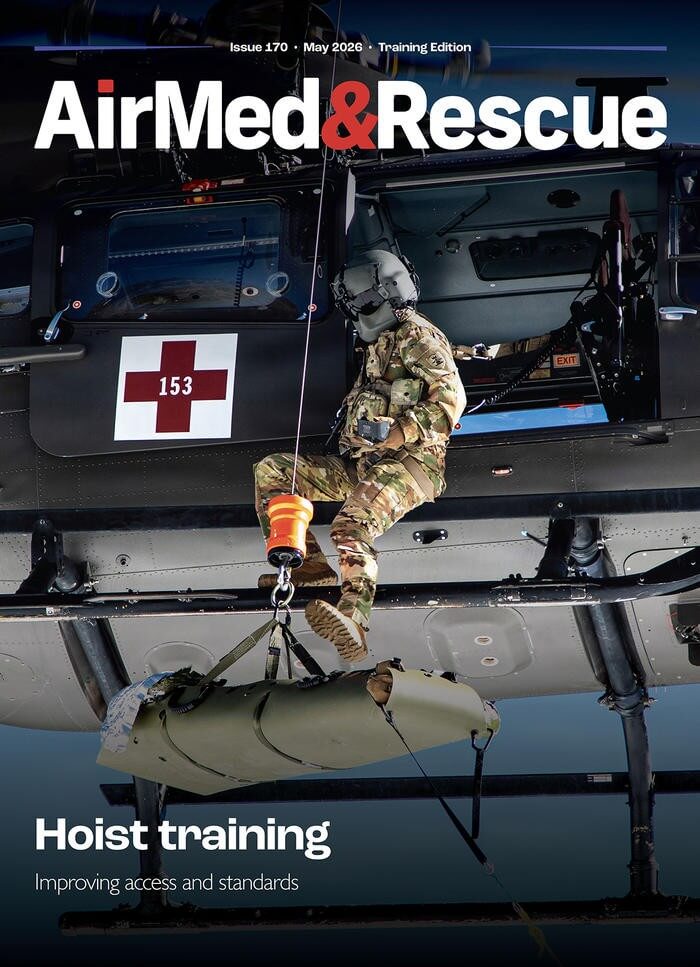
Training for special missions is on another level, so it’s a great pleasure to bring you the training edition of AirMed&Rescue for May. We have features on night flights for police aviators; the simulators for military special missions training; the systems and scenarios for hoist operations; and engineering training for airframe and powerplant mechanics.
Lauren Haigh
Lauren has worked in the publishing industry for eight years and reads and writes about healthcare, science and travel insurance on a daily basis. Her favourite aircraft is the plane from the title sequence of British educational children’s TV series Come Outside.