
Provider profile: Airmedic

Oliver Cuenca speaks to Louis-Philippe Loiselle Fortier, Vice President of Strategic Initiatives and Business Development at Airmedic, about how his company serves those in need across Quebec and further afield
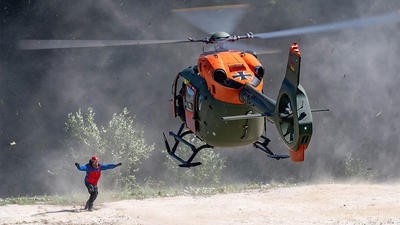
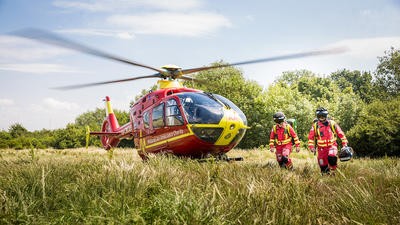
Based in the Canadian province of Quebec, air ambulance services provider Airmedic currently operates a mixed fleet of both fixed-wing and rotary-wing aircraft, comprised of Pilatus PC-12 turboprops, a Bombardier Learjet 45XR, and Airbus EC145 and BK117 helicopters.
This diverse fleet supports the company’s twin roles of providing emergency medical services (EMS) and long-distance air ambulance transfers – both of which are in high demand, Louis-Philippe Loiselle Fortier, Vice President of Strategic Initiatives and Business Development at Airmedic, explained.
“We are doing nearly 2,000 flights per year – that’s for Learjets, PC-12s, and helicopters,” he said. “We’re doing 50 to 100 flights with the helicopters right now, and around 200 to 250 flights with the Learjet. And the balance is made up by the PC-12s.”
Filling a gap
The company has grown rapidly since its establishment in the 2000s. Loiselle Fortier explained that when Airmedic began operations, the company focused on providing emergency air medical services to individuals.
“In the province, there are no publicly owned helicopter services, so we wanted to start something a little bit like STARS in the west of Canada, or Rega in Switzerland – because people were dying at the time, and there weren’t enough public services able to reach them,” he explained.
“Even today, there’s no public helicopter service (in Quebec). So we save a lot of lives each year, because we can take someone out of the woods and isolated areas and to a specialist hospital.”
We save a lot of lives each year, because we can take someone out of the woods and isolated areas and to a specialist hospital
Loiselle Fortier explained that the population centers of Quebec are primarily focused on Montreal and the St Lawrence River, so those served by Airmedic in these rural areas are a minority – nevertheless, the service has strong demand.
“In 2012, Airmedic became a private company, and that’s when we bought our first PC-12s. And then we had two AW109s. And then each year, it has grown. We added a third aircraft in 2017, and then in 2018 we changed the AW109 to the Airbus EC135.”
Between 2019 and 2023, he added, the company added a fourth, fifth, and sixth PC-12 to its fleet, before finally acquiring the Learjet 45XR for repatriations last year.
Membership and government assistance
“We are a company that does a lot of different markets – with the helicopters, we do both a membership program for individuals, and corporates. It’s like insurance – because in Quebec, there are no public helicopter services. We have a lot of individual members, and around 300 corporate members. We also work with a lot of First Nations because there’s a lot of them that are very isolated and hard to reach by road. They often don’t have an airport near them either, so we do a lot of interfacility transfers [with our helicopters] as well.
“We also work with government agencies if there’s forest fires, floods, or any other situation,” he continued. “We’re one of the first ones they reach out to, to provide helicopter services, because we can do both day flights and night flights … with night vision goggles.
“On the fixed-wing side, with the PC-12s, we’re doing mostly province-related, interfacility work, from primaries and regional hospitals to specialized hospitals in Quebec City, Montreal or Sherbrooke, most of the time.
“We are working with the First Nations as well. And it’s mostly with runways that are shorter, with gravel or dirt. So with the PC-12, we’re able to land on shorter air strips and unprepared terrain.
“We also work with corporate clients in the mining industry. They are very isolated, but they still sometimes need to evacuate workers … when they need more specialized care.
“We’re always looking at what the fastest and most reliable way to get to a patient is, and sometimes a plane is better than a helicopter.”
We’re always looking at what the fastest and most reliable way to get to a patient is, and sometimes a plane is better than a helicopter
Loiselle Fortier explained that when it comes to longer-distance flights, Airmedic flies to places such as the Caribbean, Mexico, the UK, and the USA – primarily, but not exclusively, offering flights to Canadian citizens.
Airmedic also flies organs for transport across Canada, in collaboration with the government, as well as escorts on commercial airliners.
A range of equipment
Airmedic carries a broad range of equipment on its aircraft for the simple reason that it provides greater flexibility, allowing air ambulance crews to rapidly respond to a range of missions, including neonatal pediatrics, adult obstetrics, and psychiatrics, Loiselle Fortier said.
He explained that, “even if we are going to a patient, and there’s a more important case while we are in-flight”, having a solid range of kit on board means “we have the possibility to reroute the team”.
He added that, on board Airmedic aircraft, common equipment includes a Zoll X Series monitor/defibrillator, a HAMILTON-T1 ventilator, an i-STAT blood analysis system, as well as “IV pumps and syringe pumps, suction equipment, and more specialized medication for trauma and obstetrics”.
Recruitment and training
On the question of hiring new staff, Loiselle Fortier explained the importance of relevant experience: “When we recruit [medical crew], they need to have at least three years of experience in the field of emergency or critical care. So someone working on the surgical ward for three years, and never setting foot in the emergency or critical care unit, will not be recruited by us. Because they need to have experience with life-and-death situations, CPR, and administering a range of medication in emergencies.”
They need to have experience with life-and-death situations, CPR, and administering a range of medication in emergencies
Beyond this, Airmedic will provide any additional training in-house, he said, for “crew resource management and safety training”, among other things.
New recruits, he said, are mentored by more experienced crewmembers. “We have a training tool with a checklist to make sure they meet the expectations of the company – and if the person needs more training flights, then we’re going to give them more!”
Conclusion
Loiselle Fortier is confident about Airmedic’s future, adding that, looking forward, “there is demand, there’s demand for sure,” he said. “We want to grow the service to answer that need, and work with our clients to customize and personalize our approach.”
Above all, he concluded: “We are always re-analyzing and discussing with our client, to see how we can support them, and how we can grow our capacity.”
October 2025
Issue
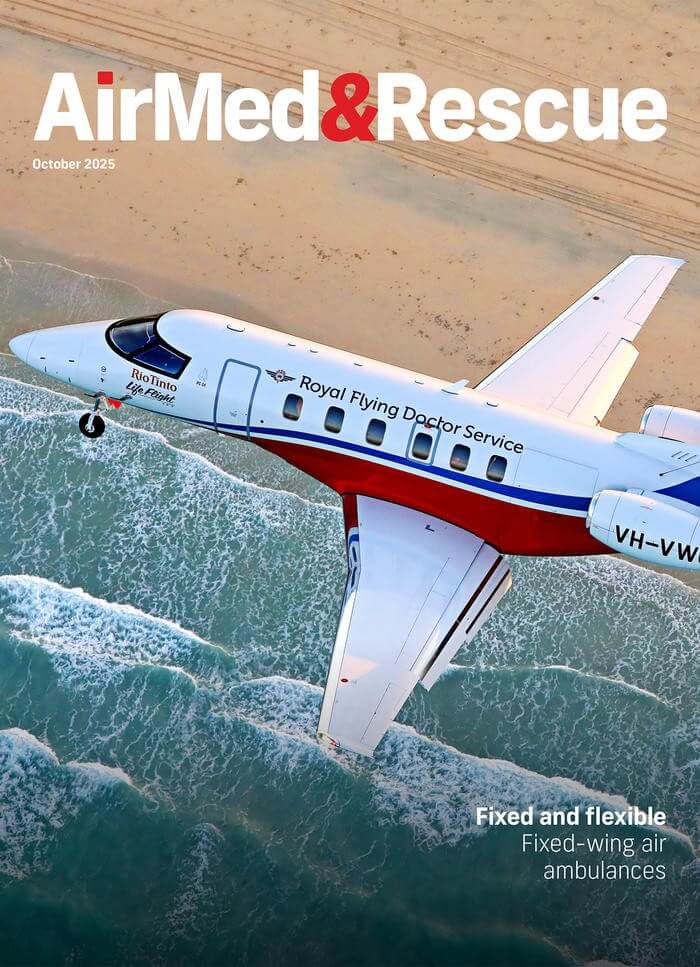
In our October edition, we bring you news, features and more showcasing special missions from around the world. We have features that focus on the fixed-wing air ambulance platforms that are enhancing air medical operations; the care and considerations when transporting children with infectious diseases at risk of deterioration; the law enforcement agencies that use aircraft to find and track persons of interest; and the challenges of treating patients with hyper- and hypothermia.
Oliver Cuenca
Oliver Cuenca was a Junior Editor at the Voyageur Group. He was previously a News and Features Journalist for the rail magazine IRJ until 2021, and studied MA Magazine Journalism at Cardiff University. His favourite helicopter is the AW169 – the workhorse of the UK air ambulance sector! He also led the creation of Waypoint: The AirMed&Rescue podcast, serving as its Production Editor and co-host.