
Provider profile: Rescue Coordination Centre Münster

Oliver Cuenca speaks to the Bundeswehr about their work flying emergency response missions across Germany in response to missing persons, medical emergencies, and major disasters
Rescue Coordination Centre (RCC) Münster, a subdivision of the German Armed Forces (Bundeswehr), is responsible for the coordination of search and rescue (SAR) operations across most of Germany.
This, according to a spokesperson from RCC Münster, is with the exception of “the coastal regions of Schleswig-Holstein and Hamburg”, encompassing “the entire German mainland, including all federal states except for the aforementioned coastal areas”.
Bundeswehr aerial SAR operations coordinated by RCC Münster are flown from three dedicated bases, in Nörvenich, North Rhine-Westphalia; Niederstetten, Baden-Württemberg; and Holzdorf, Brandenburg.
The spokesperson explained that all three bases (known as SAR 41, SAR 63, and SAR 87, respectively) are located at military airfields, operate 24/7 (“weather permitting”), and are “equipped to handle both primary and secondary rescue missions”.
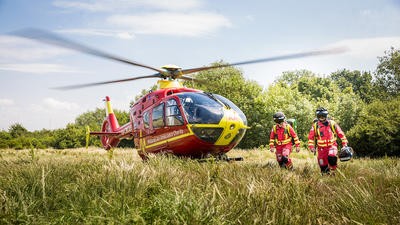
All aircraft coordinated by RCC Münster are H145 light utility helicopters (LUHs) in SAR configuration. “There are seven dedicated LUH SAR helicopters in the German army,” said the spokesperson. “These machines are pretty new, and there are no plans to upgrade them.
“The Airbus H145 LUH SAR operated by the Bundeswehr are equipped with a comprehensive suite of mission-specific systems and equipment to perform a wide range of SAR missions,” they added.
Mission equipment
These systems include avionics and flight systems, such as a four-axis autopilot, to assist in maintaining stable flight patterns, reducing workload, multiple Global Positioning System (GPS) units and five radios, allowing seamless communication with military, governmental, and civilian agencies.
Additionally, to support the detection of missing persons and other people of interest, the rotorcraft also features a range of equipment, including:
- Electro-optical and infrared (EO/IR) camera systems, such as the L3Harris WESCAM MX-15
- A high-powered Trakka Systems searchlight
- An emergency locator transmitter (ELT) tracking system capable of pinpointing beacons on 123.5, 243, and 406MHz
- A mobile phone location system, capable of detecting signals in remote areas.
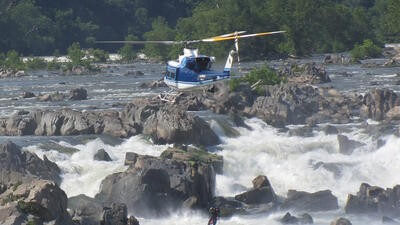
Finally, the spokesperson added that helicopters are equipped with a rescue hoist capable of lifting loads of around 270kg, a 90-meter cable, and a range of medical and survival gear, including emergency and survival kits, trauma care gear, a defibrillator, oxygen systems, and thermal blankets.
The Bundeswehr is, of course, planning to use more drones for various operations, but there is no immediate plan to implement them in SAR operations.
Common mission types
RCC Münster dispatches SAR helicopters to a wide range of military and civilian emergencies across Germany, with around 2,000 callouts per year, of which roughly 10% will lead to a mission being flown by the rescue helicopters. This includes:
Aircraft emergencies – such as crashes or forced landings of military or civilian aircraft, or the activation of emergency locator beacons, often triggered by Cospas-Sarsat alerts or air traffic control (ATC) distress calls
Medical evacuations (medevac) – including the transport of seriously ill or injured individuals, with cases such as heart attacks and other cardiac issues, severe trauma from road traffic accidents, and injuries due to accidents on farms or in the mountains
Support during military exercises – helicopters may be on standby during Bundeswehr live fire or flight training, to respond to potential injuries or aircraft ejections or crashes, or to provide rescue capabilities near training zones
Disaster relief and civilian protection – providing support during floods, wildfires, storms, and other natural disasters, including the evacuation of stranded civilians, and the airlift of medical or technical personnel
Emergency beacon investigation – responding to ELTs, emergency position-indicating radio beacons (EPIRBs), and personal locator beacons (PLBs), some of which may have been triggered accidentally, with a helicopter potentially being dispatched if location data is unclear.
Working with civilian authorities
While RCC Münster remains part of the Bundeswehr, the spokesperson explained that in providing services across Germany it plays a “vital role in military-civilian cooperation for SAR missions”. Civilian agencies can request Bundeswehr SAR support directly, whenever an aircraft goes missing, while the Bundeswehr may also assist in civilian emergencies under Article 35 of German Basic Law.
Military SAR helicopters can be deployed “within minutes, when requested by a civilian agency”, the spokesperson said. “It is heavily integrated with civilian emergency services. RCC Münster maintains 24/7 communication lines with the Polizei [police], the Rettungsleitstellen [emergency medical service dispatch centers], and German Air Traffic Control (DFS).”
Pilot and medical crew training
To work as part of the Bundeswehr’s SAR flight crew, applicants are required to already be fully qualified Bundeswehr helicopter pilots with flight experience on the Airbus H145. But in addition, the spokesperson explained, there are a number of other, “intense, specialized”, SAR-specific training requirements to prepare [pilots] for the demands of SAR missions.
“This training,” they explained, “goes far beyond standard military or helicopter qualifications, and covers technical flight skills, emergency medicine, hoist operations, survival, and civil military coordination.”
SAR pilots are expected to have training for night vision goggles (NVG) operations, hoist and winch procedures, experience of landing and taking off in mountains and other confined areas, and knowledge of various aerial search patterns – including grid patterns, sectors, and parallel sweeps.
A similar amount of training is required for SAR medics – medical crew must have Bundeswehr Rettungsassistent (paramedic) or Notfallsanitäter (emergency paramedic) level qualifications, as well as standard military aircrew training.
They are also expected to have experience of providing in-flight medical care for the most common emergencies, such as “trauma, hypothermia, drowning, etc”, and knowledge of survival and field care, for “treating patients in alpine or forested environments”.
This aspect of training reflects some of the challenges presented to crew operating within RCC Münster’s search and rescue region, which includes parts of the Alps mountain range.
Medical crew are also expected to know how to conduct hoist operations with patients.
September 2025
Issue
Our September edition is the special military issue, bringing together news, features and other articles that showcase military contributions to special missions. We have themed features on air forces helping with disaster response, the stretchers and baskets that make combat search and rescue possible, and the varied duties of military coast guards, and we have an extra non-themed feature on the medical equipment used in air ambulances.
Oliver Cuenca
Oliver Cuenca was a Junior Editor at the Voyageur Group. He was previously a News and Features Journalist for the rail magazine IRJ until 2021, and studied MA Magazine Journalism at Cardiff University. His favourite helicopter is the AW169 – the workhorse of the UK air ambulance sector! He also led the creation of Waypoint: The AirMed&Rescue podcast, serving as its Production Editor and co-host.