
Provider profile: ANWB Medical Air Assistance

Oliver Cuenca talks to Amanda Tijben, Flight Operations Manager at ANWB Medical Air Assistance, about providing an emergency aerial response across the Netherlands
ANWB Medical Air Assistance, part of the Royal Dutch Touring Club ANWB, is an emergency air ambulance service that responds to critical incidents across the Netherlands.
Founded 30 years ago, the service now responds to around 12,000 callouts per year nationwide, from four regional trauma centers located at Amsterdam University Medical Center, Erasmus Medical Center, Radboud University Medical Center, and University Medical Center Groningen.
Operations are 24/7, and provided using a fleet of four primary Airbus H135 helicopters and two backups of the same type. “Of the two spare H135s,” explained Amanda Tijben, Flight Operations Manager at ANWB Medical Air Assistance, “there’s always one in maintenance.”
She elaborated: “In the Netherlands, four hospitals hold a governmental designation for a mobile medical team (MMT). ANWB Medical Air Assistance acts as the service provider for these hospitals.
“This means we are responsible for the flight operations, while they supply the medical components – personnel, equipment, and operational strategy – as well as the ground base and vehicle.”
Tijben also added that alongside its partnership with the four trauma centers, the service maintains a long-term contract with a maintenance, repair, and overhaul (MRO) firm for the provision of Part 145 helicopter maintenance.
Alongside its regular services, ANWB Medical Air Assistance also operates a pair of Airbus H145s – one primary and one reserve – on behalf of the Fryslân Regional Ambulance Service.
Support functions are coordinated from ANWB Medical Air Assistance’s headquarters in Lelystad, where the Continuing Airworthiness Management Organisation (CAMO), finance, and flight support are based. The Fryslân medical flight operations are coordinated through a separate, dedicated dispatch center.
Major milestones
Tijben explained that the air ambulance service had evolved significantly since its inception 30 years ago, with massive leaps forward in equipment, technology, and operational capabilities and experience.
“I think, as with all helicopter emergency medical services (HEMS) operators, we’ve been improving our safety and professionalism over the years, supported by regulations, technology, and experience,” she explained. “We’ve been able to innovate throughout all those years on both the flight and medical parts – the latter specifically supported by our trauma centers.”
“I think, as with all helicopter emergency medical services (HEMS) operators, we’ve been improving our safety and professionalism over the years, supported by regulations, technology, and experience
Tijben listed a number of major milestones in the evolution of ANWB Medical Air Assistance, including the start of using night vision goggles (NVGs) to facilitate 24/7 operations, as well as the later shift from using green to white phosphor NVGs. Other landmarks were the implementation of satellite-enabled point-in-space (PinS) instrument procedures, four-axis autopilot, dedicated weather stations, and electronic maps for navigation.
On the medical side of operations, major changes over the past few decades have been the implementation of onboard blood supplies, extracorporeal membrane oxygenation (ECMO), and ultrasound devices.

Photo credit: Sander Kaaij
Expanding into the future
On top of these great leaps forward, ANWB Medical Air Assistance continues to develop. While already offering extensive coverage, it has “decided to expand the number of stations providing this service [further]”, in partnership with the Dutch Ministry of Health, Tijben noted. “Therefore, we will be increasing our fleet with one more H135 in the near future.”
We will be increasing our fleet with one more H135 in the near future
Alongside this, ANWB has also been exploring the use of new medical technology on board its aircraft – in particular, the potential to carry ECMO life support machines.
“This past year, we did a pilot [study] with ECMO on board,” Tijben explained. “The pilot has now been evaluated, and the results will be presented in the coming month. If the outcome is positive, and we do get the financial resources, we will continue this program in our [H135] helicopters.
As well as medical equipment, Tijben added that the service was looking to upgrade its onboard systems with a “solid and stable internet connection … for communication with the dispatch center and the hospitals”.
Responding to incidents
In terms of the kinds of incidents that ANWB Medical Air Assistance responds to, Tijben explained that the medical emergency varies by region. Rural areas tend to experience more agricultural incidents, such as accidents involving farming equipment, while “on the other side, in highly populated areas”, there are more “shootings, stabbing incidents, and bike or car accidents”.
Tijben reported that ANWB was developing new dispatch criteria to solve the issue of missions being aborted mid-flight due to changes in circumstances at the scene of incidents.
We do see in the Netherlands an increase in the amount of cancelled missions – most of them seem to be related to some dispatch criteria, where the need of the mobile medical team does not add value for the patient
“We do see in the Netherlands an increase in the amount of cancelled missions – most of them seem to be related to some dispatch criteria, where the need of the mobile medical team does not add value for the patient,” she explained. “So [for example], ambulance arrives and gives us a call they can handle it themselves.”
Looking ahead
Looking forward into the coming years, ANWB Medical Air Assistance is working to adapt its service to meet future needs, with a range of operational changes currently in the works.
Tijben stated that the service would “continue to innovate in the medical field, together with our trauma centers”. However, she noted that “these developments often require corresponding innovations on the aviation side to enable implementation”.
Additionally: “We are working on a concept that would allow us to operate at lower minima [weather conditions and altitudes] during night flights. The Netherlands is a relatively flat country with an excellent obstacle database, and we are therefore confident that this can be done safely.”
We are working on a concept that would allow us to operate at lower minima for weather conditions and altitudes during night flights
Additionally, ANWB plans to radically streamline its dispatch operations to further improve the effectiveness of its work. Tijben explained: “Currently, there are 10 dispatch centers, and we aim to centralize all four helicopters under a single dispatch center, as we believe this would improve efficiency in our specific operational context.”
The ultimate goal, she concluded, is to “minimize the operational limitations caused by external conditions”, allowing for maximum responsiveness at all times, “while maintaining the highest standards of safety and efficiency”.
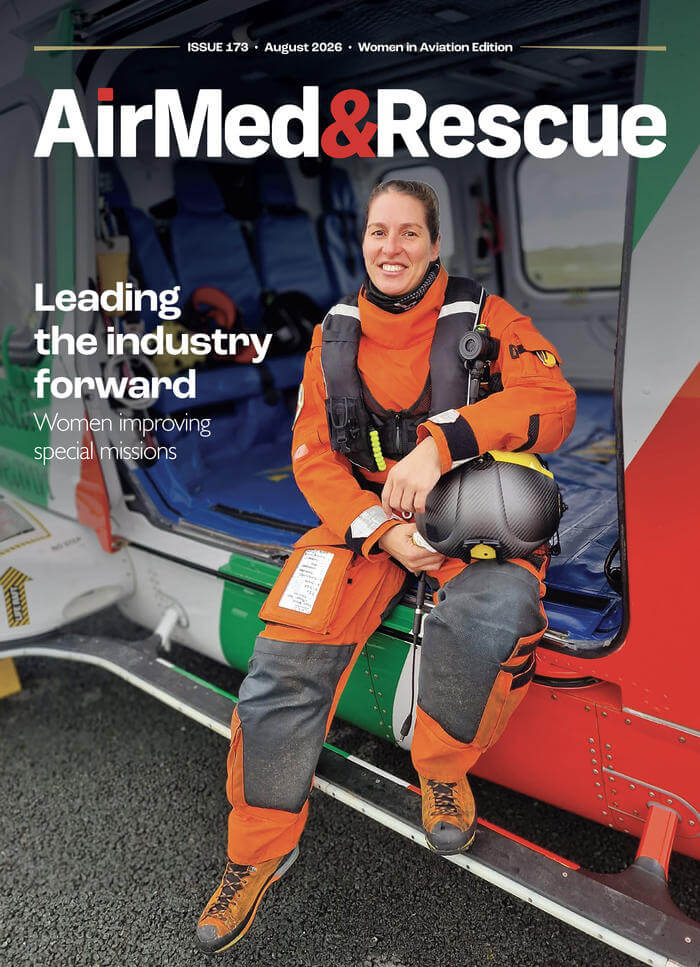
August 2026
Issue
August is a special time of year, and it is my pleasure to present a special Women in Aviation edition of AirMed&Rescue. We have features on the importance of preventing and knowing the early signs of hoist spin; the leadership roles and the value of visibility of women in the industry; the inward-facing and external sensors improving special missions; and the variety and standards that flight suits have to meet.
Oliver Cuenca
Oliver Cuenca was a Junior Editor at the Voyageur Group. He was previously a News and Features Journalist for the rail magazine IRJ until 2021, and studied MA Magazine Journalism at Cardiff University. His favourite helicopter is the AW169 – the workhorse of the UK air ambulance sector! He also led the creation of Waypoint: The AirMed&Rescue podcast, serving as its Production Editor and co-host.