

Provider profile: Fairfax County Police Department

Oliver Cuenca speaks to Captain Karen Maslona, Commander, Helicopter Division, at Fairfax County Police Department, about its work in policing the US state of Virginia
Fairfax County Police Department’s (FCPD’s) Helicopter Division was created in 1972, initially using an Enstrom F-28 helicopter operating part-time from Dulles Airport. The service was suspended in 1975 due to a non-fatal crash, and later relaunched in 1983 as a full-time operation.
The Division acquired its first Bell 429 in 2011, and now flies two aircraft of that type, providing both law enforcement and medical response services across Fairfax County, Virginia.
Captain Karen Maslona, Commander of the Helicopter Division at FCPD, explained that while the Helicopter Division continued to deliver on both its “twin missions”, there had been a reduction in the number of medical incidents it responds to.
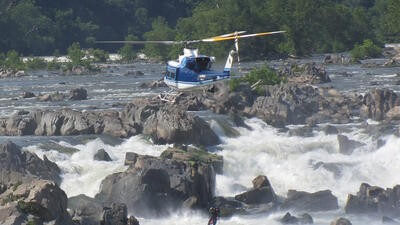
“There used to be quite a few – we would go for about 400 a year,” she explained, adding that due to an expansion in the amount of critical care ground transport in the region, as well as improvements in the local road network, demand had declined in recent years.
However, she added that the police missions had stayed “right on par”, and that as a result of the additional capacity afforded to FCPD by the reduction in medical cases, “we’ve tried to expand to see where else we can be useful”.
Maslona noted: “We’ve kind of branched out to see if we could provide surveillance, overwatch, things of that nature. We’ve started working with our K9 [dog] unit, and our SWAT team … so that in the event that we needed to transport them somewhere quickly we could.”
We’ve kind of branched out to see if we could provide surveillance, overwatch, things of that nature. We’ve started working with our K9 unit, and our SWAT team … so that in the event that we needed to transport them somewhere quickly we could
A range of mission types
FCPD’s Helicopter Division responds to “felonies, mostly”, Maslona noted, with a particular focus on “anything weapons-related. We’ve shootings, stabbings, murders. We’ll do hit-and-run vehicles, if it rises to a felony. We have also had carjackings, foot pursuits, vehicle pursuits, and we can also do surveillance.
“Sometimes, it’s just that the person’s in danger – burglaries of occupied dwellings, missing adults, missing juveniles, people that are in emotional crisis,” she added.
Beyond this, the Division also provides overwatch services to assist ground-based officers, and community support.
Maintenance
Maslona explained that while day-to-day maintenance and upkeep of the Division’s aircraft were the responsibility of FCPD’s Director of Maintenance – tasks such as “engine washes, repairs, and 50-hour inspections” – the Department also maintains a contract with Massachusetts-based maintenance, repair, and overhaul (MRO) provider Summit Helicopters.
“Summit do our larger-scale work,” she said. “They’ve overhauled our engines, they’ve overhauled our helicopters. They’ve also assisted us with finding new technologies, which helps streamline the process.”
They’ve overhauled our engines, they’ve overhauled our helicopters. They’ve also assisted us with finding new technologies, which helps streamline the process
Technology
One key new technology that the Division recently installed on its rotorcraft with Summit’s support is APT SureStreamer, an air–ground video communications solution, which the Department uses in tandem with the DroneSense situational awareness platform.
“We have SureStreamer for our live feed,” Maslona explained. “It sends a link to your phone or email, and then you can actually watch the live feed. So our command staff and executive staff, they’re able to watch incidents as they’re occurring.”
Likewise, she added, “if we’re working with K9 or SWAT, and we’re in a field or something like that, they can actually see the terrain, and they can see what’s ahead of them. Same thing with patrol – they can see where they need to tighten up their perimeter, and can get a live overview of everything that’s occurring at that moment.”
Other key equipment carried by FCPD on its helicopters include a TrakkaBeam searchlight, Shotover augmented reality tactical mapping systems, a WESCAM MX-15 electro-optical and infrared camera, night vision goggles (NVG), a siren, and a public address system.
Alongside this, the aircraft also carry a range of medical equipment, including a Zoll defibrillator.
“Our medics have the capability of giving whole blood, and they are also capable of doing rapid sequence intubation,” Maslona added.
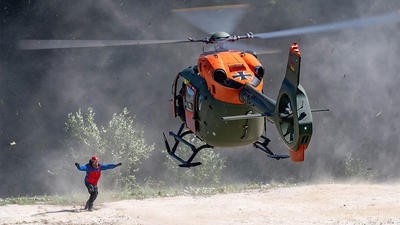
Restricted airspace
A key restriction on how FCPD’s Helicopter Division can operate is the airspace itself – a large section of the county falls within the 15-mile radius of the Washington DC metropolitan area flight restricted zone (FRZ), limiting where and how they can fly at any given time.
These pilots have been working in these areas for a long time, and they have a really good working relationship with the air traffic controllers. They know the paths, they know the routes, they know the busy times, and they know where to stay away from, so that’s been very helpful for us
This challenge, Maslona explained, is navigated through a mixture of experienced piloting and strong relationships with air traffic controllers: “These pilots have been working in these areas for a long time, and they have a really good working relationship with the air traffic controllers. They know the paths, they know the routes, they know the busy times, and they know where to stay away from, so that’s been very helpful for us.”
However, despite this, flight paths can change suddenly in the event of major incidents, reported Maslona: “Since the
tragic crash at Reagan Airport in January [2025], it’s changed a lot. We’ve had to be a lot more fluid, and there’s been times where it used to be that they would be able to just have visual sight separation, but now that’s not a possibility.”
Additionally: “We do have a lot of temporary flight restrictions. Since the change in presidents, there’s been a lot of movement in the area. So, flight restrictions pop up often.”
Drones
Alongside its helicopter operations, FCPD is also equipped with a range of uncrewed aircraft to support its operations, attached to divisions such as the Department’s crash reconstruction, crime scene investigation, SWAT, and bomb disposal units.
They are also starting to implement drones as a first responder (DFR)
“They are also starting to implement drones as a first responder (DFR),” said Maslona. “We’ve got, I think, about seven or eight pods now on rooftops. They’re trying to put them in the areas that have the most calls for service, but they’re not everywhere yet.”
She added that while drones were useful, there were a lot of things – such as longer-duration flights – which they were not as effective for, due to limited battery life. Consequently, FCPD maintains a “tiered approach” to the use of its aircraft.
The future
Looking forward, Maslona said that the main job of the Helicopter Division was to support the operations of officers on the ground – something they are always trying to find new ways to do.
“Whether it’s support for detectives, support for patrol, or support for any of the specialty units, [we are] always branching out and bringing up ideas on what other ways we can assist,” she said.
This includes ensuring that knowledge and experience is passed down to younger officers as the years go by: “We’ve got some of our senior members that are going to be in their retirement years, so we’re making sure that they’re passing on their information to the junior members and making the unit successful moving forward.”
In parallel to this, she said, was the need to “constantly branch out and find new or better technologies, and then the same thing with the medical side”.
Furthermore, Maslona added, a key part of how the Division was looking to expand its operations was by collaborating with other emergency service providers.
“We’re doing ride-alongs with the fire department right now, just to build the trust and the relationship with each other,” she said. “If the police emergency medical technician (EMT) program expands, we might be able to offer it to the fire department to use it as a recruiting tool.”
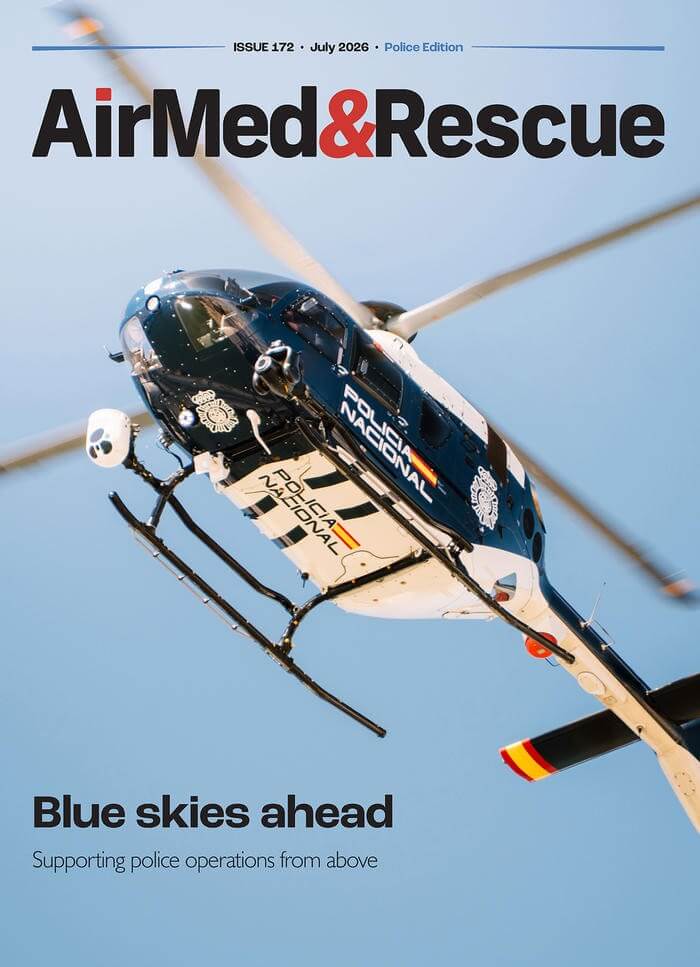
July 2026
Issue
As another July rolls around, it’s wonderful to bring you the airborne policing edition of AirMed&Rescue. We have features on the development and strategies used during aerial missing person searches; the active threats that affect aviation and law enforcement services particularly; the bread and butter of police aviation, the patrol and support operations; and the increasing use of drones as a force multiplier and sometimes as a first responder.
Oliver Cuenca
Oliver Cuenca was a Junior Editor at the Voyageur Group. He was previously a News and Features Journalist for the rail magazine IRJ until 2021, and studied MA Magazine Journalism at Cardiff University. His favourite helicopter is the AW169 – the workhorse of the UK air ambulance sector! He also led the creation of Waypoint: The AirMed&Rescue podcast, serving as its Production Editor and co-host.