
Provider profile: Priority 1 Air Rescue

Oliver Cuenca speaks to David Eng, BI and Business Ops at Priority 1 Air Rescue, about how his company provides training to military and civilian aircraft operators
Founded in 1999, special missions aviation training firm Priority 1 Air Rescue (P1AR) has since grown into a major international company, with training facilities in Mesa, Arizona, and Bordeaux, France, as well as offices in Vancouver, Canada, and Malta.
Business Intelligence (BI) and Business Ops David Eng noted that the company had deployed to carry out training all around the world, with a “heavy focus on Europe, but we’ve also been in Suriname, Guyana, Guatemala, Mexico, Oman, [and] Jordan”.
He explained that the company had traditionally focused on providing training for “the back-of-the-aircraft crew”, including “your hoist operators, flight mechanics, tactical flight officers, technical crewmembers (TCMs)”. This includes teaching skills such as “hoisting for search and rescue (SAR), use of force for anti-drone ops or … some fast roping for SWAT teams”.
Standardizing training while remaining adaptable
As a company that provides training across many countries with differing operational cultures and regulatory frameworks, P1AR has had to work hard to ensure that training remains standardized, while still flexible enough to meet the specific needs of clients.
“It’s certainly a challenge working across languages,” noted Eng. “But even in English, there’s a wide variation in how some words are used, like if I order a biscuit in the UK I’m going to get something different than what I’m expecting here in the US, right? And that’s true even more so with very specialized language.”
It’s certainly a challenge working across languages. But even in English, there’s a wide variation in how some words are used, like if I order a biscuit in the UK I’m going to get something different than what I’m expecting here in the US, right? And that’s true even more so with very specialized language
To mitigate this, he explained, P1AR aims to ensure that there is a standard core instructional process, centered on “four modalities, from classroom to our hoist procedural tower, our simulator, and live flight”.
This overall structure is then adapted to meet the needs of various clients. This, he said, is necessary even for operators that work within the same general field, such as different branches of the US military, which have a different standard for techniques such as hand signals.
“We’re not asking you to change how you do things as an organization,” he explained, adding: “If you ask us to give you advice, we’re happy to do that, and we have actually … helped [smaller organizations] write their standard operating procedures or standard operating guides.”
Likewise, Eng said that the company would adapt its training processes to fit the specific equipment an operator uses, such as various types of hoist.
Course offerings and modalities
Alongside tailoring courses to the organization, Eng explained that finding the right course for the crewmembers themselves was also important.
He said: “We offer courses for a variety of different stages of that crewmember’s development. We can start from the ab initio, initial training, where they’ve maybe never been on a helicopter. That’s like ‘here’s just how to be safe in the helicopter’, and a bit more of the academics on classroom pieces.”
Alongside more tailored options, P1AR also offers around 25 pre-built class-based lessons, many of which are focused on aspects of special missions operations – such as SAR, aerial firefighting, mountain rescue, nighttime flying, underwater egress, and use of force.
“SAR is definitely our bread and butter, but we have a variety of courses,” Eng said.
Eng also reported that while live flights were still an important aspect of the overall training offered, the development of class-based education and the use of both hoist towers and simulators had been an effective way to reduce costs for clients while upholding training standards.
He also noted that his company’s simulators reduced the risks of providing training to military personnel, allowing them to run virtual scenarios that could not be achieved in a live flight without putting lives at risk.
We’re able to do that in the sim to kind of build that situational awareness, the decision-making element – we can throw more things at them in the simulator, and leverage the different modalities for training and the technology to be able to move the more risky pieces into the simulator
“We’re able to do that in the sim to kind of build that situational awareness, the decision-making element – we can throw more things at them in the simulator, [and] leverage the different modalities for training and the technology to be able to move the more risky pieces into the simulator,” added Eng.
P1AR maintains four simulators to support its work – two in the USA, and two in France.

Despite the effectiveness of simulation training, however, Eng noted that there was still a place for practical tools such as hoist towers.
“The reason why … is that even as great as the simulator is and as much as you can do with VR, there’s still, for hoisting, a very physical element of the job,” he explained. “You have to physically pull a rescue basket with a 200lb dude into the helicopter. And that’s something that even the best simulators that have motion and things can’t replicate.”
You have to physically pull a rescue basket with a 200lb dude into the helicopter. And that’s something that even the best simulators that have motion and things can’t replicate
For P1AR’s military clients, Eng argued that the kind of training that was typically requested is guided by several emerging trends: namely, budget pressure, airframe availability, and the emergence of drone technology.
“We’re definitely seeing lots of budget pressure, both budget and also airframe availability. There obviously continues to be more stuff going on in the world, and so agencies are kind of at a higher ops tempo,” he said, meaning that crews and aircraft are deployed for longer, and funds are being directed elsewhere.
He continued: “We’ve definitely felt some of that … and so certainly being able to leverage the simulator and the hoist tower is helpful.”
Alongside these pressures is the emergence of drone warfare, Eng reported, especially throughout the wars in Ukraine and the Middle East. As a consequence, more military clients are looking to use helicopters as anti-drone platforms, “whether that’s for electronic warfare, or firing weapons out of it”.
Future plans
Looking ahead, Eng said that Priority 1’s strategy was to remain adaptive and regularly update courses on an annual basis. He noted that the company was actively involved in the development of both its simulator software and hardware, integrating new elements or scenarios.
Additionally: “We’re definitely in explorations of looking at our facility footprint [and] if there’s another site that would better serve our customers. We’re pretty early in that process, but we are looking at where the folks that we train with are, and if we can help to reduce that travel cost. If they’re travelling from Australia to France, that’s a pretty pricey trip, right?”
“We don’t foresee any decrease in the need for training,” Eng concluded, so the ultimate goal was to continue to “make sure we have the right facilities and the right places to be able to meet that need”.
September 2026
Issue
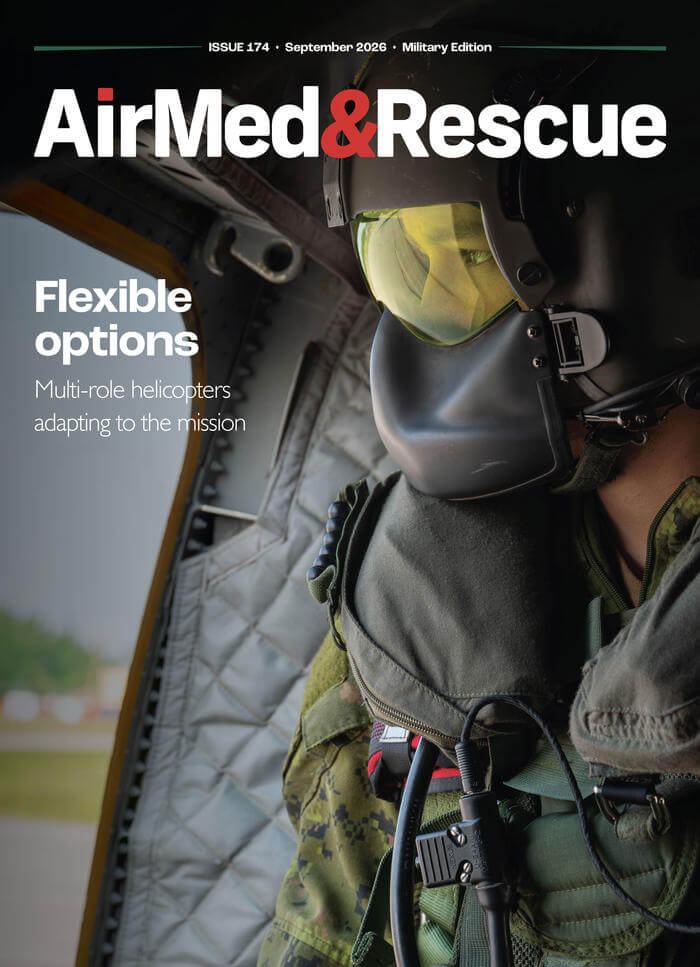
As we reach the equinox, I’m happy that we have an interesting military edition of AirMed&Rescue for you to read on those longer nights. We have features on the benefits of governmental institutions having a multipurpose helicopter; why military operators are at the forefront of exploring optionally piloted aircraft; how uncrewed aerial vehicles are serving as platforms for sensors that can operate in extreme situations; and on the equipment that is essential to carry on board an emergency medical services aircraft.
Oliver Cuenca
Oliver Cuenca was a Junior Editor at the Voyageur Group. He was previously a News and Features Journalist for the rail magazine IRJ until 2021, and studied MA Magazine Journalism at Cardiff University. His favourite helicopter is the AW169 – the workhorse of the UK air ambulance sector! He also led the creation of Waypoint: The AirMed&Rescue podcast, serving as its Production Editor and co-host.