
Provider profile: SkyCare Repatriation

Oliver Cuenca talks to Dr Lee Collier, Chief Medical Officer at SkyCare Repatriation, about the young company’s work, and its plans for the future
Operating out of London Biggin Hill Airport in the London Borough of Bromley, SkyCare Repatriation is a recently established international air ambulance and repatriation service which grew out of ground ambulance operator BM Ambulance.
Aircraft and equipment
The company currently operates just one aircraft – a Pilatus PC-12 NGX turboprop. Dr Lee Collier, Chief Medical Officer at SkyCare Repatriation, said that the choice of a fixed-wing turboprop aircraft to launch SkyCare’s operations reflected the work of the operator’s parent firm, which predominantly conducts repatriations in Western Europe. As a result, range plays a secondary role to efficiency and cost-effectiveness.
SkyCare carries a selection of medical equipment on board the aircraft, he added: “We’ve got a Spectrum medical interior, a medical air compressor, and suction built into the interior. Then we’ve got a Hamilton T-1 ventilator, a Schiller DEFIGARD Touch 7 monitoring system, a Siemens epoc blood/gas analyzer, and a GlideScope.”
Beyond conducting its own flights, SkyCare also provides medical escort services, said Dr Collier: “If the patient is amenable to commercial flights and is outside of our range, then we can do commercial escorts as well. In recent months, we’ve been to China, the US, and all over Europe doing commercial escorts.”
He added that there were also cases where the patient was not fit for a commercial flight repatriation, but was beyond the range of SkyCare’s PC-12. In such cases, “we would look at doing a sub-charter”.
Biggin Hill
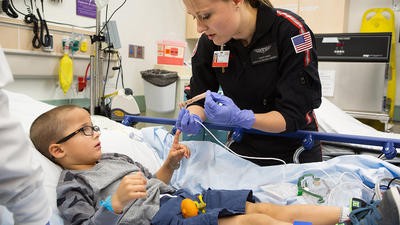
Dr Collier explained that the base at Biggin Hill Airport, established at the start of this year, was ideally placed to align with BM Ambulance’s existing operations: “BM Ambulance is based in Ashford, Kent. So one of the reasons why they have always done well in the long-distance road repatriation market is access to the Channel Tunnel trains from Folkestone, which is right there. And of course from there, Biggin Hill is really the first big-league airport from where we are.”
One of the reasons why they have always done well in the long-distance road repatriation market is access to the Channel Tunnel trains from Folkestone, which is right there
Additionally, he noted that as a privately owned, family-run airport with strong links to London, there was a strong synergy between how it and BM Ambulance operate. Beyond that, Dr Collier said, Biggin Hill has a “thriving community” of companies around it – including SkyCare’s aviation partner, Oriens Flight Operations.
“Oriens have their own hangar at the other side of the airport, where they’re the UK distributor and maintenance provider for Pilatus,” he noted. “That was another big draw to Biggin Hill, having Oriens here, to be able to be co-located with the Pilatus service and maintenance people for the UK, and to have them handle the aviation side of things.”
The company recently formed a partnership with Lia’s Wings, a charity that specializes in the repatriation of young children, which previously featured as the subject of AirMed&Rescue’s June 2023 provider profile. SkyCare is now an aviation partner of the charity, which in turn established a base at Biggin Hill to support the collaboration.
A separate company
Despite the influence of SkyCare’s parent company, Dr Collier confirmed that the medical repatriation firm was “trying not to be seen as a continuation of BM Ambulance as such”.
“It’s a spinoff company in a way,” he said. “In some senses we’re not new to the industry, but we very much wanted to make SkyCare a new company with new branding and a new base at London Biggin Hill. And it’s been hard work – you can sell a great product, but that doesn’t mean people will show up on your doorstep to buy it. And that’s where conferences, and getting out there, talking to people, and finding out what they need, come in and are really helpful.”
He added: “A conversation I’ve been having, particularly with people in the insurance industry, is ‘Are we competing on price or quality?’ And the answer of course is mixed, because the bottom line matters, but quality matters too.”

Staff
SkyCare’s medical team is drawn from a “staff bank” of vetted and checked freelancers, Dr Collier said, sourced from “across London and the southeast – paramedics, doctors, and nurses”.
Once added to the pool of available staff, SkyCare medical staff will typically undergo a “two-day training weekend that covers all the classroom training” necessary to meet European Aero-Medical Institute (EURAMI) standards. (He added that, while the company does not currently have EURAMI accreditation, it is working towards it.)
They will then undergo “a day of practical training on the aircraft with our equipment and ground ambulances”, he added.
In terms of the kind of mission that SkyCare responds to, Dr Collier explained that many of their customers were “just private individuals who have just picked up the phone” – something which he said surprised him initially.
“I expected it to be coming from insurers and from the repatriation industry, but it’s not been,” he said. “It’s mostly people who have gone on holiday and fallen unwell. It’s strokes, it’s heart attacks, it’s trauma – such as broken legs, broken hips. They’re the top three really.”
Despite this, SkyCare is still working with big players in the insurance and repatriation world, and plans to do more business once it finalizes its EURAMI accreditation. “Some companies insist on accreditation – but it’s going to take a few months to do that,” he said. “But there are plenty of players that don’t necessarily insist on accreditation – so it’s getting busier!”
Looking to the future
Looking forward, Dr Collier said that he hoped that SkyCare Repatriation would become the “go-to people” for long-distance medical transportation to and from the southeast of England.
He highlighted that approximately 50% of the UK population were located in southeast England, and that this presented opportunities.
Working with operators from across Europe and across the world is the main goal
“I would like to say that we’ll buy more planes – I hope we will – and I’d like to say we’ll recruit more staff – I hope we will. But working with operators from across Europe and across the world is the main goal,” Dr Collier added.
December 2025
Issue
Our December edition rounds off the year with articles relating to special missions from around the world. We have features that look into the upgrades that have been integrated into special missions platforms to improve operations; the technology used to alert and support aerial firefighting tactics, helping attack fires quicker and more strategically; the simulators that are making training for special missions better and safer; and the latest updates and announcements of digital and physical technology in the last year.
Oliver Cuenca
Oliver Cuenca was a Junior Editor at the Voyageur Group. He was previously a News and Features Journalist for the rail magazine IRJ until 2021, and studied MA Magazine Journalism at Cardiff University. His favourite helicopter is the AW169 – the workhorse of the UK air ambulance sector! He also led the creation of Waypoint: The AirMed&Rescue podcast, serving as its Production Editor and co-host.