
Provider profile: Wellstar AirCare

Oliver Cuenca speaks to Zack Lancaster of Wellstar AirCare about the program’s rapid expansion throughout the US state of Georgia
Established in 2021, Wellstar AirCare has grown rapidly to become a major provider of air medical services across the US state of Georgia, providing an emergency response for adult, pediatric, and neonatal patients.
Initially operating from a base in the city of Augusta, the service recently established its second base in the Atlanta metropolitan area in early 2026.
“We started the first helicopter here in Augusta as a partnership with the Children’s Hospital of Georgia – at that time we were AU Health – and we launched the program under a spearhead of Dr Phillip Coule and myself,” explained Zack Lancaster, Executive Director of Air Medical Transport and Program Director at Wellstar AirCare.
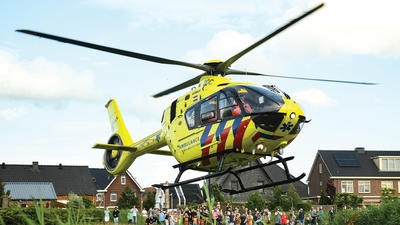
The two bases are each home to an Airbus H145 helicopter – AirCare 1 in Augusta and AirCare 2 in Atlanta, operated in collaboration with aviation partner Metro Aviation, which provides aircraft maintenance and helps ensure that operations remain “future-proof”, Lancaster reported.
The program is also planning further expansion to meet the high levels of demand for its services.
“We're planning for AirCare 3 already,” said Lancaster. “Coule and myself and the Wellstar leadership, we’ve already started looking at where could the next aircraft be and what benefit would it be. If you ask me, I’d love to have a helicopter north, south, east, and west of Atlanta and cut response times even more to our facilities.”
Launching during the pandemic
Despite launching in 2021, operations were not delayed by the Covid-19 pandemic, Lancaster said – in fact, it led to the acceleration of the program’s timeline.
“The planning for all this started before the pandemic,” he explained, adding that Wellstar AirCare had launched to fill a void left by another vendor that operated in the area between 2009 and 2018. That vendor was supplying an aircraft for Wellstar Children’s Hospital of Georgia’s pediatric and neonatal teams, Lancaster reported, “so there became a void in the Augusta area of no air medical support.
We built the aircraft to complete flights that were currently not being done, which was high-flow nasal cannula, which requires massive amounts of oxygen; pre-hospital extracorporeal membrane oxygenation (ECMO); and advanced pulmonary cases that were all due to the pandemic
“If anything good came out of the pandemic, it was AirCare,” he said. “We launched right in the middle of it, and we were able to utilize the aircraft to support rural Georgia and rural South Carolina through the pandemic. We built the aircraft to complete flights that were currently not being done, which was high-flow nasal cannula, which requires massive amounts of oxygen; pre-hospital extracorporeal membrane oxygenation (ECMO); and advanced pulmonary cases that were all due to the pandemic.”
Operations
While the program primarily operates in Georgia, Lancaster explained that the location of the two bases allows for flights to states such as “Florida, South Carolina, North Carolina, Tennessee, and Alabama.
“AirCare 1 here in Augusta is right next to the Georgia-South Carolina line, so the aircraft is actually credentialed in South Carolina as well,” he noted. “And then with AirCare 2 we are close enough to the Alabama line, we’ve worked on Alabama licensure as well to be a little bit of mutual aid to the hospitals right there on the Georgia-Alabama line as well.”
As in many parts of the southern USA, air ambulance operators are vital to ensuring that those in the region’s vast, rural areas have access to healthcare – particularly tertiary healthcare – that they need. The disparity in access, Lancaster explained, makes the AirCare program a “shining star” for those in the more remote parts of Georgia.
“It’s geography. The biggest enemy of Georgia healthcare is geography,” he said. “There’s around four major cities, and all the major hospitals are populated in those cities. Outside of that, healthcare is behind the times, struggling, but we’re getting better at supporting them from our tertiary care centers with helicopters.”
There’s around four major cities, and all the major hospitals are populated in those cities. Outside of that, healthcare is behind the times, struggling, but we’re getting better at supporting them from our tertiary care centers with helicopters
In terms of the kinds of incidents that AirCare is typically called out to assist with, Lancaster explained that typical cases tend to be trauma and emergency on-scene response, including car accidents, heart attacks, and strokes.
However, a key trend – reflecting the program’s expansion across Georgia – is that “support for our rural hospitals has now become more of our profile”, he noted, adding that alongside this, there had been an increasing focus on bringing the best possible on-site medical care.
“The big swing over the last five years is not so much being just a fast ambulance that doesn’t have to stop at stop signs or speed bumps, it’s about bringing ICU-level care to stabilize the patient before transporting them,” Lancaster highlighted. “Ten years ago it was just load and get out of there and get to Atlanta as fast as you can. Now we’re bringing the kind of care you were receiving in Atlanta andAugusta to the patient wherever they are, stabilizing, making sure everything is okay, and then having a much easier transport back to the tertiary care centers.”

Equipment
Lancaster explained that even with the substantial capabilities of the H145, “weight is still a big issue”, with careful consideration required to ensure that capabilities are maximized without impeding functionality.
That said: “Having the larger interior medical cabin [and] extra seats for patients, it definitely allowed us to expand our medical care. We can take a three-person neonatal team along with the isolette and a parent. So that’s, you know, five people on board plus all the technology in the isolette to carry for our most tiniest infants.”
Despite weight limitations, Wellstar’s two helicopters are well equipped with a wide range of medical equipment to support emergency medical services (EMS) operations, including a Zoll X Series monitor, a C-MAC video laryngoscope, a HAMILTON-T1 ventilator, an Aerogen vibrating mesh nebulizer, a Lumify point-of-care ultrasound, i-STAT point-of-care lab testing, Sapphire volumetric IV pumps, and a mobile neonatal intensive care unit system.
We started our whole blood program in 2022. Initially it started with component therapy, and then, as the trauma literature showed, whole blood was the best for our patients
The aircraft also routinely carries whole blood on board. “We started our whole blood program in 2022,” Lancaster said. “Initially it started with component therapy, and then, as the trauma literature showed, whole blood was the best for our patients. So I worked with the trauma leadership in the Wellstar system, wrote a plan, and worked with our local blood center to get it on the aircraft, and have been proudly carrying whole blood since.”
Alongside medical equipment, all crewmembers are also issued with white phosphor night vision goggles (NVG) to support nighttime operations – Wellstar AirCare operates continuously throughout the year on a 24/7 basis.
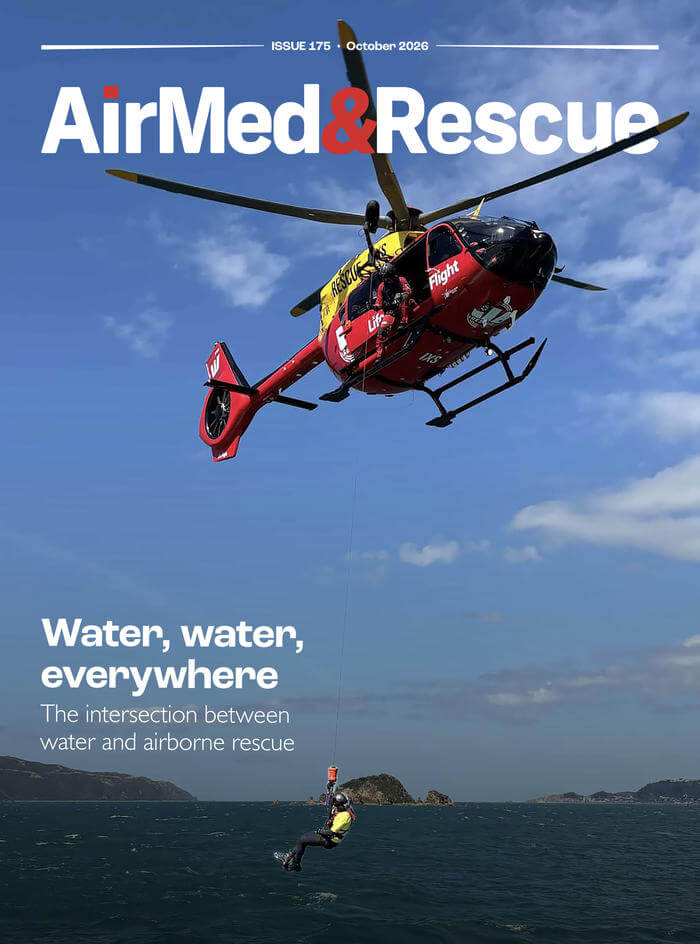
October 2026
Issue
The latest edition of AirMed&Rescue is packed full of content to keep you occupied in October. We have features on the challenges that swiftwater presents when trying to rescue someone; how sensor technology is affecting and improving aerial firefighting missions; why operators choose to have a varied fleet of aircraft to perform special missions; and what can be done to improve the accessibility and awareness of mental health assistance programs for safer and sustainable working conditions.
Oliver Cuenca
Oliver Cuenca was a Junior Editor at the Voyageur Group. He was previously a News and Features Journalist for the rail magazine IRJ until 2021, and studied MA Magazine Journalism at Cardiff University. His favourite helicopter is the AW169 – the workhorse of the UK air ambulance sector! He also led the creation of Waypoint: The AirMed&Rescue podcast, serving as its Production Editor and co-host.