

Remote first response

Drone use in police forces is widening to the role of first responder. Rob Coppinger finds out how this emerging technology is changing operations
The growth of the drone market is delivering technological advances that mean these flying robots can more and more supplement and enhance policing operations, with police forces procuring these uncrewed aerial vehicles (UAVs) to assist generally or to act as first responders. As these UAVs have been adopted, police forces are looking beyond the quadcopters so loved of hobbyists and are trialing drones with ever more capable sensors.
The New Zealand Police operates a fleet of the battery-powered Chinese drone maker DJI’s remotely piloted aircraft system (RPAS) platforms. They are the Avata, Mavic, Phantom, and Matrice models and they were selected to provide a scalable, national capability for general policing, tactical response, and other specialist operations. So far, the New Zealand Police have found that these RPAS often provide major time savings by quickly reaching scenes as first responders, supporting cordons, and providing real-time situational awareness. The drones have been used for search and rescue (SAR), emergency and civil defense response, photography, surveillance, and supporting emergency service operations.
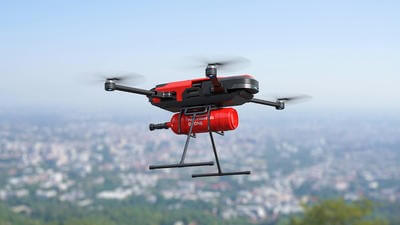
Drones were first introduced into the Western Australia (WA) Police Force in 2018. The WA Police Force has also chosen specific technologies for its drone fleet. High-definition cameras, lighting, sirens, and speakers have been payloads that the Force has invested in. The WA Police Force said: “Western Australia is the single largest policing jurisdiction in the world, and the inclusion of RPAS technology has significantly enhanced police search and response capabilities across vast distances and rugged terrain that cannot always be accessed by vehicles or personnel.”
Canada is another country with vast regions, and it is looking ahead to more capable drones that can fly safely, avoiding other air users. The Alberta Royal Canadian Mounted Police’s (RCMP’s) Officer-in-Charge of Air Services, Inspector Corey Blize, said: “Hopefully, as we go with detect-and-avoid technology, we’d be able to get even greater radiuses for those rural-type searches that are going to have to cover a lot of ground.” ‘Detect and avoid’ is, as the phrase suggests, where the drone can detect other aircraft and maneuver to safely continue on the journey.
As we go with detect-and-avoid technology, we’d be able to get even greater radiuses for those rural-type searches that are going to have to cover a lot of ground
Police forces are seeing advantages in drones over and above traditional crewed aviation. “Police RPAS provide significant operational benefits by delivering rapid, low-cost aerial capability that would otherwise require manned aviation resources,” New Zealand Police’s Senior Sergeant Bevan Cranston said. “They can be deployed immediately, often arriving on scene faster than helicopters, and at a fraction of the cost, with very low ongoing maintenance requirements. Their small size and ease of use allow them to be launched close to an incident, while reducing risk to staff and the public.”
Stadium views
In the UK, West Midlands Police announced earlier this year that it would be installing drones at Villa Park and Molineux football stadiums. The project is a partnership between West Midlands Police, the Premier League, Aston Villa and Wolverhampton Wanderers, and the National Police Chiefs’ Council (NPCC). The drones will eventually be housed in weatherproof ‘drone hubs’ at the two stadiums. They will be flown by experienced police pilots working from control rooms many miles away.
The drones will help police search for missing people, give officers a real-time view of a serious collision, and aid with the detection of civil drones flying illegally around the Premier League grounds. Announcing the launch in February, West Midlands Police’s then Assistant Chief Constable, Matt Welsted, said: “We’ll be using the drones as first responders, so that they can take off even when teams aren’t playing, and get to the scene of serious collisions, or help with searches for wanted or missing people quickly and safely … This is a truly groundbreaking use of technology which will have a real impact on fan safety at football matches, and wider public safety in the West Midlands.”
This is a truly groundbreaking use of technology which will have a real impact on fan safety at football matches, and wider public safety in the West Midlands
In New Zealand, a scoping exercise is underway for the police force’s next procurement, as Cranston explained: “Our current fleet is now considered RPAS generation one, and we are scoping RPAS generation two, which is expected to significantly expand capability and endurance. This future capability may include advanced multi-rotor platforms, autonomous helicopters, fixed-wing, or vertical takeoff and landing (VTOL) aircraft, depending on operational needs and funding.” The key features of this future capability include long-duration loiter capability, beyond-visual-line-of-sight (BVLOS) operations, and autonomous landing and refueling.
In December 2025, the WA Police Air Wing negotiated, on behalf of Australian law enforcement agencies, regulatory exemptions from the Civil Aviation Safety Authority (CASA) to allow police drones to operate BVLOS and over populous areas. For the RCMP, while Canada can have areas with a low population density, BVLOS does still require police observers to be involved. Blize said: “The regulations, in regard to beyond-visual-line-of-sight, [are] heavily dependent now, without any special authorities, on the population density of the area. And so, we can do some BVLOS under what’s called Level 1 Complex Operations with a visual observer put in the middle of the area for the detect and avoid. But it’s all based on that population base, so, unless you’re out in a rural area where the population is very small, you can’t use that in an urban environment per se.”
For its own more extensive flight operations, New Zealand Police is expecting the RPAS “generation two” platforms to incorporate 360-degree detect-and-avoid systems, similar to terrain collision avoidance systems, or TCAS, to safely integrate them into a shared airspace with crewed aircraft.

Drone in a box
While longer-range operations still have technological and regulatory obstacles, drones are being deployed for SAR, evidence capture, crash scene mapping, crowd monitoring, and providing situational awareness during critical incidents and major events. Drones will help police personnel search more widely faster and “enhance the efficiency of incident response”, according to the WA Police. For some police forces, the concept of a unit going on patrol with a UAV in the back of the patrol vehicle or venturing out from a station when called is the old way of doing things. To make the most of the new drone technology and exploit its capabilities for a rapid first response, the idea now can be summed up as ‘drone in a box’.
In North Yorkshire, Cleveland Police has implemented the drone-as-first-responder (DFR) concept as part of a national UK program that sees drones stationed in weatherproof boxes. They are launched and piloted remotely from Cleveland Police’s control room. The concept is the DFR can reach the scene of an incident in as little as 90 seconds. According to Cleveland Police, the drone sends back a “live-time view of what’s happening”, so police resources can be “effectively deployed”. The drone’s imagery is then available for subsequent investigation or prosecution and, at the end of the task, they will return to their boxes and recharge to prepare for the next deployment.
Since the beginning of 2026, a DFR has been deployed to 73 incidents across the Cleveland area. There are 59 pilots and they deploy drones to incidents such as searching for vulnerable missing people, illegal off-road bikes, or tracking a suspect. They can also be used during pre-planned policing operations. The DFR drone-in-a-box capability is in addition to Cleveland’s fleet of “business as usual” drones, which were deployed 2,185 times in 2025.
The DFR drone-in-a-box capability is in addition to Cleveland’s fleet of business as usual drones, which were deployed 2,185 times in 2025
In February this year, police in New South Wales, Australia, launched the PolAir-Remote program drones, which are also housed in a self-contained box that they are launched from, return to, and recharge in. The first two drones were installed on the rooftop of the police station of the town of Moree about 650km northwest of Sydney and 400km west of New South Wales’ Pacific coast. Since their installation in January, the two drones have been activated to aid with arrests for assaults, breaking and entering, and for vehicle recoveries.
PolAir-Remote is a collaboration between New South Wales (NSW) Police Force’s Aviation Command and its Technology & Communication Services Command. Another two drones are remotely piloted from a remote operations center at Bankstown Airport in Sydney’s suburbs, with real-time video being fed back to operational police. The trial in Moree runs for six months, with more drones expected to be installed in other locations. Following the launch of the PolAir-Remote program, the NSW Police Deputy Commissioner for Regional Field Operations, Paul Pisanos, said: “This is the first time drones will be used in this capacity – where they will be remotely piloted without the need for an on-site pilot. The drones are an expansion of the existing aviation capabilities used across the state ... The trial has so far proven to be successful in tackling regional crime and giving the region a boost in operational resources.”
A key component
Since 2024, the WA Police Force has also trialed a drone-in-a-box system. This was at Yanchep Police Station about 60km north of Perth on the Western Australian coast. This autonomous drone has been housed in a self-contained charging and storage unit. It is capable of launching, flying pre-programmed missions, landing and then recharging without direct human intervention. The system is remotely operated by an officer based at the Police Air Wing, with a second operator required on the ground to monitor operations.
The RPAS program continues to meet agency expectations and provides meaningful support to officers and partner agencies
The WA Police said: “The RPAS program continues to meet agency expectations and provides meaningful support to officers and partner agencies. RPAS technology remains a key component of WA Police Force capability, forming part of the broader statewide RPAS framework coordinated by the Police Air Wing.”
The WA Police Air Wing, which chairs Australia’s National Law Enforcement Working Group, which works with CASA, is based at Perth’s Jandakot Airport. The Wing has more than 80 police RPAS pilots deployed across metropolitan and regional areas.
In New Zealand, all pilots complete their initial training through a Part 141 training provider approved by the country’s Civil Aviation Authority. The initial qualification process is a five-day course covering aviation law, safety, legislation, and practical flying skills.
They will be used for more longer-term search and rescue situations, monitoring major events, critical incidents, those kind of things
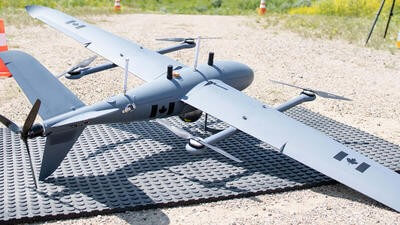
The Alberta RCMP is to obtain quadcopters that have a flight endurance of up to 70 minutes. The Canadian Mounted Police also want to operate fixed-wing drones for longer. “They will be used for more longer-term search and rescue situations, monitoring major events, critical incidents, those kind of things,” Blize said.
Blize said he wants some dedicated RPAS pilot positions within his unit who would be able to conduct these longer-duration/range drone missions. “This unit can come in and take over from the local pilots and be in that [mission pilot role] for the long haul,” while the local police that were operating the drones could return to “frontline policing”, he explained.
With quadcopters, the altitude the RCMP fly at is under 400ft, but with the fixed-wing RPAS they will operate at higher altitudes. Fixed-wing platforms can fly for four hours instead of a time measured in minutes. The fixed-wing RPAS would be used for the more traditional SAR operations and not necessarily as a first responder. “We’ll be working with Transport Canada over time in regard to incorporating those systems, and it’s just like everybody, it’s trying to sort out that airspace and who’s flying at what and what they’re allowed,” said Blize.
Trying to sort out what does what could be a crude description of how police forces worldwide are slowly integrating drones into their operations. For some, that rapid flight time to a local ongoing crime scene will be the appropriate application, beaming back video in real time from an event, while other drones will be logging many hours in search and rescue. What is not unclear is the current and future importance of RPAS to police work and the safety of the public.
July 2026
Issue
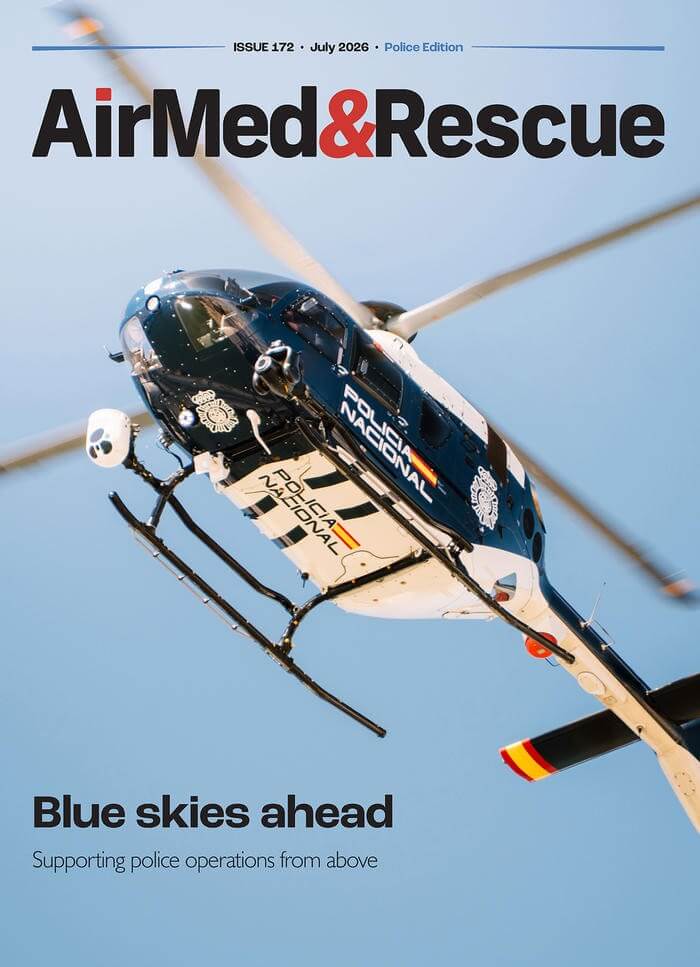
As another July rolls around, it’s wonderful to bring you the airborne policing edition of AirMed&Rescue. We have features on the development and strategies used during aerial missing person searches; the active threats that affect aviation and law enforcement services particularly; the bread and butter of police aviation, the patrol and support operations; and the increasing use of drones as a force multiplier and sometimes as a first responder.
Rob Coppinger
Rob Coppinger is a veteran aerospace writer whose work has appeared in Flight International, on the BBC, in The Engineer, Live Science, the Aviation Week Network and other publications. He has covered a wide range of subjects from aviation and aerospace technology to space exploration, information technology and engineering. In September 2021, Rob became the editor of SpaceFlight Magazine, a publication by the British Interplanetary Society. He is based in France.