
Saving lives in swiftwater scenarios

Worldwide training in swiftwater rescue is a deep well of knowledge regarding safety, environmental conditions, equipment, and risk, reports Jennifer Ferrero
Swiftwater rescue is dangerous because it leaves less time to act and carries greater risks. Fast-moving water constantly pushes people into hazards, increasing the chances of drowning and hypothermia. Rescuing someone in these conditions requires advanced skills, specialized equipment, and the ability to spot and anticipate risks in a rapidly changing situation. There are millions of rivers worldwide, with over 165 considered major rivers. Water speed can be affected by flooding, rapids, and narrow channels. Rescuers also operate in floods, lakes, and oceans.
Worldwide, swimmers trained in swiftwater rescue are standing by for the call. In some cases, they are called for lifesaving efforts; in others,for recovery.
Darci Cruz is an Aviation Rescue Swimmer with the Brazilian Navy and has held the role for 17 years. He operates in oceans, rivers, lakes, floodplains, and coastal environments, and said he’s part of one of the largest search and rescue (SAR) areas in the South Atlantic. Álvaro San Martín operates SARChile and provides swiftwater rescue training in that region and nearby countries. James Whitfield has worked in this field for 18 years and currently works for Search & Rescue Services Ltd (SRSL), providing air medical and rescue services on New Zealand’s North Island. His role today is Critical Care Flight Paramedic and Rescue Swimmer. Finally, in Utah, Scott Solle is the Director of Training for the Swiftwater Safety Institute of Jackson, Wyoming, which provides training across the USA, and into Mexico and South America.
Routes into swiftwater rescue
There are many different ways to enter the industry. Solle said he initially became involved with whitewater rafting tours and eventually SAR out of necessity. Cruz became involved to “help people in distress”, and added: “Search and rescue combines technical expertise, teamwork, aviation, and the opportunity to save lives during critical situations.” Whitfield entered the field because “I was always drawn to high-performance emergency medicine and environments where technical skill, teamwork, and decision-making genuinely change outcomes.” San Martín joined swiftwater rescue because he is a rafting and mountain guide. His business is called to help when the Chilean government needs rescue support.
As with any career, there are challenges in training for swiftwater rescue. In New Zealand, Whitfield said, “the biggest challenges are often environmental and operational rather than purely clinical. Weather, terrain, access limitations, rotor wash, fatigue, time pressure, and constantly evolving risk all influence decision-making during rescue operations. In these environments, crews are continually balancing the urgency of reaching a patient against the safety margins required to conduct the mission safely.”
Weather, terrain, access limitations, rotor wash, fatigue, time pressure, and constantly evolving risk all influence decision-making during rescue operations. In these environments, crews are continually balancing the urgency of reaching a patient against the safety margins required to conduct the mission safely
In Chile, San Martín said one of his greatest challenges was a lack of support. He also said most of their rescues were recovery missions because of the time required to reach the location or other factors. He shared that he must adapt to different situations, equipment, and devices. Solle said that, in the USA and other locations where they conduct training, they often train folks who will either become competitors or complete the training only to focus on a different job, creating a gap in trained personnel. Cruz said that, in his work in Brazil, it was a challenge to locate a missing person in a timely manner, and “search and rescue is highly dependent on time, environmental conditions, and available information”.
Whitfield cited a story in New Zealand that resonated with him: “I recall an incident involving a patient on a fishing trawler more than 100 miles offshore who had suffered a cardiac arrest and achieved return of spontaneous circulation (ROSC) prior to our arrival. By the time we reached the vessel, operational constraints meant we had less than 10 minutes on scene before needing to depart. In situations like this, priorities shift rapidly – the immediate focus becomes safe extraction and rapid transport, with more advanced clinical interventions continuing once the patient is in a more controlled environment.”
In Brazil, Cruz said that swiftwater rescue wasn’t often called upon, but when flooding occurred, it was mission-critical. “Routine helicopter swiftwater rescues are relatively uncommon in Brazil. However, they become critically important during major flooding disasters caused by severe rainfall and tropical storm systems.”
Mustang Survival has been in the business of making rescue equipment for almost 60 years, this expertise and experience is built upon collaboration and integration with rescue personnel. Brent VanBruaene, Business Development Manager for Public Safety at Mustang Survival, said that the equipment is vital when considering any sort of swiftwater rescue: “ Having the right equipment is critical in swiftwater rescue because the hazardous environment leaves very little margin for error. Rescuers may be operating in fast-moving debris filled water, low temperatures, poor visibility, and difficult access conditions. All while simultaneously managing victims, ropes, boats, or other rescue systems.
“Personal protective equipment (PPE) provides more than just protection. It has to support the rescuer’s ability to perform the mission. Properly selected flotation, thermal protection, exposure protection, and rescue-specific support items should allow the rescuer to move efficiently, maintain mobility and remain functional throughout an extended operation.
“Durability is equally important. Swiftwater PPE is routinely exposed to abrasion, repeated immersion, contaminated water, rocks, structures, and other hazards that may be far beyond what conventional recreational marine equipment experiences. Equipment needs to maintain its protective characteristics despite this operational abuse.” VanBruaene added: “Ultimately, the purpose of professional rescue PPE is to reduce the workload being placed on the rescuer. When this goal is obtained, the rescuer can devote more attention and energy to situational awareness, technical decision-making, and completing the rescue. That is why equipment selection should always begin with the mission profile rather than simply selecting a product because it is classified as marine equipment.”

Conditions for training
Solle also cited differences in river water flow between low- and high-water conditions and how that could affect their training. “You’ve got different rivers all over the country; what we teach in one place may be different in another place. We may go to a location and train there; we’ll look at the river and ask what meets all the minimum requirements for teaching our course. Rivers are unpredictable in how much water they have.” He said the Colorado River was setting records for low water levels and drought. He also said that because SAR was a deep topic that involved many roles, not just swiftwater rescue, water rescue was just one component of training among several SAR conditions. They try to meet with trainees in April before the spring runoff begins.
Training elements can vary by location, but still overlap. In New Zealand, Whitfield said: "Swiftwater and aerial rescue require layered, highly specialized training. This includes rescue swimmer capability, flood and moving-water awareness, winch operations, survival training, aviation safety, crew resource management, and advanced pre-hospital clinical care. Most importantly, training must be repetitive, realistic, and scenario-based. Many of these technical and non-technical skills are highly perishable and can deteriorate quickly if they are not practiced regularly in operationally relevant environments.”
Solle said that in the USA and beyond, “we have different courses, and there are those people in recreational situations who want to become educators – they take a rec class; the river guides, their job is to navigate, and when things happen, they need to perform guiding skills to save people”. He said there were variables depending upon someone’s role as a river guide or a SAR person.
Personnel require rescue swimmer qualification, helicopter underwater escape training (HUET), diving training, survival courses, mountain rescue techniques, aircrew training, and continuous operational exercises
Cruz cited specific types of training: “Personnel require rescue swimmer qualification, helicopter underwater escape training (HUET), diving training, survival courses, mountain rescue techniques, aircrew training, and continuous operational exercises.” He closed with: “Realistic and recurring training is essential.”
San Martín said they had different programs and worked with the Swiftwater Safety Institute and the US National Fire Protection Association (NFPA), and they teach the program there. He is going to bring the programs to different countries in South America.
The tools for learning
Technology and equipment are also factors in swiftwater rescue that all subjects have experienced in different ways. In Chile, San Martín said they don’t have much high-tech equipment, but they are using drones to find people. Otherwise, he orders equipment from Amazon and eBay, which he said was very easy.
Whitfield listed the equipment he requires: “Specialist PPE is essential – drysuits or immersion suits, helmets, flotation devices, rescue knives, thermal protection, communications equipment, and water-specific harness systems.”
The value of rescue equipment is that it is designed for the job, and the job is demanding, said VanBruaene: “The fundamental difference is that professional rescue PPE is designed around an operational mission rather than simply around keeping somebody afloat or protected from the weather. A professional rescuer needs to be able to swim aggressively, climb, crawl, work from boats, operate rope systems, carry communications equipment, and make physical contact with a distressed victim. Those requirements create very different design considerations than those associated with conventional boating or recreational marine apparel.
“Rescue dry suits may incorporate reinforced high-wear areas, protective padding, improved mobility, integrated dry socks, cargo storage, and field-repair capabilities because rescuers routinely operate in environments where durability, mobility, and continued operational readiness are critical. Mustang Survival’s Sentinel Water Rescue Dry Suit is an example of this mission-specific design approach. It incorporates reinforced knee, elbow, and seat areas; protective padding; mobility-based sizing; waterproof/breathable construction; and replaceable seals.
“The distinction is therefore not simply that professional equipment is more rugged. It is that every component should be evaluated in terms of how it affects the rescuer’s ability to perform the task safely and efficiently.”
The distinction is therefore not simply that professional equipment is more rugged. It is that every component should be evaluated in terms of how it affects the rescuer’s ability to perform the task safely and efficiently
Cruz listed technical items such as “GPS navigation, moving-map systems, night vision devices, thermal imaging cameras, weather-monitoring systems, and advanced communication equipment”, which significantly improve situational awareness and safety. He added that, for equipment, they rely on rescue helmets, flotation vests, rescue harnesses, gloves, protective footwear, and thermal protection. In special circumstances, he added, they need rescue straps, cutting tools, and medical equipment.
Solle said that because he couldn’t find the rescue and whitewater equipment when needed, he started his own equipment company alongside his work with the Swiftwater Safety Institute and Grant County Search and Rescue. His company is called Solgear, a play on his last name.
Other equipment, of course, is much larger and more impactful: helicopters. In Brazil, Cruz said they use helicopters, factoring in weather, crew experience, and aircraft capabilities. He shared that different aircraft platforms were considered: “Larger helicopters typically provide greater endurance, payload capacity, and rescue equipment options, while smaller aircraft may offer superior maneuverability in confined areas.”
Whitfield said weather could be a restricting factor for helicopter operations “very often. The same weather that creates the flood emergency also poses aviation challenges – low cloud, poor visibility, wind shear, turbulence, heavy rain, and powerline hazards. There are times when aircraft simply cannot operate safely, regardless of the urgency of the incident.”
Power of experience
The rescuers provided advice based on their experiences. Cruz said: “Never underestimate the power of moving water. Maintain situational awareness, train realistically, communicate effectively, and always prioritize rescuer safety. A rescuer who becomes a victim can no longer help others.”
San Martín also said that communication between the team was most important. Whitfield reflected his thoughts on communication as well, especially when a helicopter is involved: “Poor communication in aviation rescue environments can become dangerous very quickly. Everyone must understand the plan, contingencies, hazards, and abort criteria. The best teams communicate constantly, but calmly and clearly. Good crews often anticipate problems before they develop.”
A rapidly changing environment or mission profile needs gear that can be used in multiple scenarios, explained VanBruaene: “Operational versatility is extremely valuable in rescue because the environment can change much faster than responders can realistically change PPE. A rescue crew may begin an incident working from shore, transition into a boat, enter the water, operate downstream, and then spend an extended period working in cold, wet, or windy conditions. Flood-response crews may move between vehicles, structures, boats, and moving water several times during the same incident.
“If PPE can accommodate those transitions without continually changing equipment, it reduces complexity and helps keep rescuers mission-ready. Every equipment change introduces wasted time, logistics, and the possibility of someone entering a hazard zone wearing equipment that is not appropriate for the conditions they may ultimately encounter.” VanBruaene continued: “There is also an important human performance consideration. PPE that provides protection but significantly restricts mobility, traps excessive heat, or creates unnecessary bulk can itself become a performance issue. The ideal system balances protection, breathability, mobility, flotation and durability within the expected operation.
“That does not necessarily mean that one piece of equipment should be expected to perform every mission. There are situations where specialized equipment is still the appropriate choice. Ice rescue, is an example operation that can create unique PPE requirements. The goal should be to equip responders for the reasonably foreseeable worst-case conditions within their mission profile. All while maintaining enough mobility and comfort that they can actually work effectively in that equipment.

“A useful way to think about it is that rescue PPE should provide a range of capabilities. The broader the range of conditions a trained rescuer can safely operate in without changing equipment, the more adaptable and immediately deployable that rescue team becomes. For manufacturers, that means designing equipment around the complete mission rather than a single moment within the rescue,” concluded VanBruaene.
How can rescuers anticipate risk so they make the right choices? In the case of helicopter use, Solle shared: “It’s more dangerous; here we work with different agencies, and some of them don’t work at night; some will fly in worse weather than others. If you are working with an air ambulance, they may be limited by the Federal Aviation Administration (FAA). I’ve been in helicopters in bad weather, it’s a lot more charged; there’s a different feel to it – the pilot and rescuers are accepting a level of risk.”
According to Cruz, “risk anticipation comes from experience, continuous training, constant environmental assessment, and maintaining situational awareness. Conditions can change rapidly, requiring immediate adaptation.”
Risk anticipation comes from experience, continuous training, constant environmental assessment, and maintaining situational awareness. Conditions can change rapidly, requiring immediate adaptation
In a shifting, dynamic, and volatile scenario, what is the best way to assess needs? Whitfield said: “By constantly reassessing. Dynamic risk assessment is continuous in rescue aviation. Conditions change minute to minute, so crews need to remain adaptable without becoming reactive. Strong preparation, clear leadership, good communication, and recognizing deteriorating safety margins early are all essential.”
Whitfield also said that the strength of a crew was knowing when to deploy a helicopter in a swiftwater rescue situation. “In swiftwater environments, especially, that might mean direct insertion and recovery, but it can equally mean using the aircraft to deploy personnel and equipment, conduct aerial search, provide overwatch and real-time situational awareness, or support coordination across multiple agencies. The helicopter is an incredibly versatile asset, and knowing how to match its capability to the situation, rather than defaulting to a single approach, is a key part of what makes operations safe and effective.”
Committed training
Worldwide, swiftwater rescue training can provide a solid foundation for communication, risk assessment, and the best use of equipment. Factors such as government support and a deep pool of trained personnel are critical in SAR scenarios. Experts are committed to the success of their missions, no matter where they are in the world, which provides peace of mind for all who enjoy rivers and lakes for recreation or face environmental challenges such as flooding.
October 2026
Issue
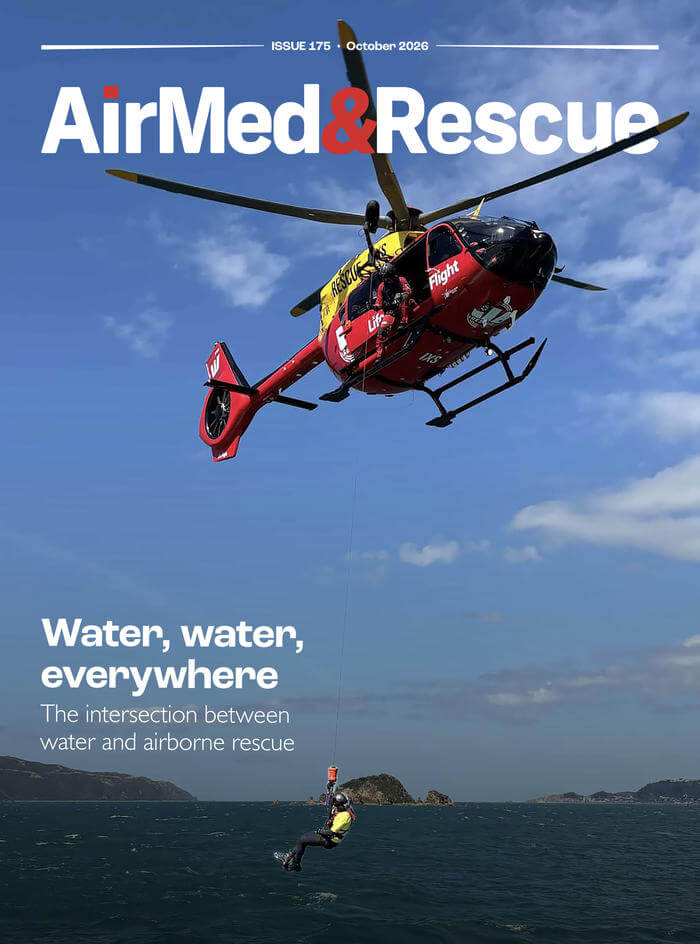
The latest edition of AirMed&Rescue is packed full of content to keep you occupied in October. We have features on the challenges that swiftwater presents when trying to rescue someone; how sensor technology is affecting and improving aerial firefighting missions; why operators choose to have a varied fleet of aircraft to perform special missions; and what can be done to improve the accessibility and awareness of mental health assistance programs for safer and sustainable working conditions.
Jennifer Ferrero
Jennifer Ferrero owns Ferrero Agency. She focuses her writing on feature stories for aerospace and manufacturing trade publications. She also provides marketing and public relations services. She has been an entrepreneur and writer for over 25 years. She lives in Spokane, Washington.