
Spin class

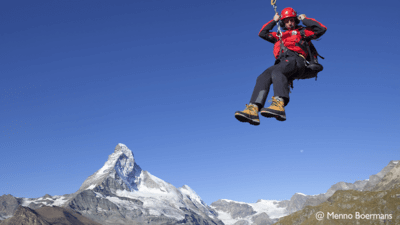
Spinning during helicopter hoist operations can be at least disorientating for those involved and, at worst, extremely dangerous. Avoidance is always best and preparation is key, reports Emma Kelly
“The moral of the story is to always know when a spin is likely to develop, identify ways to avoid it, and have a plan in place if it does happen,” said Kim Germishuys, SAR Technical Crewmember at Bristow Ireland.
Germishuys has experienced spin a few times in her career, which started in search and rescue (SAR) in Cape Town, South Africa, as a surf lifeguard and maritime SAR for the National Sea Rescue Institute of South Africa. “I started my helicopter career as a volunteer rescue swimmer over 20 years ago. I then became a full-time hoist operator on a sea pilot transfer helicopter and in 2021 I eventually landed a winch operator position on the Dutch Caribbean Coast Guard helicopter in Curaçao,” said Germishuys.
Today, Germishuys finds herself in a very different environment, as a winch operator and paramedic on the Irish Coast Guard SAR Leonardo AW189s based in Waterford, on Ireland’s southeast coast, one of four bases operated by Bristow Ireland in the country. “Ireland has a very rugged coastline, with regular storms coming off the North Atlantic. With this in mind, the crews need to be proficient flying in all conditions, whether it’s offshore, in the mountains or along the many cliffs and beaches,” she explained.
In Australia, Georgia Whitehouse, Rescue Crew Member (RCM) with CHC Helicopter, faces different conditions, but agrees on the importance of preparation. “It starts in preparation, equipment design, procedures, and briefing so we avoid any potential for a spin or swing in the first instance,” she said.
Whitehouse is based at Royal Australian Air Force Base Amberley in Queensland delivering SAR and emergency medical services (EMS) operations, primarily on the Leonardo AW139, across Australia supporting the Australian Defence Force (ADF), as well in national and international military exercises. “Our role is to deliver 24/7, all-weather rescue capability – everything from overland and offshore SAR to medical retrievals and support defense operations,” Whitehouse explained.
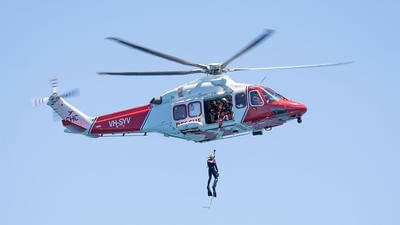
Much of this work involves specialized hoist operations, including night stretcher recoveries from the water and automated letdowns using the aircraft SAR modes.
“We work across a wide range of environments – offshore, coastal, inland, and mountainous or cold-weather regions. That can mean anything from open water to alpine, rugged terrain or hot, dusty desert conditions,” Whitehouse said. “As an all-weather SAR crew, we’re constantly adapting. The wide range of conditions we operate in can heavily influence how a hoist load behaves. Wind, terrain, and environmental complexity all play a big role in hoist dynamics, particularly when it comes to managing spin.”
Likewise, on the other side of the country in Western Australia (WA), Bec Lickel, Aircrew Officer (AO) with RAC Rescue, faces a variety of hoisting conditions. RAC Rescue is the only dedicated emergency rescue helicopter service in the vast state of WA, which covers almost 2,530,000km², and is predominantly tasked with all-hazards rescue incidents including car accidents, land and water rescues, farm accidents, and incidents in remote areas. RAC Rescue’s AW139s are funded by the WA state government, managed by the Department of Fire and Emergency Services (DFES), and sponsored by RAC.
Lickel operates from Bunbury in the state’s southwest. “We cover a diverse range of geography, from the coast to farmland in the wheatbelt, out to the mountain ranges on the south coast and everything in between. This provides us with some amazing scenery, as well as a range of complex hoisting and confined-area operations,” she says.

Knowing the symptoms
For all three, the key is recognizing the conditions that can result in a spin, avoiding them and knowing how to deal with spin events if they occur.
“Spin is usually the result of a combination of environmental and aerodynamic factors coming together,” explained Whitehouse. “Wind and turbulence are key drivers of hoist load instability, particularly crosswinds and disturbed airflow around the aircraft.”
Very low or no wind conditions can also increase the likelihood, with the absence of ambient airflow meaning there is less natural aerodynamic damping acting on the load, with rotor downwash and recirculating airflow beneath the aircraft increasing the potential for load rotation and oscillation.
“The aircraft downwash on a windless or low-wind day is the key factor which can induce a spin,” concurred Germishuys. “It can also occur in certain winching situations where the wind or the downwash of the aircraft is manipulated by a ship’s structure, a cliff face or a cliff corner.”
Operating near obstacles, in confined areas, close to the ground or structures can all create disturbed and unpredictable airflow, which increases the likelihood of rotation, agreed Whitehouse.
“Load shape, surface area and orientation, particularly any asymmetry, will affect how much the load is affected by downwash and therefore the likelihood of spin occurring,” said Lickel, with light or variable wind conditions increasing the effects of rotor downwash.
Load shape, surface area and orientation, particularly any asymmetry, will affect how much the load is affected by downwash and therefore the likelihood of spin occurring
Asymmetrical loads, large surface areas or poor rigging all increase susceptibility, added Whitehouse. In stretcher operations, wake formation can contribute, while in strop rescues, equipment such as fins can provide additional rotational forces. “We recently ran a hypothermic strop recovery scenario where there was very little wind, and spin became one of the biggest considerations,” explained Whitehouse. “Even small adjustments, like removing fins from the patient before the lift and minimizing time in the highest rotor wash zones, made a noticeable difference.”
Aircraft positioning and any movement between the aircraft and load can influence how and when a spin develops.
Aircraft with a higher power requirement are more susceptible to spin due to the increased downwash. This is a trade-off, said Germishuys, with the power capabilities of such helicopters to be able to hover and conduct winching operations.
Training correctly
Effective training is vital to ensure crew can handle whatever they face. “We have a comprehensive training and checking program to ensure we are regularly out flying and conducting training serials,” said Lickel. “This ensures we are well drilled in the procedures and are able to respond appropriately if it occurs during live operations.”
Germishuys said initial training covered basic flight principals, including the effect of the helicopter’s downwash and understanding the effects of the wind during winching operations, while recurrent training ensures crew are trained for all eventualities. “We are trained in the use of hi-lines in various situations and what to do in the event a spin does develop,” she said. “It is something that can be practiced in a safe, controlled situation, so that one is prepared for when a bad spin does develop and the crew does not hesitate in mitigating the situation.”
Whitehouse said CHC crew conduct scenario-based hoist training across a range of environments, including simulation, focusing on load control, aircraft positioning, and coordinated crew response. “This exposes crews to the conditions where spin is more likely, helping build early recognition and, critically, the judgment to respond appropriately under pressure,” she added.
This exposes crews to the conditions where spin is more likely, helping build early recognition and, critically, the judgment to respond appropriately under pressure
Whitehouse said training also included managing rotation on approach to the aircraft, focusing on avoiding instinctive reactions that could lead to injury, such as grabbing the aircraft to stabilize, which can lead to shoulder injuries. Rather, the RCM is trained to use a controlled open hand on the aircraft step to dampen spin while protecting the patient’s head and limbs, she explained.
Out in the field, it’s vital to always be aware of the environment and conditions to minimize the possibility of a spin. “It’s a dynamic risk assessment that happens continuously during your shift,” explained Germishuys. This starts with the pre-flight briefing, taking note of the weather, the wind conditions, and the situation. “It is threat and error management, constantly identifying and assessing the threat and briefing ways to mitigate it,” Germishuys added.
This continues at the SAR location. “We take note of wind in the area, how the wind or turbulence is moving where the casualty is located or at the winching area, what can be done to avoid a spin, and the safest action that needs to be taken in order to protect the winchman or persons on the hook in the event of a spin,” Germishuys said.
During the pre-winch briefing, a safety brief is always discussed by the crew. “Depending on the safest course of action and the situation, various plans can be decided and verbalized so that pilots and winch operator know what action needs to be taken and the winchman knows what to expect in the event a spin occurs,” she explained.
If a safe flight path is possible, this could include conducting a “gentle fly-away at low speed to produce enough airflow over those on the hook to reduce or even abate the spin enough to recover them into the cabin safely”. Alternatively, the winch operator and/or casualties can be placed back on the ground or into the water.
Prompt action is crucial. “If a spin starts to develop, early mitigation is essential to prevent injury to the Rescue Crew Officer-qualified Critical Care Paramedic (RCO CCP) and patient,” said Lickel. If the CCP and patient are close to the ground, the AO may choose to carefully place the load back on the surface or, if they are close to the aircraft, they may elect to continue hoisting the load to just below the aircraft and manage the situation from there, she said. “In some cases, it may be more practical for the aircraft to transition to forward flight to arrest the spin, but this is a last resort due to the associated risks,” Lickel added.
The right tools and techniques
RAC Rescue uses several tools to avoid the risk of spin in the first place. “During water hoist recoveries, it can be as simple as removing dive fins if the patient is wearing them, as the fins can catch the wind and cause a rapid spin,” said Lickel.
For stretcher hoist operations, a basket stretcher with a mesh base is used, allowing air to pass through, with an 85m tagline attached to the stretcher. “During the hoist, the tagline attendant will position themselves between the one and three o’clock position to the aircraft and apply pressure to the tagline to stop the stretcher from spinning. Through the use of the tagline, the AO and RCO CCP are also able to work together to pull the stretcher away from the sponson as it reaches the door to assist in the recovery into the aircraft,” Lickel explained.
“We also use other techniques, like conducting control checks lower to the ground where the load is less affected by the aircraft downwash,” she added. Furthermore, the CCP will keep themselves in an upright position with their medical packs between their legs to reduce the chance of catching downwash and inducing spin. They might also use their hands, or fins during water rescues, to help direct airflow.
We also use other techniques, like conducting control checks lower to the ground where the load is less affected by the aircraft downwash
Bristow Ireland crew have “a few tools in our toolbox” to reduce the chances of a spin, concurred Germishuys, pointing to changing the aircraft’s height during winching to reduce the downwash or using a hi-line to stabilize the person or equipment on the hook.
Bristow Ireland uses two different lengths of hi-line – a 50m-long winch operator-deployable hi-line and a 70m aircraft-deployable hi-line. The operator also uses a dual-hoist setup to provide redundancy in case one hoist fails.
Dual-hoist systems provide a critical backup capability in the rare event of a primary hoist failure, said Whitehouse. Such redundancy is particularly important during long-range overwater operations at night or marginal weather conditions, she added.

Teamwork
Managing spin is very much a team effort. “It comes down to coordination between pilots and crew, combined with good technique and planning,” explained Whitehouse. “Strong communication, clear debriefs, and regular training all play a key role in anticipating and managing spin before it develops.”
Whitehouse said the tagline (trail line) and hi-line were the most effective tools they had to diminish spin. When attached to loads, such as the stretcher, they give the crew direct control of the load, significantly reducing rotation. “On land, the RCM controls the tagline to stabilize the stretcher as the load is hoisted. This method is also routinely employed during overwater wet stretcher lifts, where controlled tension is maintained on the tagline throughout the lift,” Whitehouse explained.
When a tagline isn’t available, technique becomes more important, said Whitehouse, adding that early recognition and coordinated crew response were key. “Like most things in SAR, managing spin is about anticipation as much as reaction. Minimizing the risk is the starting point, followed by continually reassessing and adapting as needed,” she said.
Like most things in SAR, managing spin is about anticipation as much as reaction. Minimizing the risk is the starting point, followed by continually reassessing and adapting as needed
She points to minimizing time spent in high rotor-wash areas, keeping the hoist smooth and controlled, using body positioning to dampen smaller rotations, and returning to the pick-up point if needed to regain control. “Our training and CHC’s operating standards are designed to reduce the cognitive load in these moments, so my team and I can make clear, safe decisions under pressure,” Whitehouse added.
Crews need to be prepared for changing conditions. “Hoist operations can be complex due to the rapidly changing environment and require constant reassessment and implementation of small adjustments to ensure the hoist recovery runs smoothly,” said Lickel.
Safety
The focus is keeping the patient stable, protected, and supported throughout the lift, said Whitehouse, with patient packaging designed to reduce the impact if rotation occurs. CHC uses Lifesaving Systems’ Medevac 406 titanium framed stretcher, with the patient securely strapped in to minimize movement, and wearing hearing, head, and eye protection. “When hoisting from the water using a hypothermia strop, we remove any items that could contribute to spin and secure the patient’s arms to minimize rotational forces,” she added.
The restraint configuration used on RAC Rescue’s stretchers is designed to protect patients throughout a hoist extraction, including spin. “There are seven restraints placed over the patient, including two over the shoulders, to prevent them from sliding either up or down the stretcher if a spin was to develop,” Lickel explained.
RAC Rescue’s flight standards team is constantly looking at and testing new ways to improve operations, including spin prevention, said Lickel. “However, the design of our rescue devices combined with tagline procedures and the extensive training we undergo continues to be very effective at spin prevention,” she said.
With knowledge, techniques, and training, crews are well equipped to handle the situation. “Being prepared is the key to a safe outcome,” said Germishuys.
Whitehouse concurred: “Ultimately, it comes back to training, communication, and coordination across the crew.”
August 2026
Issue
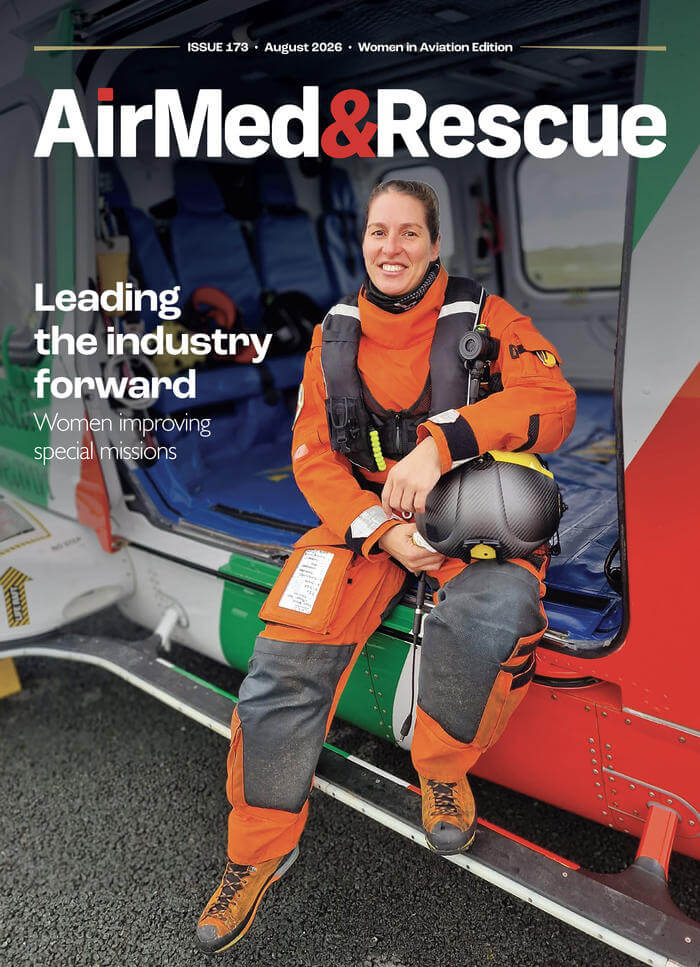
August is a special time of year, and it is my pleasure to present a special Women in Aviation edition of AirMed&Rescue. We have features on the importance of preventing and knowing the early signs of hoist spin; the leadership roles and the value of visibility of women in the industry; the inward-facing and external sensors improving special missions; and the variety and standards that flight suits have to meet.