
Special report: Dashing into the fray

Jon Adams looks at what makes the Dash 8-400 the ideal candidate for Conair’s successful and ongoing program of conversion and operation of the platform as an airtanker
Global wildfire threats need a modern, effective, and efficient response. This is where the Dash 8-400 steps in. The platform comes in two firefighting variants: the Dash 8-400AT is an airtanker designed for pure firefighting and the Dash 8-400MRE is a multi-role variant that can be quickly reconfigured for airtanker, medevac, cargo, or passenger missions. The Dash 8-400 itself is the most advanced model of its type and Conair has been building the airtanker for 20 years, having just delivered its 27th Dash 8-400 conversion. Conair takes the De Havilland Canada DHC (Dash) 8-400 and extensively remodels it to make it capable of dropping 10,000L of retardant, water, or foam/gel from an external fitted tank through the proprietary Retardant Delivery System (RDS), which has multiple, constant-flow coverage levels from a single, controlled-flow release.
Specifications
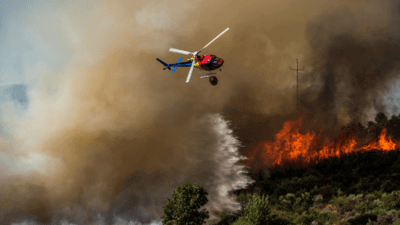
The Dash 8-400AT is a land-based airtanker, powered by two Pratt & Whitney PW150A turboprop engines. The top-of-the-range engines and high T-tail permit the fully loaded tanker to operate from 5,000ft (1,500m) runways, making it a perfect complement to firefighting operations, as shorter runways are more numerous in rural regions and provide closer access to many wildfires, allowing for faster responses to the outbreaks. The aircraft is also able to fly quickly, with a cruise speed of 360kts and drop speed of 125kts, increasing the number of drops possible in a given time. As well as its speed, the platform beats other airtankers for fuel efficiency: it is able to deliver more than twice as much payload for fuel burned than any other large airtanker, which is a huge benefit for the cost of operation and for ongoing sustainability. The aircraft also has an excellent low-speed maneuverability, which is vital when navigating low-altitude drops in mountainous terrain.
The aircraft also has an excellent low-speed maneuverability, which is vital when navigating low-altitude drops in mountainous terrain
Manufacture and design
Using the Dash 8-400 as a base platform has many advantages over converting any other platform for the job, besides the strong performance specifications that make it an ideal airtanker in the first place. The advantages of the low cost and high availability of the airframe cannot be understated. When there is demand for more assets to address the growing need for aerial firefighting, having a platform that is available and cost-effective is key to supplying aircraft to fit the necessity for tankers. The base craft, made by De Havilland Canada, has a strong operational history, proving it to have the reliability needed for continuous operation as an airtanker into the future, prepared for the high-stress missions in its new life as a firefighting airplane. Parts and expertise of the Dash 8-400, still operating commercially today, are readily available for decades to come, ensuring continued emergency response operations far into the future, not at risk of grounding due to a lack of parts or obsolescence. And the airtanker, made by Conair and certified by Transport Canada, the only regulator in the world specifically addressing the aerial firefighting environment, meets international standards to operate, streamlining a safe path for use into new markets.
The tanks of the Dash 8-400AT and MRE are uniquely external; this is a deliberate choice that retains the integrity of the airframe, ensuring continued airworthiness and keeping the aircraft pressurized, reducing pilot fatigue. The external tank also makes the aircraft an ideal platform for multi-role operations beyond firefighting, such that the Dash 8-400MRE is easily reconfigured for passengers, medical evacuations, cargo, or joint roles when it is not being used for firefighting.
The tank and delivery system are special, Michael Benson, Director of Business Development at Conair, explained: “It’s an incredibly reliable retardant delivery system. As much as we talk about the airplanes themselves, which are very important to determine how fast you can get to the incident and how well you can perform in mountainous terrain, it’s the Retardant Delivery System that determines what the footprint of your payload looks like. Our system has been certified by the Interagency Airtanker Board (IAB), which requires a very, very high level of consistency and certainty in terms of the drop if you require a specific coverage level for a specific fuel type, geography, or fire intensity; that is what you can count on receiving on the ground, and it’s very repeatable, ensuring an effective payload delivery. That is part of our value proposition of the aircraft.
As well as an incredibly responsive and reliable Retardant Delivery System, it’s capable of carrying 10,000L of product, which is significant. It is the sweet spot we found in terms of being able to make sure that we had a high payload as well as a really long mission
“As well as an incredibly responsive and reliable Retardant Delivery System, it’s capable of carrying 10,000L of product, which is significant. It is the sweet spot we found in terms of being able to make sure that we had a high payload as well as a really long mission, because, of course, mission duration is critically important, as there are many large fires where an airtanker may make a drop, return to the tanker base, reload in six minutes, and fly back to the fire, repeating this process until containment lines are completed.”

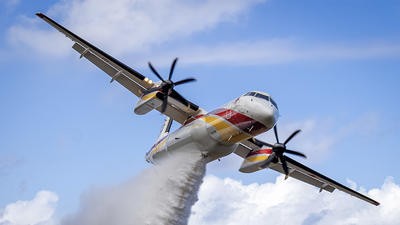
Exploring the many roles that the MRE variant can perform, Benson said: “Aircraft are expensive, and if you can distribute an acquisition cost over a variety of different response missions, or a number of different missions, that can be beneficial for agencies. There’re increased fires, there’re increased floods, there’re all kinds of perils from global warming, there is insecurity in the world from a defense perspective – the Dash 8-400MRE hits a lot of those different buttons. It has capabilities to move passengers very easily, in a very capable airplane, with short runway requirements, fast turboprops, great supply chain, support from the OEM, and it’s very reliable. It can carry 64 passengers, comfortably transporting personnel or evacuating citizens. And then it can change within a few hours to fundamentally switch roles. It could go into a cargo configuration, for example, where it can carry 9 tons of cargo. Or there’s a combi configuration where you have 19 passengers in addition to a significant amount of cargo.
If you can distribute an acquisition cost over a variety of different response missions, or a number of different missions, that can be beneficial for agencies
“As well, there’s a configuration with 32 seats and six different medevac stations, complete with oxygen, full power, and stretchers, useful for a mass casualty event. Then there’s an aerial firefighting option as well, where there’s a tank on the airplane, which carries retardant or water, or water enhancer or a foam. It’s a click-in, click-out system, reconfigurable in a few hours. All fully STC certified by Transport Canada, the highest certification standards.”

Worldwide operation
Although Conair is based in Canada, its operations and use of the Dash 8-400 airtanker are not restricted to that country. Demand is high for the airtanker around the world and, at the start of 2026, Conair had delivered a total of 27 converted Dash 8-400s – but if you look at the last five years alone, 22 of these 27 were delivered, showing that the need for agile, efficient, and capable airtankers is at its highest level ever. Conair is delivering large airtankers fast to agencies who are ready to commit to modernizing, diversifying, or expanding fleets.
Conair’s operations are vast, with over 55 years of experience in aerial firefighting and special aircraft conversions, creating 16 different aircraft types and converting more than 200 individual aircraft for firefighting. The company provides services that include aircraft available for purchase, lease, or contract, and support with engineering, flight operations, and maintenance. As well as its own global reach, its US subsidiary Aero-Flite operates a growing fleet of three Dash 8-400ATs, as well as four CL-415 water scoopers and seven Avro RJ85 land-based airtankers for water drops. Aero-Flite has a long history of aerial firefighting and covers the entire continental USA with its firefighting services.
In Australia, Conair partners with Field Air, bringing large airtanker firefighting operations to the continent, now operating two Dash 8-400ATs and one RJ85 each year, supporting firefighters in Queensland, Victoria, and New South Wales.
Beyond owning and operating its own fleet of 80 firefighting aircraft, contracted to agencies, Conair produces airtankers for sale to governments. The French government now owns and operates eight of the Dash 8-400MRE models and uses them in operations across the country and as far afield as Réunion, a French island in the Indian Ocean which has a large national park prone to wildfires.
The French government now owns and operates eight of the Dash 8-400MRE models and uses them in operations across the country and as far afield as Réunion, a French island in the Indian Ocean which has a large national park prone to wildfires
Furthermore, as France is well placed centrally in Europe, in 2026 France has offered a Dash 8-400MRE as part of the rescEU program to be used to assist neighboring or participating countries with their disaster response. Nicknamed the ‘Fireguard’, the multi-role version is the sole Dash 8-400 airtanker model that the Sécurité Civile operates, making best use of its many functions in periods when the fire season does not demand its full attention. The multi-role ability to carry 64 passengers, nine pallets of cargo, or a combination of passengers, cargo, and supine patients, as well as the 10,000L of retardant or water, permits the French authorities to efficiently make use of the fleet regardless of the disaster or mission that is being demanded from it.
The Canadian province of Saskatchewan ordered two Dash 8-400AT models and two Dash 8-400MRE models in 2024, with final delivery due in 2028. Purchased and operated by the Saskatchewan Public Safety Agency, the modern aircraft will be able to assist in wildfire incidents in one of Canada’s provinces that is more vulnerable to fire, working alongside the government-owned and operated fleet of water scoopers. The aircraft’s multi-role capabilities enable the province to use the aircraft year-round, responding to a myriad of emergencies outside of the fire season, from floods to ice storms to supply shortages, connecting northern, remote communities with support in the face of crisis.
The future of firefighting
Conair plans to continue to produce airtankers converted from Dash 8-400s. Benson explained the ability of Conair to keep up with the demand for its unique aircraft: “Right now we are producing them at a rate of four to five a year. And what we’re finding is, as soon as we have converted them into an airtanker, they’re being used, immediately deployed as agencies face more wildfires and larger wildfires. We easily have the ability to scale up the production if demand requires. All we need are commitments from customers to do so.”
June 2026
Issue
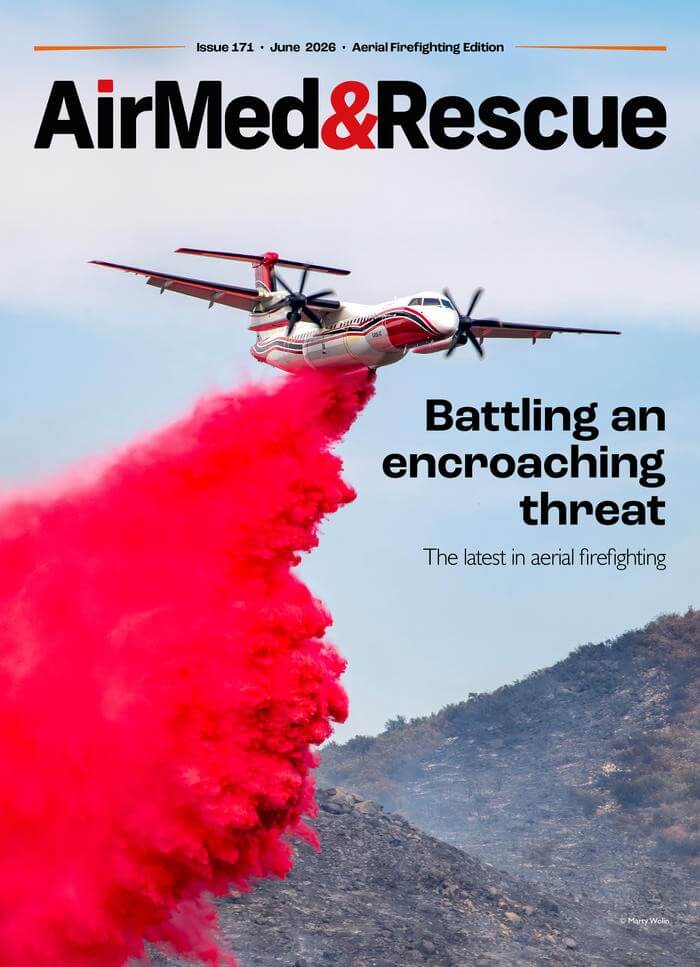
As the northern hemisphere heats up for another hot summer, I’m pleased to bring you the aerial firefighting edition of AirMed&Rescue. We have features on how climate change is accelerating firefighting technology; the improvements in Australian firefighting capacity; and getting ahead of wildfires before they become unmanageable.
Jon Adams
Jon is the Editor of AirMed&Rescue. He was previously Editor for Clinical Medicine and Future Healthcare Journal at the Royal College of Physicians before coming to AirMed&Rescue in November 2022. His favorite helicopter is the Army Air Corps Lynx that he saw his father fly while growing up on Army bases.