
Special report: Emergency response coordination for the Crans-Montana fire

What started as a local emergency quickly escalated into an air medical operation of international scale. Lauren Haigh investigates the global coordination of helicopters, crews, and transfers triggered by a sudden mass-casualty event
The global coordinated response to the Swiss Crans-Montana fire on New Year’s Day demonstrated the central role of the Valais Cantonal Rescue Organization (KWRO in German and OCVS in French), the robust links between operator networks in Valais and the critical role of air traffic management. It also highlighted the effectiveness of broader European frameworks and the strength of global solidarity in the face of an unprecedented disaster.
The scale of the emergency was quickly ascertained, and the KWRO/OCVS activated its response plan. “The OCVS held the overall operational command. The strategic overview and engagement of all helicopter assets were managed by our EMS Dispatch Center 144,” explained OCVS Director Dr Fredy-Michel Roten. “Our Dispatch Center 144 maintains a real-time global overview, tracking not only vehicles and helicopters but also individual members of our militia system via mobile technology. Having all competencies and real-time positioning in one organization allows for unparalleled coordination speed.” More than 250 people were coordinated by Dispatch Center 144 and OCVS officers.
On-site coordination
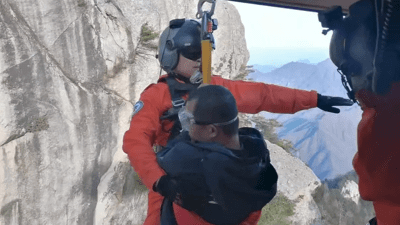
Air-Glaciers was the first helicopter crew to arrive on the scene and they handled the on-site coordination of aviation responses, providing a link between KWRO/OCVS’s central command and the evolving situation on the ground. Eliane Zürcher, spokesperson for Air-Glaciers, explained that the helicopter rescue operator always responds on behalf of a coordinating authority. She provided an insight into the coordination of rescues in the canton of Valais. “All air and ground operations are coordinated by the KWRO – regardless of whether it is a rescue of an individual or a major incident. Even outside of major incidents, we work together with other organizations on rescue operations,” she said. “For example, if several people are buried in an avalanche, several helicopters from different rescue organizations are called in. The various crews work hand in hand on site. This is part of our everyday work.” These strong links ensure the swift and effective coordination of operations, with familiar and well-established connections and protocols.
In Valais, Air Zermatt and Air-Glaciers have robust operational networks that are reinforced by Swiss Air-Rescue Rega during peak periods, enabling helicopters to respond quickly to emergency situations, irrespective of the time of year.
“Air-Glaciers operates three rescue helicopters in the canton of Valais during the winter season,” Zürcher said. “In high season, we can increase this number thanks to the versatility of the Airbus Helicopters H125 Écureuil. This allows us to respond to seasonal demand.”
Corina Zellweger, spokesperson for Rega, explained that Rega’s operational network consists of 14 helicopter bases throughout Switzerland: “This enabled Rega to provide rapid medical assistance throughout Switzerland at all times in the hours and days following the incident.”

A strong local network
This combined operational capacity feeds into a comprehensive local network. “In Valais, we are in the fortunate position of having a very dense network of helicopter resources,” Dr Roten confirmed. “However, our primary doctrine is the ‘next best’ principle: in critical cases, we always engage the closest and most suitable rescue asset in the best interest of the patient, regardless of borders.”
At the peak of this mission, 15 helicopters were involved, including several from Air-Glaciers, Air Zermatt, and Rega, in addition to one French and one Italian operator. As well as being responsible for tactical coordination, Air-Glaciers provided mobile refueling capabilities. “This was crucial for keeping the assets airborne without long transit times to permanent bases,” Dr Roten noted.
After receiving the alert from the KWRO, the Rega helicopter flight coordinator acted in accordance with the plan that Rega follows in the event of a mass influx of burn victims
During the period from 1–8 January, eight Rega rescue helicopters from six different cantons flew a total of 37 missions for seriously injured patients, and Rega’s jet crews transported a total of 27 patients within Switzerland and abroad using three ambulance jets. Zellweger provided an insight into these operations. “After receiving the alert from the KWRO, the Rega helicopter flight coordinator acted in accordance with the plan that Rega follows in the event of a mass influx of burn victims. This includes, among other things, checking the capacity of intensive care units in central Swiss hospitals and contacting the Center for Severe Burn Injuries in Hamburg, Germany,” Zellweger detailed. “This enabled the Rega flight coordinator to gain an overview of the available capacity while the emergency services in Crans-Montana were still busy providing initial medical care on site and carrying out the necessary triage.”
Patient transfers
When it came to the distribution of patients, this was a coordinated effort between hospitals and KWRO/OCVS’s Dispatch Center 144. “The hospitals reported their real-time capacities directly to the Dispatch Center, which then relayed this information to our Dispatch Officer on site. This officer then assigned each patient to the appropriate transport asset and destination hospital to ensure balanced patient flow,” Dr Roten stated.
While the KWRO/OCVS maintained local operational command, the Federal Office for Civil Protection (FOCP), via the national disaster medicine network Katamed, coordinated requests for additional assets and international assistance. Given the complex nature of many injuries, the capacity of national hospitals was reached and, at this point, additional air medical transfers were arranged to hospitals in the European Union (EU) through bilateral agreements and the EU Civil Protection Mechanism. “The EU’s Emergency Response Coordination Centre (ERCC) established contact with the Swiss national authorities within hours after the incident and initiated the European Burn Mass Casualty Response Plan,” stated a European Commission spokesperson. The ERCC received offers from 24 countries, offering treatment, transport, burn assessment teams and in-kind assistance, including specialized medical blades. “The ERCC deployed two teams specializing in severe burns composed of specialized health staff, as well as two liaison officers, and coordinated the medical evacuation of 39 patients,” said the spokesperson.
The ERCC deployed two teams specializing in severe burns composed of specialized health staff, as well as two liaison officers, and coordinated the medical evacuation of 39 patients
During the patient transfer phase of the operation, Rega helicopters and three Rega ambulance jets carried out the transfer flights to hospitals in Switzerland and abroad. “These took place on days when, based on experience, Rega flies many missions because many people in Switzerland are pursuing winter sports activities in the ski resorts,” Zellweger pointed out. “With this increased number of missions, Rega’s national air rescue coordination center plays a particularly important role, coordinating all ongoing missions so that the next crew suitable for the mission is called up.”
Airspace control
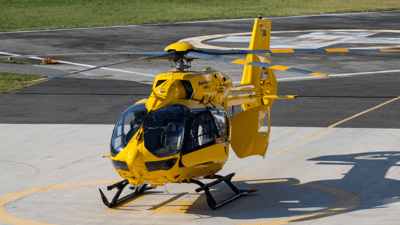
Airspace control was a key factor during the operation and, in order to ensure safety, a restricted area (R area) with a radius of 2.8km around the accident site was established. “This measure provided a clear framework for the crews involved and reduced external traffic at a critical moment,” explained Pia Wertheimer, Spokesperson for Skyguide Swiss Air Navigation Services. “When our air traffic controllers took over operations in the tower the following morning, the majority of the immediate rescue flights had already been completed.”
Ground personnel at Sion Airport organized a separate area on the apron for aircraft responding to the catastrophe. “This helped keep ground operations orderly and allowed the remaining flights linked to the catastrophe to be handled efficiently and with the necessary sensitivity,” Wertheimer outlined. The busy time of year added an additional layer of complexity to the challenging operations. “From a technical point of view, our systems and procedures functioned as designed. From a human point of view, however, these were anything but normal circumstances,” Wertheimer highlighted. “Although none of our controllers were directly affected, the tragedy weighed heavily on them, as it did on all of us. They continued to work in what could best be described as ‘normal operations under profoundly abnormal conditions’.”
From a technical point of view, our systems and procedures functioned as designed. From a human point of view, however, these were anything but normal circumstances
Payerne airfield, which supports both civil and military operations, also ramped up capability to help with transfers when needed. “Throughout this period, our teams did their utmost to give these flights the priority, space, and respect they required,” Wertheimer said.
Analysis of lessons learned
Reflecting on key challenges, Dr Roten said that KWRO/OCVS was currently conducting a standard ‘lessons learned’ analysis. “This process is part of our commitment to continuous improvement, ensuring that we identify any potential for optimization to be even better prepared for future large-scale incidents,” he explained.
The European Commission spokesperson told AirMed&Rescue that the response reflected a decade of lessons learned since the Colectiv nightclub fire in Bucharest, Romania: “The 2015 incident highlighted areas for improvement in Europe’s capacity to manage large-scale burn emergencies. Procedures have been refined and are now consolidated within the EU Burn Mass Casualty Response Plan. This includes early clinical needs assessment, centralized coordination through the ERCC, rapid mobilization of burn expertise, and early international patient redistribution, which were applied in a coherent and integrated manner. While elements of these procedures had been used in more limited incidents previously (North Macedonia, 2024, and Albania, 2023), Crans-Montana marked the first full-scale application of this European burn mass casualty framework, demonstrating significant developments in collective preparedness and operational capability.”
Procedures have been refined and are now consolidated within the EU Burn Mass Casualty Response Plan. This includes early clinical needs assessment, centralized coordination through the ERCC, rapid mobilization of burn expertise, and early international patient redistribution, which were applied in a coherent and integrated manner
The response to the Crans-Montana fire demonstrated how highly coordinated air medical systems, supported by strong leadership and international cooperation, can function effectively under intense pressure. It serves as a powerful case study in coordinated disaster response.
March 2026
Issue
This edition is bursting at the seams with articles from all corners of the special missions sector. We have features on the California wildfires that ravaged the state last year, what the cost–benefit analysis looks like for single-engine rotorcraft and autorotations, how the mission dictates the modification needed to the platform, and what can be done to further prevent the problems associated with inadvertent entry into instrument meteorological conditions.
Lauren Haigh
Lauren has worked in the publishing industry for eight years and reads and writes about healthcare, science and travel insurance on a daily basis. Her favourite aircraft is the plane from the title sequence of British educational children’s TV series Come Outside.