

Tank up: portable water sources for aerial firefighting

Dip tanks are being used around the world to tackle the growing wildfire threat. Emma Kelly talks to helicopter pilots and fire authorities about their benefits and limitations
Bushfire frequency and severity in countries including Australia, Greece and the USA are increasing at a time of prolonged dry conditions, reducing natural water sources. As a result, dip tanks have never been more useful tools in the fire fight.
Dip tanks can be permanent fixtures of the fire zone landscape or temporary solutions aiding firefighters where and when needed. Fire authorities, including Orange County Fire Authority (OCFA) in California and Greece’s Hellenic Fire Service, use both types heavily throughout their fire seasons, while Forest Fire Management Victoria (FFMVic) in Australia added rigid portable tanks for the first time in the 2024/25 season.
“We currently have two permanent fixed dip tanks in service and multiple portable dip tanks within Orange County. The City of Yorba Linda also has two fixed heli-hydrants that we have access to,” said Fire Captain Natalie Nacker, who has been with OCFA for 18 years. “Our fixed dip tanks have been in service for approximately three seasons and the portable dip tanks have been in service since the beginning of wildland firefighting in California.”
OCFA’s fixed tanks are located in the Ortega Highway and the city of Aliso Viejo area – “the wildland/urban interface of our county” – while the portable tanks are strategically located based on “proximity and turnaround time to our fire hazard areas”, said Nacker.
The fixed tanks are part of OCFA’s strategic plan on fighting wildland fires. Fixed dip tanks are converted shipping containers with added plumbing for water supply and lighting for night operations. Each dip site, located in clear areas for helicopters to land if needed, features a fire hydrant. “They hold 5,000gal of water and will self-fill when they drop to a certain level,” said Nacker, with the tanks typically utilized by the Firehawks and Bell helicopters using hoses to siphon water. The portable tanks are put into operation where deemed “safe and necessary”, primarily in rural areas, with designated units shuttling water.
The Hellenic Fire Service has been using permanent dip tanks for decades, and more recently portable ones, on both aerial and ground assets. The portable tanks are strategically positioned near active fire fronts in accessible areas, typically adjacent to roads where high-capacity fire trucks can operate, said Zisoula Ntasiou, Fire Colonel at the Hellenic Fire Service, Chief of Aerial Firefighting Operations and Vice President of the CTIF International Association of Fire Services. “Portable dip tanks are typically deployed in remote areas where water sources are not readily accessible, such as isolated wildfire zones or high-altitude alpine regions,” she said. Fire officers responsible for the forest fire action plan at each station will decide on strategically accessible locations for tanks. “Since 2000, we have also utilized portable dip tanks in remote or isolated areas where helicopters deliver water to fill them, enabling ground crews to access vital water supplies,” she added.
FFMVic Air Base Manager Emily Farrugia said the 2024/25 fire season, which ended in May, was the first time FFMVic had used converted shipping tanks as portable dip tanks, with a 25,000–30,000L capacity – much greater than the collapsible collar tanks previously used. They were very effective, said Farrugia, most notably during major bushfires in the Grampians National Park in western Victoria, in late 2024 / early 2025. “In the first instance, we used them as water dip tanks to reduce the turnaround time for the rotary aircraft,” said Farrugia, with water trucked to the tanks by road. The tanks were moved a number of times, depending on the fire front, to positions lacking water.
“Then we switched the tanks to retardant to build a retardant line to protect the western side of Halls Gap [a town that is the gateway to the Grampians],” Farrugia explained.
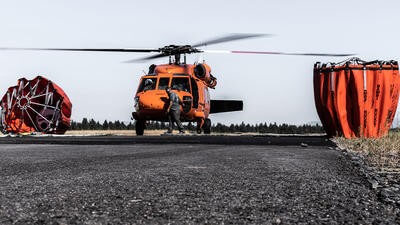
The tanks were used multiple times on consecutive days, with Helitak 348 (an AS332 Super Puma) and Helitak 233 (a Black Hawk EH-60A) filling up using long-line buckets. “On 25 December alone we used 86 bucketloads of retardant out of the tank,” said Farrugia. The dip tanks were subsequently used elsewhere in Victoria.
Strategic location
It is vital for all involved to know the exact location of tanks. “Each fire station is responsible for developing a forest fire action plan prior to the start of each season,” explained Ntasiou. “This plan includes the identification and mapping of all dip tanks available for use by fire trucks and aerial firefighting units, specifying their locations, capacity and operational availability.” Pre-season inspections are conducted on each tank to assess its condition and accessibility.
The tanks’ locations are recorded and integrated into a dedicated geographic information system (GIS) layer within the fire service’s operational platform, Engage. “This digital layer provides firefighters with comprehensive, real-time information for each water source, including geographic coordinates, name and classification [natural or constructed], infrastructure details, water capacity and filling method, accessibility by fire truck and helicopter, ownership status [public or private], municipality jurisdiction and fire station area of responsibility,” said Ntasiou. This gives all operational personnel immediate access to critical logistical data, enabling more effective planning and response.
The fixed tanks are part of OCFA’s strategic plan on fighting wildland fires
Multiple factors were considered when deciding tank location in Victoria, said Farrugia, including areas lacking water, the ability to truck in water, and any permission required from private landowners. Once a suitable position was identified, a grid location was updated into the mapping system, highlighted as a water point.
OCFA also addresses numerous issues before positioning tanks, including city ordinances, fire hydrant location, security to prevent tampering, and financial factors.
Dip tanks are proving valuable resources. Nacker said they are heavily used during the season, as well as in training exercises, while Ntasiou said that, “last fire season, in the Alpine zones forest fires, they solved our main issue with water” for both helicopters and ground forces.
Ease of use and efficiency
The benefits are clear: allowing more drops with greater efficiency, a smaller turnaround circle for the helicopters, saving time and fuel, providing quick access and the opportunity to extinguish a fire sooner, said Ntasiou.
Nacker highlighted ease of use and efficiency. “It allows helicopters to stay in the air while filling up with water, not having to land, connect to a water supply, fill up and take off,” she said. “It makes the turnaround a lot quicker so the aircraft can get back into the fire fight.”
Farrugia agreed: “It got the retardant as close as possible to where we were building the edge of the fire line. It was taking 90 seconds to fill the bucket and the helicopter was only gone for about three minutes. It was a really tight turnaround.” Furthermore, when using water, it is far more cost-effective to transport water to the tanks by road rather than using up helicopter flying time to find a source.
The benefits are also obvious for pilots. “Tanks can be placed closer [to a fire] than a major water source, thus increasing the number of dips and the amount of water or retardant that can be applied to the fire line,” said Christine Brown, a pilot with Coulson Aviation who operates year-round in the Los Angeles area.
Brown has five years’ experience using dip tanks, currently flying a Boeing CH-47D Chinook fitted with an internal tank and retractable snorkel. Dip tanks were used on every major fire in the LA area last year, said Brown, with some tanks in permanent locations, some remotely filled and portable dip tanks for active fires. Coulson Aviation also has its own mobile retardant base that comes as part of the Quick Reaction Force package for fires in the LA area.
“In southern California, it is common for counties to pre-position dip tanks during periods of high fire activity. That way, helicopters have access to a closer water source during the initial attack,” said Brown. In many cases, the tanks are used for extended attack fire operations, with the dip tanks set up at strategic locations near the active fire perimeter. “Dip tanks are normally located in open fields or parking lots. I used one last year that was in the parking area of a ski resort,” said Brown.
The use of dip tanks is a relatively new experience for Australian helicopter pilot Leah Colbert, who has been an aerial firefighter in Victoria since 2014, initially flying a Bell 206L and then an Airbus AS350. For the last three years, Colbert has been waterbombing in the AS350 B3 and a co-pilot on the Sikorsky S-61 with Paton Air Helicopters. “We had some permanent dip tanks added to our High Country [region of Victoria] by the state in 2024 to primarily support the tanked machines. Long line and buckets with power fill were able to get into the streams and creeks, but the tanked machines were having to ferry long distances back to lakes – sometimes 20–30NM,” she explained.
Lack of natural water sources
In 2024/25, Colbert also gained experience of portable dip tanks, converted from shipping containers and placed in suitable locations by truck with water pumped in or trucked, often the latter due to the lack of water.
“The Wimmera/Grampians have significant water issues, and overseas pilots initially tend to struggle with the concept of how dry it is and the distances to water in Australia,” Colbert said. “Often in these areas, creeks and rivers are dry in summer, small farm dams are shallow and muddy, and distances to reservoirs can cause significant delays.” Small farm stock dams can cause issues for larger aircraft, and the water is muddy and shallow. “High downwash and recirculation in mud and dust can cause issues with visibility,” she added. In contrast, dip tanks are deeper and higher, and there are fewer issues with tail clearance and dust.
Tanks can be placed closer to a fire than a major water source, thus increasing the number of dips and the amount of water or retardant that can be applied to the fire line
Paton Air’s fleet used dip tanks on five fires during the 2024/25 season, including the Super Puma that built the retardant lines for the Grampians fire. “Our Super Puma used the retardant dip tank to build a precise retardant line on a rocky escarpment to protect the town of Halls Gap. Using precision long-line pilots in these areas is a perfect display of how effective dip tanks can be,” Colbert said, with the Super Puma able to line a section in extremely steep terrain.

Getting it right
There are challenges, however. “One of the downsides of a dip tank is that only one helicopter can use it at a time as opposed to many helicopters using a large lake,” explained Brown. “The learning curve can be steep when using a bucketed helicopter because of the precision required to get the bucket into the tank.”
Colbert added: “Use of a belly tank can be challenging dependent on the location of the snorkel in that sometimes you have to be forward of the tank. Because it is higher, your downwash dissipates easily, so you require more power.”
The use of dip tanks can require additional ground personnel, with OCFA locating a crewmember for safety and monitoring, and FFMVic positioning ground crew for tasks including water pumping and traffic control.
In terms of maintenance, Nacker said a quick visual of the tanks and minor housekeeping is required ahead of operations – “nothing loose or not secured, to prevent debris getting caught up in the rotor wash”.
With changes in fire behavior and water availability, the use of dip tanks is likely to grow. “The fixed dip tanks have been a huge success and our department is looking to get more and strategically place them in other areas of our county,” said Nacker.
Greece is looking to expand the use of portable tanks, particularly in isolated and high-altitude alpine areas, taking into account the impact of climate change and the potential scarcity of accessible fresh water, while FFMVic plans to continue using portable tanks in 2025/26.
“There are permanent dip tanks popping up in many different locations, and I’m sure we will see more as wildfires grow in intensity and severity,” said Brown.
Colbert highlighted the lack of water sources in Victoria: “There is very little to no water available for helicopters in the Wimmera/Grampians area, ultimately resulting in aircraft having significant ferry times.”
Brown commended the use of dip tanks: “They are essentially just big buckets of water or retardant in strategic locations, and there’s not much I’d change with that.

August 2025
Issue
Our August magazine is the inaugural women in aviation edition, highlighting and showcasing female voices from the airborne special missions sector. We have features on blood products used in emergency medical services, challenging hoist rescues, pregnancy while flying, and portable water sources for firefighting. We also have interviews, a gallery, an industry voice, a news analysis piece, and a provider profile, as well as a review of the Paris Air Show.