
What it takes to make it in SAR

For those looking to break into the sector, special missions professionals tell AirMed&Rescue about the various training opportunities available, what kind of experience and personal qualities are most useful, and why it’s not just a rewarding career but also a vocation
Search and rescue (SAR) aviation represents one of the most demanding yet deeply rewarding sectors of the aviation industry. Beyond the high stakes and technical complexity, it is a field defined by purpose, where skilled professionals work under pressure to save lives in the most challenging environments. From military services to civilian operators, SAR crews blend advanced flying expertise, specialized medical and technical training, and emotional resilience to carry out their missions. This article explores the career pathways, professional development, psychological demands, and operational challenges faced by SAR aviation personnel, shedding light on the evolving nature of this vital domain.
An attractive choice
According to John Barnard, Head of Operations at LifeFlight Training Academy, SAR aviation is considered a high-profile part of the industry, well paid and usually home based. “The ideal flight crew candidate should have 3,000 hours plus an airline transport pilot license (ATPL). In terms of experience, multi-engine, ex-military pilots with experience in instrument flight rules (IFR) and night vision imaging systems (NVIS) have a good background but may not be fully experienced. Conversely, civilian trained pilots often do not have substantial NVIS experience,” he said.
The real-world impact of saving lives and making a tangible difference provides deep satisfaction
The US Coast Guard (USCG) offers career paths to both officers and enlisted members, according to Captain Neal Corbin, Commanding Officer of Air Station Astoria. “The appeal lies in several factors, including serving one’s country and contributing to national and maritime security. The USCG also provides a consistent and meaningful mission, operating a modern fleet of aircraft equipped with advanced technology and offering extensive specialized training. Career progression, competitive pay and benefits, and a global reach add to the attractiveness of this career path,” he said. “The real-world impact of saving lives and making a tangible difference provides deep satisfaction, fostering a strong sense of community and teamwork. The variety of missions, including traditional SAR operations, law enforcement, counter-narcotics, alien migrant interdiction operations, environmental protection, and icebreaking operations, make the work challenging.”

Specialized opportunities
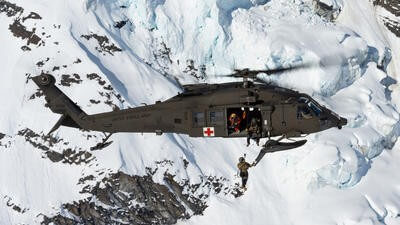
A bachelor’s degree is highly recommended for aspiring USCG officers, observed CAPT Corbin. “Primary pathways include the Officer Candidate School (OCS), the Coast Guard Academy or the Direct Commission Aviator program. Candidates must also pass the aviation selection test battery (ASTB) and meet rigorous physical and medical standards. Enlisted personnel also play critical roles in CG aviation. After basic training, those interested in earning an aviation degree can pursue several pathways, including aviation survival technician (AST), who are underwater rescuers who are highly trained in parachute operations, water rescue, and emergency medical care. They are often the first to arrive, jumping from helicopters to assist those in need,” he said. “Another path is aviation maintenance technician (AMT), who are responsible for maintaining and repairing USCG aircraft, ensuring their constant operational readiness.”
A strong mechanical aptitude, attention to detail and a commitment to teamwork are essential to success in these roles
The avionics electrical technician (AET) paths specialize in the complex electronic systems of the USCG aircraft, including navigation, communication and sensor systems, explained CAPT Corbin. “Their expertise is essential to maintaining the operational effectiveness of the aircraft. Regardless of the degree chosen, enlisted personnel receive specialized training at various USCG training centers,” he said. “A strong mechanical aptitude, attention to detail and a commitment to teamwork are essential to success in these roles. The USCG is a military force that requires compliance with military regulations and lifestyle, including potential deployments. Although the USCG conducts SAR activities inland, its primary focus remains search and rescue at sea.”
Continuing professional development
Alec Aspden, Technical Crew Manager at Bristow Helicopters, observed that training is part of life for SAR crews, who train on every shift. “Technical crews are trained and assessed to the highest medical standards required for their role, including bespoke training tailored to specific SAR requirements. Initial training for technical crews at Bristow is in two areas: aviation training and SAR training with a clinical preceptorship. The clinical preceptorship can last from as little as a month, up to two years, depending on experience. After this, staff must maintain continuing professional development (CPD). This includes building a personal portfolio of their work and experience, as well as annual direct training provided by Bristow,” he said.
A recent development will see UK winch operators at Bristow complete a new course that will provide them with a level 5 diploma in First Response Emergency and Urgent Care, a nationally recognized qualification regulated by the Office of Qualifications and Examinations Regulation (Ofqual), explained Aspden. “In terms of career development, SAR crews can progress into different roles as they gain experience, with flight crews progressing through an established pilot career progression and technical crews having the opportunity to move into more clinical roles, instructional roles or management positions,” he said. “Our SAR teams currently train on their aircraft every shift. The company is preparing to open a new state-of-the-art SAR training facility in Lee-on-Solent in the coming months, which will give teams access to an unprecedented level of advanced simulation training.”
SAR crews at the Royal Canadian Air Force (RCAF) undergo rigorous and continuous training, whether assigned to fixed-wing or rotary-wing assets. “Their training is highly specialized with a realism that many other companies will never experience,” a spokesperson for the RCAF said. “For SAR technicians, initial training begins with a selection process, followed by a 15-day land survival course before completing an intensive 11-month Core Team Member (RTM) course at the Canadian Forces School of Search and Rescue (CFSSAR). This course covers a wide range of essential skills and knowledge, laying the foundation for a career as a SAR technician. The RTM course includes paramedic training, which is essential for providing advanced medical care in remote environments, parachute and fixed-wing operations to prepare SAR technicians for airborne insertion via fixed-wing aircraft. It also includes rescue diving training, enabling surface and underwater rescues using compressed air breathing apparatus, [and] mountaineering skills, as the use of rope rescue skills enables rescuers to reach victims that are inaccessible via helicopter winch or other extraction vehicles. Finally, as a post-RTM degree, SAR technicians train operationally and attend a further four years of formal courses to become a fully qualified team leader (TL).”
Recurrent training is essential for all SAR crew deployments. For SAR technicians, this involves retraining in medical, parachuting, diving and survival skills, as well as mission-based training, both on the ground and in the air, to remain prepared for operations, the RCAF noted. “CPD is supported by advanced courses and leadership training for all SAR crews. SAR crews regularly fly training missions to maintain the specific skills and expertise required for their roles, ensuring they remain mission ready. These training missions are critical to maintaining the high level of proficiency needed for successful search and rescue operations.
SAR crews frequently participate in SAR exercises at both unit and national levels, working with other agencies and allied forces. These exercises enhance coordination, improve interoperability, and provide opportunities to share best practices
“Additionally, SAR crews frequently participate in SAR exercises at both unit and national levels, working with other agencies and allied forces. These exercises enhance coordination, improve interoperability, and provide opportunities to share best practices, ultimately strengthening the overall effectiveness of SAR missions. As all SAR technicians must advance to TL, once this is achieved, they can then branch out into instructor or advisory and standards roles within operational squadrons, schools or headquarter positions.”

Emotional and psychological wellbeing
SAR professionals need to manage the emotional and psychological effects of their work, particularly after difficult missions. In addition to technical skills, personal qualities contribute to success in SAR roles. The team of Australia’s CareFlight observed that while everyone responds differently to the emotional and psychological demands of SAR work, certain personal attributes can help individuals cope more effectively. “Emotional intelligence, something that can be developed through training and experience, is key. So is resilience. But perhaps most important is honesty. The ability to recognize when something has affected you, and to feel comfortable speaking up, is crucial,” they said. “It allows teammates to understand and offer support and is often the first step in managing the emotional impact of a mission. Open communication plays an important role. Informal but meaningful moments like a post-mission coffee, a mission break, or a full crew debrief can create space to talk about the experience and help everyone process what happened.”
SAR is not for everyone and many only stay a few years
According to Jim Stafford, Tactical Flight Officer at the Victoria Police Air Wing, SAR professionals in general are a different type of people. “SAR is not for everyone and many only stay a few years. We do rigorous psychological testing for entry but, even then, some people are not comfortable with multiple exposures to different things. Typically, a good debrief over coffee at the end of a mission is fine and sufficient for most people, but we encourage our people to talk it out if they need it, and we have regular opportunities to chat with healthcare professionals if needed. I stay focused on the task and how well we can do it,” he said. “I do not go home at the end of a shift thinking too much about a job we have just done. It is gratifying to have made a difference, and that is all that matters. It is essential that we work well in the crew environment and understand the principles of crew resource management (CRM) training.”
Organizations play a key role in supporting mental health, as professional support services, peer programs, and a culture that actively encourages psychological safety are important, according to the CareFlight team. “In our organization, the value placed on teamwork and preparedness extends to wellbeing, with structures in place to help staff recognize and address stress before it becomes overwhelming. Ultimately, beyond technical skills, qualities such as self-awareness, humility, communication, and the ability to work as part of a tight-knit team are what truly make someone successful in a SAR role,” they said.
SAR operational challenges
In addition to the emotional aspects, environmental risks, especially weather, are among the biggest challenges of the SAR business. Bart Sinnaeve, Director of Operations for Europe and West Africa at NHV Group, observed that while distances in some regions of the world are manageable, in other regions, such as across the Atlantic, distances can become a much more important operational factor. “The competence of the entire crew is crucial,” he said. “Pilots must master the aspects of flying, while hoist operators require equally high technical skills. Medical personnel on board must be prepared to operate independently, without the support of a full hospital team. They must stabilize patients on site, for example on a ship; lift them on board and keep them in condition during the transfer by helicopter, often in very confined spaces, until they reach a suitable emergency facility. As for the water rescuers, they must be highly trained and physically capable. They are incredibly strong and competent, and rightly proud of what they do.”
These challenges require continuous adaptation and innovation. At the same time, SAR aviation is evolving, with unmanned aerial systems (UAS) providing cost-effective solutions with reduced risk
SAR teams face evolving operational challenges, including increasingly complex environments, integrating new technologies, maintaining communications in remote areas, limited resources, interagency coordination, unpredictable emergencies, and the impact of increasing natural disasters, according to CAPT Corbin. “These challenges require continuous adaptation and innovation. At the same time, SAR aviation is evolving, with unmanned aerial systems (UAS) providing cost-effective solutions with reduced risk. Improved sensor technology, including thermal and optical imaging and more advanced sensors, improves search capabilities. Advanced communications systems, especially satellite-based, improve connectivity in remote areas,” he said. “Sophisticated navigation systems such as Global Positioning System (GPS) enable precise tracking, and artificial intelligence (AI) is being integrated to analyze data from multiple sources, including graphical image analysis, to optimize target detection. Advanced training simulators provide realistic practice scenarios. These advances are increasing the effectiveness and efficiency of SAR operations, enabling faster response times and ultimately saving more lives. The future of SAR aviation will likely require greater integration of these technologies, coupled with a continued focus on training and interagency collaboration.”
June 2025
Issue
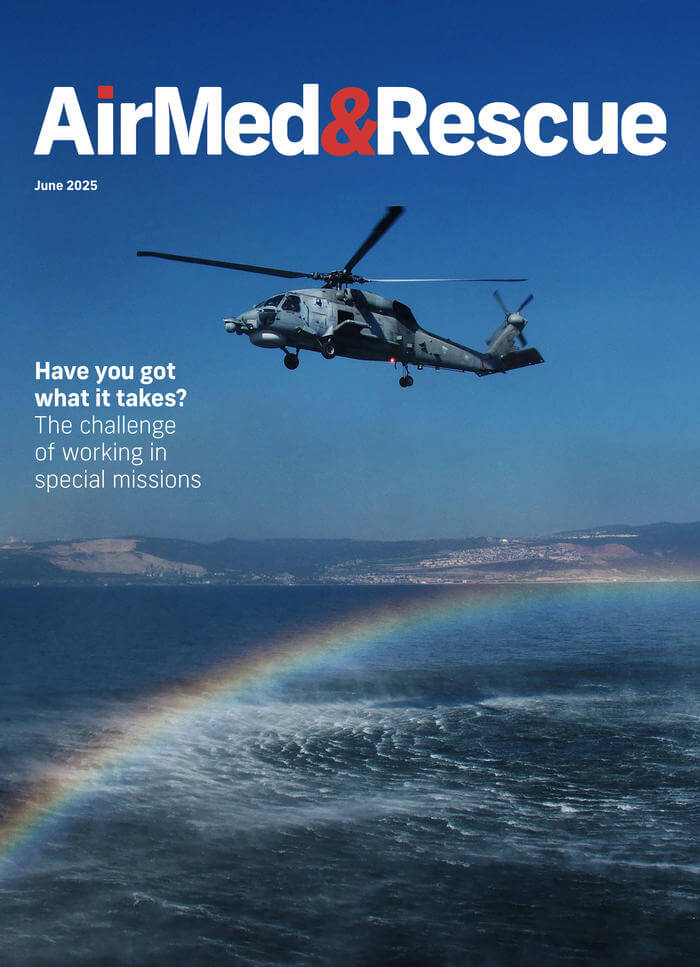
Our June edition covers a range of articles with a wealth of experiential information in the features, such as search and rescue as a career route, the latest night vision technology, the increasing popularity of drones for firefighting, the importance of helmets in special missions, why diversity matters in aviation, and why switching to special missions as a job is more fulfilling; plus we have more of our regular content.
Editorial Team
The AirMed&Rescue Editorial Team works on the website to ensure timely and relevant news is online every day. With extensive experience and in-depth knowledge of the air medical and air rescue industries, the team is ready to respond to breaking industry news and investigate topics of interest to our readers.